What Is Creatinine Clearance (CrCl) and Renal Clearance Physiology?
Creatinine clearance (CrCl) is the volume of blood plasma completely cleared of creatinine per unit of time by the kidneys, conventionally quantified in milliliters per minute (mL/min). Creatinine is an endogenous metabolic byproduct of creatine phosphate catabolism in skeletal muscle tissue. Under steady-state conditions, creatinine is synthesized at an essentially constant rate, freely filtered across the glomerular filtration barrier, and neither reabsorbed nor substantially metabolized by the renal tubules.
Because approximately 10% to 15% of urinary creatinine is actively secreted into the lumen by organic cation transporters (OCT2 and MATE1) in the proximal tubule, measured creatinine clearance slightly overestimates true Glomerular Filtration Rate (GFR). Nevertheless, CrCl remains one of medicine's most vital, universally applied surrogates for overall functional nephron mass.
In clinical pharmacology, creatinine clearance is indispensable. When renal excretory function declines, water-soluble drugs and active metabolites that depend on glomerular filtration accumulate in systemic circulation. Without precise dose adjustments calculated from creatinine clearance, patients face severe drug toxicities, including lethal hemorrhages from direct oral anticoagulants, neurotoxicity, or profound ototoxicity and nephrotoxicity from antimicrobial agents.
The Cockcroft-Gault Equation: Formula Breakdown & Units
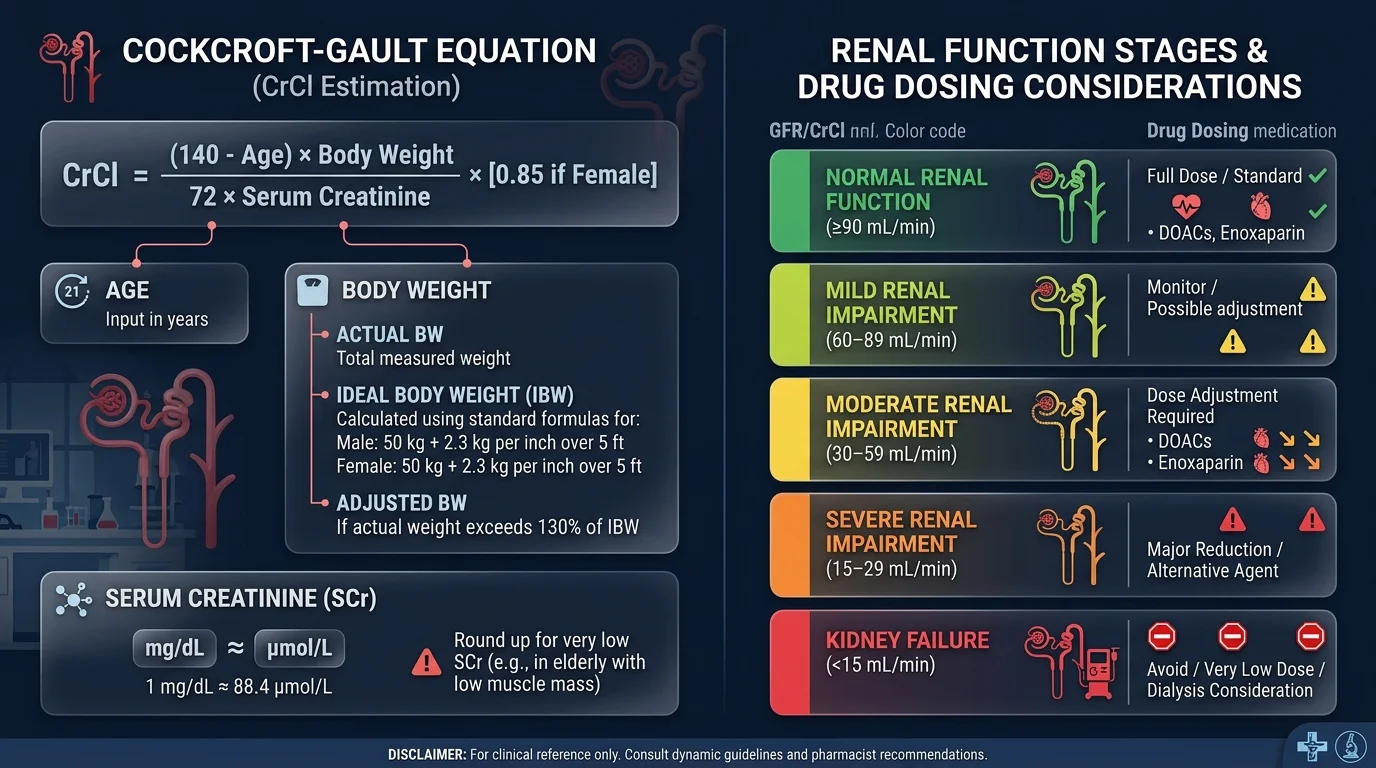
Introduced in 1976 by Donald W. Cockcroft and M. Henry Gault following an analysis of 249 adult male patients, the Cockcroft-Gault formula allows clinicians to rapidly estimate 24-hour creatinine clearance from a single steady-state serum creatinine measurement, patient age, biological sex, and weight:
CrCl (Male) = [(140 - Age) × Weight (kg)] / [72 × Serum Creatinine (mg/dL)]
CrCl (Female) = CrCl (Male) × 0.85
When laboratory creatinine is reported in Standard International (SI) units (µmol/L), the constant changes to reflect the conversion factor ($1\text{ mg/dL} = 88.4\text{ }\mu\text{mol/L}$):
CrCl (Male) = [(140 - Age) × Weight (kg) × 1.23] / Serum Creatinine (µmol/L)
CrCl (Female) = CrCl (Male) × 0.85
Why Is Female Clearance Multiplied by 0.85?
Biological females possess on average approximately 15% less skeletal muscle mass per kilogram of total body weight compared to biological males. Because endogenous creatinine production is strictly proportional to active muscle mass, a female generates less creatinine daily for any equivalent level of renal excretory capacity. Multiplying the male equation by 0.85 corrects for this lower daily creatinine generation rate.
Actual, Ideal (Devine), or Adjusted: Which Weight Should You Use?
The single most debated parameter in applying the Cockcroft-Gault equation is which weight variable to insert. In the original 1976 study, Cockcroft and Gault used total actual body weight. However, their study population had an average weight of only 72 kg, with very few obese individuals. In contemporary clinical practice, applying actual weight to an obese patient artificially inflates calculated clearance because adipose tissue contributes negligibly to daily creatinine generation.
To prevent medication dosing errors, clinical pharmacologists follow standard weight-selection algorithms based on Ideal Body Weight (IBW) and Adjusted Body Weight (AdjBW):
1. Ideal Body Weight (Devine Formula 1974)
Ideal Body Weight estimates lean muscle mass based on height:
- Men: $\text{IBW (kg)} = 50 + [2.3 \times (\text{Height in inches} - 60)]$
- Women: $\text{IBW (kg)} = 45.5 + [2.3 \times (\text{Height in inches} - 60)]$
2. Adjusted Body Weight (AdjBW40) for Obese Patients
When a patient's actual body weight exceeds 120% of their IBW, or their Body Mass Index (BMI) is $\ge 30\text{ kg/m}^2$, adipose tissue adds some vascular volume and extracellular fluid (~20% to 40%) but far less than lean muscle. Pharmacokinetic consensus utilizes a 40% adjustment factor:
$\text{Adjusted Body Weight (AdjBW)} = \text{IBW} + 0.4 \times (\text{Actual Weight} - \text{IBW})$
| Patient Weight Category | BMI / Ratio Definition | Recommended Weight Input | Pharmacological Rationale |
|---|---|---|---|
| Underweight | Actual Weight < IBW | Actual Body Weight (ABW) | Using IBW overestimates clearance, leading to drug overdoses. Always use actual weight. |
| Normal Weight | Actual Weight 100% to 120% of IBW | Actual Body Weight (or IBW) | Actual weight closely mirrors true creatinine generation; both metrics yield concordant estimates. |
| Overweight / Obese | Actual Weight > 120% of IBW (BMI ≥ 30) | Adjusted Body Weight (AdjBW40) | Prevents severe overestimation of clearance for hydrophilic drugs (anticoagulants, aminoglycosides). |
Creatinine Clearance (CrCl) vs. Estimated GFR (eGFR): Critical Differences
A frequent source of hospital medication errors is the interchangeable substitution of automated laboratory Estimated Glomerular Filtration Rate (eGFR) for Creatinine Clearance (CrCl). While both evaluate kidney filtration, they differ fundamentally in design, mathematical units, and clinical purpose:
| Feature / Parameter | Creatinine Clearance (Cockcroft-Gault) | Estimated GFR (CKD-EPI 2021) |
|---|---|---|
| Units of Measurement | mL/min (Absolute volumetric clearance) | mL/min / 1.73 m² (Indexed to standard body surface area) |
| Variables Included | Age, Biological Sex, Serum Creatinine, Patient Weight | Age, Biological Sex, Serum Creatinine (Weight excluded) |
| Tubular Secretion | Includes ~10%–15% proximal tubular creatinine secretion | Statistically calibrated against measured inulin/iothalamate GFR |
| Primary Clinical Role | Renal Drug Dosing Adjustments (FDA package inserts) | CKD Staging & Diagnosis (KDIGO consensus guidelines) |
| Impact in Body Size Extremes | Accounts for patient size; weight modifications (IBW/AdjBW) apply | Can misestimate true clearance in very small or very large adults unless un-indexed |
When assessing overall functional decline in chronic kidney disease, clinicians evaluate our GFR Calculator and pair it with the BUN Creatinine Ratio Calculator to differentiate prerenal azotemia from intrinsic parenchymal injury. However, when writing medication orders for narrow-therapeutic-index drugs, Cockcroft-Gault CrCl in absolute mL/min remains the legal regulatory gold standard.
Renal Drug Dosing Benchmarks in Cardiovascular Care (DOACs & Heparins)
In cardiology and critical care, accurate CrCl calculation is lifesaving. Direct Oral Anticoagulants (DOACs) and low-molecular-weight heparins depend substantially on renal excretion. Accumulation secondary to undetected clearance reduction dramatically escalates life-threatening hemorrhagic stroke or gastrointestinal bleeding.
| Cardiovascular Medication | Renal Elimination % | Cockcroft-Gault CrCl Cutoff | Mandatory Dosing Modification |
|---|---|---|---|
| Rivaroxaban (Xarelto) Non-valvular AFib |
~36% active renal | CrCl 15 to 50 mL/min CrCl < 15 mL/min |
Reduce dose from 20 mg daily to 15 mg once daily. Avoid use / contraindicated. |
| Apixaban (Eliquis) Non-valvular AFib |
~27% active renal | CrCl 15 to 29 mL/min (or 2 of 3: Age ≥80, Wt ≤60kg, SCr ≥1.5) | Reduce dose from 5 mg BID to 2.5 mg twice daily. Evaluate clinical bleeding hazard with HAS-BLED Score. |
| Dabigatran (Pradaxa) Direct Thrombin Inhibitor |
~80% renal | CrCl 30 to 50 mL/min CrCl 15 to 30 mL/min CrCl < 15 mL/min |
Consider 110 mg BID (EU/Canada). Reduce to 75 mg BID (US labeling). Contraindicated due to catastrophic bleeding risk. |
| Enoxaparin (Lovenox) LMWH in ACS / NSTEMI |
Renal tubular clearance | CrCl < 30 mL/min | Reduce therapeutic dose from 1 mg/kg Q12H to 1 mg/kg once every 24 hours. Cross-reference with the TIMI Risk Score Calculator. |
| Digoxin Inotropic / Rate Control |
~70% to 80% renal | CrCl < 50 mL/min | Decrease daily maintenance dose by 50%; perform frequent serum concentration monitoring. |
In patients with atrial fibrillation being evaluated for stroke risk using the CHA₂DS₂-VASc Score Calculator, determining Cockcroft-Gault CrCl is the essential companion step to ensure anticoagulant safety.
Measured 24-Hour Urine Creatinine Clearance & BSA Normalization
When mathematical estimation equations are suspected to be inaccurate—such as in patients with severe malnutrition, advanced liver disease, bilateral amputations, or extremes of body habitus—the clinical reference gold standard is measured 24-hour urine creatinine clearance.
The patient collects all urine voided over an exact 24-hour period (1,440 minutes). A venous blood sample is drawn during the collection window to measure serum creatinine. The laboratory calculates clearance using the fundamental mass conservation principle:
CrCl (mL/min) = [Urine Creatinine (mg/dL) × Urine Volume (mL)] / [Serum Creatinine (mg/dL) × Collection Minutes]
Body Surface Area (BSA) Normalization
To compare measured clearance to population reference standards, laboratories normalize the result to an average young adult body surface area ($1.73\text{ m}^2$) using the DuBois and DuBois formula:
$\text{Normalized CrCl} = \text{CrCl (mL/min)} \times \frac{1.73\text{ m}^2}{\text{Patient BSA (m}^2\text{)}}$
Normal Reference Ranges & Renal Impairment Staging Table
Normal creatinine clearance varies with biological sex and decreases progressively with advancing age as nephrons undergo natural senescence. After age 40, physiological CrCl declines at an average rate of 0.8 to 1.0 mL/min per year.
| Renal Function Category | Cockcroft-Gault CrCl Range | Physiological & Clinical Significance | Standard Pharmacokinetic Action |
|---|---|---|---|
| Normal / Preserved | ≥ 90 mL/min | Full filtration capacity; young healthy adult baseline (Males 95–140, Females 85–125 mL/min). | Standard, unadjusted pharmaceutical dosing. |
| Mild Impairment | 60 to 89 mL/min | Early nephron loss or normal physiological aging in older adults. | Full dose for most drugs; monitor narrow-therapeutic-index agents. |
| Moderate Impairment (Stage 3) | 30 to 59 mL/min | Substantial reduction in excretory capacity; accumulation of renally eliminated active drugs. | Mandatory dose reduction for DOACs, enoxaparin, beta-lactams, and SGLT2 inhibitors. |
| Severe Impairment (Stage 4) | 15 to 29 mL/min | Advanced renal disease; high risk of metabolic acidosis and hyperkalemia. | Major dose reduction; extended dosing intervals; avoid nephrotoxins. |
| Kidney Failure (Stage 5 / ESRD) | < 15 mL/min | End-stage renal disease; requires renal replacement therapy (hemodialysis or peritoneal dialysis). | Avoid most renally cleared drugs; dose post-dialysis per protocol. |
Clinical Limitations, Confounders & When Cockcroft-Gault Fails
While the Cockcroft-Gault equation is the bedrock of drug dosing, clinicians must recognize clinical scenarios where serum-creatinine-based formulas fail:
- Non-Steady-State Conditions (Acute Kidney Injury): The Cockcroft-Gault formula assumes constant daily creatinine production and steady-state serum concentrations. In evolving Acute Kidney Injury (AKI), serum creatinine lags behind filtration cessation by 24 to 48 hours. Using Cockcroft-Gault in an oliguric, acutely ill patient drastically overestimates clearance. In acute oliguria, evaluate fractional sodium excretion with our FENA Calculator.
- Severe Sarcopenia and Malnutrition: Cachectic, bedbound, or amputee patients possess markedly diminished muscle mass, generating negligible amounts of creatinine. A patient with severe muscle wasting may have an artificially low serum creatinine of 0.4 mg/dL despite profound renal failure, falsely generating a "normal" Cockcroft-Gault score.
- Advanced Cirrhosis (Hepatorenal Syndrome): Cirrhotic patients exhibit decreased hepatic creatine production, severe muscle wasting, and increased tubular creatinine secretion. Cockcroft-Gault overestimates true filtration by up to 100% in end-stage liver disease.
- Medications Blocking Tubular Secretion: Drugs such as trimethoprim and cimetidine selectively inhibit organic cation transporters (OCT2) in the proximal tubule. This elevates serum creatinine by 0.2 to 0.4 mg/dL without causing any genuine reduction in true glomerular filtration.
Realistic Clinical Worked Case Scenarios
Case 1: Atrial Fibrillation Anticoagulant Dosing in an Older Adult
Patient Presentation: An 81-year-old female with non-valvular atrial fibrillation is admitted for anticoagulation initiation. Her height is 5'2" (157.5 cm) and actual body weight is 54 kg (119 lbs). Admission serum creatinine is 1.40 mg/dL (123.8 µmol/L).
Step-by-Step Calculation:
- Height in inches over 5 feet: 2 inches.
- Ideal Body Weight (IBW): $45.5 + (2.3 \times 2) = 50.1\text{ kg}$.
- Actual Weight ($54\text{ kg}$) is within normal range ($107\%$ of IBW). Use Actual Weight ($54\text{ kg}$).
- Cockcroft-Gault Male Equation: $\frac{(140 - 81) \times 54}{72 \times 1.40} = \frac{3,186}{100.8} = 31.6\text{ mL/min}$.
- Apply Female Correction (0.85): $31.6 \times 0.85 = \mathbf{26.9\text{ mL/min}}$.
Clinical Interpretation & Pharmacokinetic Decision: The patient's CrCl of 26.9 mL/min falls into the severe renal impairment range (15–29 mL/min). If prescribed Apixaban (Eliquis), she meets two of the three dose-reduction criteria (Age ≥ 80 and Weight ≤ 60 kg), requiring a mandatory dose reduction to 2.5 mg orally twice daily. If Rivaroxaban were selected, 15 mg once daily would be indicated. Dabigatran should be avoided.
Case 2: Antimicrobial & Anticoagulant Dosing in Class III Obesity
Patient Presentation: A 52-year-old male presents with deep vein thrombosis and cellulitis. Height is 5'10" (177.8 cm) and actual weight is 135 kg (297.6 lbs), corresponding to a BMI of $42.8\text{ kg/m}^2$. Admission serum creatinine is 1.30 mg/dL.
Step-by-Step Calculation:
- Height in inches over 5 feet: 10 inches.
- Ideal Body Weight (IBW): $50 + (2.3 \times 10) = 73.0\text{ kg}$.
- Actual weight ($135\text{ kg}$) is $185\%$ of IBW (severe obesity). Adjusted Body Weight (AdjBW40) must be used:
- $\text{AdjBW} = 73.0 + [0.4 \times (135 - 73.0)] = 73.0 + 24.8 = \mathbf{97.8\text{ kg}}$.
- CrCl using Actual Weight: $\frac{(140 - 52) \times 135}{72 \times 1.30} = 126.9\text{ mL/min}$ (Severely inflated).
- CrCl using Ideal Body Weight: $\frac{(140 - 52) \times 73}{72 \times 1.30} = 68.6\text{ mL/min}$ (Overly conservative).
- CrCl using Adjusted Weight: $\frac{(140 - 52) \times 97.8}{72 \times 1.30} = \mathbf{91.9\text{ mL/min}}$.
Clinical Interpretation & Pharmacokinetic Decision: Utilizing actual body weight would falsely estimate clearance at 127 mL/min, risking supratherapeutic accumulation of renally eliminated drugs. Using Adjusted Body Weight establishes true functional clearance at 92 mL/min, ensuring safe, therapeutic antimicrobial and anticoagulant dosing.
Frequently Asked Questions (PAA Optimized)
What does creatinine clearance (CrCl) measure?
Creatinine clearance measures the volume of blood plasma completely cleared of creatinine per minute (mL/min). It serves as a bedside clinical estimate of glomerular filtration rate (GFR) to evaluate kidney function and adjust medication dosages.
How is the Cockcroft-Gault equation calculated?
The standard Cockcroft-Gault formula is: CrCl (mL/min) = [(140 - Age) × Weight (kg)] / [72 × Serum Creatinine (mg/dL)]. For females, the calculated result is multiplied by 0.85 to account for lower muscle mass.
Which body weight should be used in Cockcroft-Gault for obese patients?
For obese patients (BMI ≥ 30 kg/m² or actual weight > 120% of Ideal Body Weight), pharmacokinetic consensus recommends using Adjusted Body Weight: AdjBW = IBW + 0.4 × (Actual Weight - IBW). Using actual weight in obesity causes significant overestimation of clearance.
What is the difference between Creatinine Clearance (CrCl) and eGFR?
Creatinine clearance (Cockcroft-Gault) is reported in absolute mL/min and is the legal regulatory standard required by FDA drug package inserts for dosing adjustments. Estimated GFR (eGFR from CKD-EPI) is indexed to body surface area (mL/min/1.73 m²) and is primarily used for CKD staging.
Why is female creatinine clearance multiplied by 0.85?
On average, biological females possess approximately 15% less muscle mass per unit of body weight compared to biological males. Because creatinine is derived from muscle catabolism, females produce less baseline creatinine per day, requiring the 0.85 mathematical correction factor.
What is a normal creatinine clearance level?
Normal creatinine clearance in healthy young adults ranges from 95 to 140 mL/min for males and 85 to 125 mL/min for females. After age 40, clearance naturally decreases by approximately 0.8 to 1.0 mL/min per year.
When does the Cockcroft-Gault equation become inaccurate?
The formula becomes inaccurate during unstable Acute Kidney Injury (AKI) with rapidly shifting creatinine levels, in severe muscle wasting, cachexia, or limb amputations, in liver cirrhosis, and in competitive bodybuilders with supra-physiological muscle mass.
Peer-Reviewed Citations & Pharmacokinetic Guidelines
- Cockcroft DW, Gault MH. Prediction of creatinine clearance from serum creatinine. Nephron. 1976;16(1):31-41. doi:10.1159/000180580.
- Devine BJ. Gentamicin therapy. Drug Intell Clin Pharm. 1974;8:650-655.
- U.S. Food and Drug Administration (FDA). Pharmacokinetics in Patients with Impaired Renal Function — Study Design, Data Analysis, and Impact on Dosing and Labeling. Guidance for Industry. September 2020.
- Kidney Disease: Improving Global Outcomes (KDIGO) CKD Work Group. KDIGO 2024 Clinical Practice Guideline for the Evaluation and Management of Chronic Kidney Disease. Kidney Int. 2024;105(4S):S117-S314. doi:10.1016/j.kint.2023.10.018.
- Salazar DE, Corcoran GB. Predicting creatinine clearance and renal drug elimination in obese patients. J Pharmacokinet Biopharm. 1988;16(5):503-516. doi:10.1007/BF01062973.
- Winter MA, Guhr KN, Berg GM. Impact of various body weights and serum creatinine concentrations on Cockcroft-Gault creatinine clearance in an obese inpatient population. Pharmacotherapy. 2012;32(7):604-612. doi:10.1002/j.1875-9114.2012.01098.x.