Physiological Architecture of Urea & Creatinine Handling
The serum Blood Urea Nitrogen to Creatinine ratio (BUN:Cr) compares two distinct nitrogenous end-products of human metabolism. Although both analytes are routinely quantified on basic metabolic panels to evaluate renal health, their physiological generation, filtration kinetics, and tubular handling diverge fundamentally:
- Blood Urea Nitrogen (BUN): Urea is synthesized exclusively in the liver via the urea cycle as the primary mechanism for detoxifying ammonia produced during dietary and tissue protein catabolism. In the kidneys, urea is freely filtered at the glomerulus; however, approximately 40% to 50% of filtered urea is passively reabsorbed along the proximal tubule and inner medullary collecting duct. Crucially, when effective circulating blood volume drops, the renin-angiotensin-aldosterone system (RAAS) and antidiuretic hormone (ADH / vasopressin) heavily upregulate water and urea reabsorption to conserve volume.
- Serum Creatinine: Creatinine is generated at a relatively stable, constant rate from the non-enzymatic conversion of creatine and phosphocreatine in skeletal muscle tissue. Like urea, creatinine is freely filtered across glomerular capillaries. However, unlike urea, creatinine undergoes virtually zero tubular reabsorption (with only a modest 10% active secretion by proximal tubular organic cation transporters). Consequently, creatinine excretion closely mirrors true glomerular filtration rate (GFR).
This differential tubular handling provides the biochemical foundation for the ratio. When renal hypoperfusion occurs, slow tubular fluid flow stimulates extensive urea reabsorption while creatinine continues to pass into the urine. This causes BUN to rise disproportionately to creatinine, driving the serum ratio above 20:1. When assessing total renal function trajectory, pairing this ratio with filtration estimates from the GFR Calculator and weight-adjusted excretion rates from the Urine Output Calculator provides indispensable clinical context.
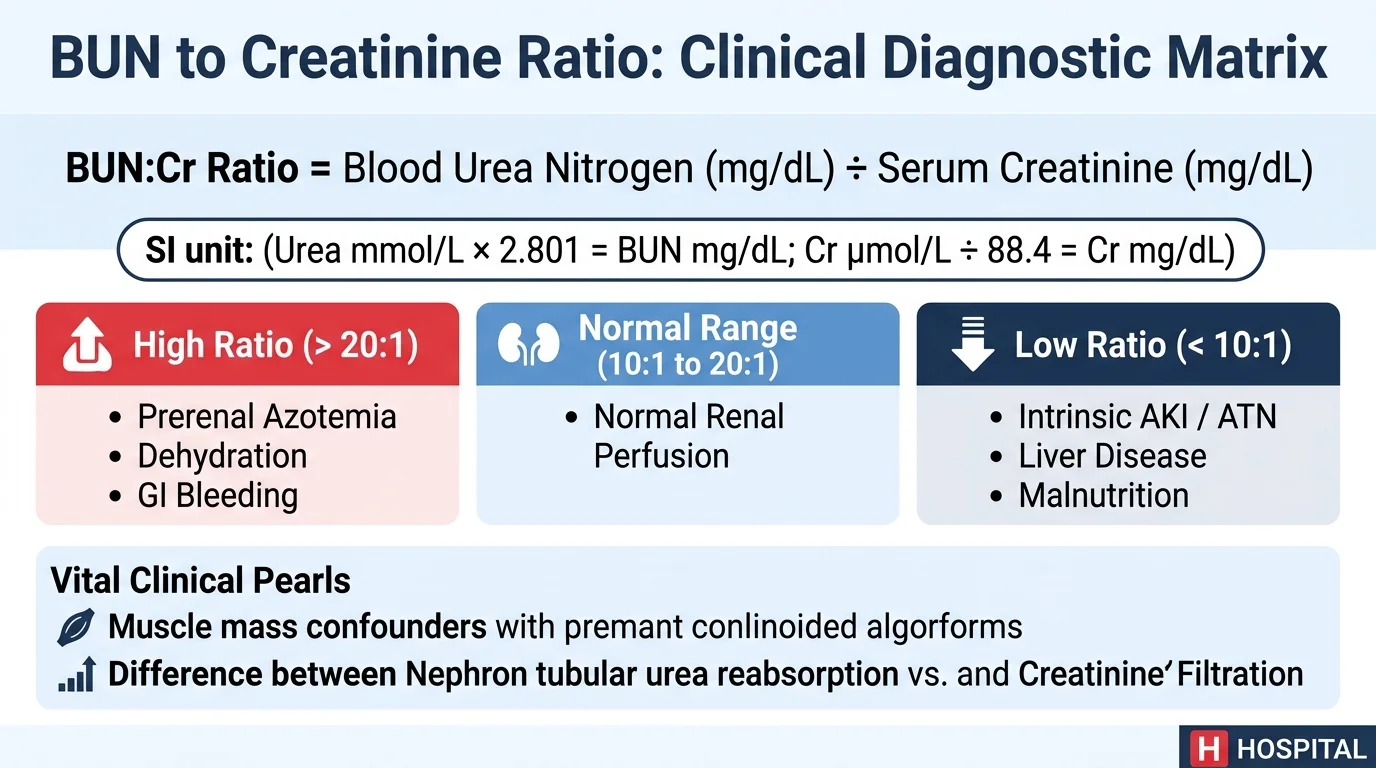
Calculation Formulas & Unit Conversion Dynamics
When laboratory values are reported in conventional United States units ($\text{mg/dL}$), calculating the BUN-to-creatinine ratio requires direct arithmetic division:
International SI Unit Conversion Mechanics: Many clinical laboratories outside the United States report total serum urea in millimoles per liter ($\text{mmol/L}$) and serum creatinine in micromoles per liter ($\mu\text{mol/L}$). Dividing these raw SI values directly without conversion yields a meaningless number because urea and creatinine possess different molecular weights and reporting definitions:
- Urea ($\text{mmol/L}$) to BUN ($\text{mg/dL}$): Total urea has a molecular weight of $60.06\text{ g/mol}$, while the two nitrogen atoms in urea account for $28.014\text{ g/mol}$. To convert urea in $\text{mmol/L}$ to nitrogen mass in $\text{mg/dL}$, multiply by $2.801$:
BUN (mg/dL) = Serum Urea (mmol/L) × 2.801
- Creatinine ($\mu\text{mol/L}$) to Creatinine ($\text{mg/dL}$): Creatinine has a molecular weight of $113.12\text{ g/mol}$. Dividing micromoles per liter by $88.4$ yields milligrams per deciliter:
Creatinine (mg/dL) = Serum Creatinine (µmol/L) ÷ 88.4
- Consolidated SI Conversion Equation: Combining both conversion factors yields the unified mathematical relationship:
Conventional Ratio = [Urea (mmol/L) ÷ Creatinine (µmol/L)] × 247.6
Step-by-Step Clinical Calculation Protocol
-
1
Verify Paired Phlebotomy Specimen
Ensure both BUN and creatinine measurements originate from the same blood draw. Comparing a morning BUN with an evening post-dialysis or post-resuscitation creatinine creates false ratios.
-
2
Confirm Measurement Analyte & Units
Check whether the laboratory reports Blood Urea Nitrogen (BUN) in mg/dL or total Urea in mmol/L. These values cannot be interchanged directly.
-
3
Select the Corresponding Unit Toggle
Select U.S. mode for mg/dL values, or SI mode if entering mmol/L for urea and µmol/L for creatinine. The calculator handles molecular weight conversions automatically.
-
4
Compute the Arithmetic Ratio
Divide the conventional BUN value by the serum creatinine value. For example, a BUN of 30 mg/dL and a creatinine of 1.2 mg/dL yields $30 \div 1.2 = 25.0$, documented clinically as 25:1.
-
5
Evaluate Absolute Numerator & Denominator
Never interpret the quotient in isolation. Inspect whether the ratio is driven by true renal hypoperfusion, severe muscle breakdown, liver dysfunction, or low muscle mass.
-
6
Correlate with Clinical Volume & Urinalysis
Corroborate findings with fractional excretion indices (FENa Calculator), hourly urine volumes (Urine Output Calculator), and hemodynamic targets.
Clinical Case Scenarios: Real-World Differential Diagnosis
Case Scenario 1: Upper Gastrointestinal Bleed with Prerenal Azotemia
Patient Presentation: A 68-year-old male with a history of osteoarthritis managed with daily over-the-counter naproxen presents to the emergency department reporting 24 hours of lightheadedness, weakness, and dark tarry stools (melena). Vital signs reveal tachycardia (heart rate 112 bpm) and orthostatic hypotension (blood pressure 102/64 mmHg sitting, dropping to 88/52 mmHg standing).
Pathophysiological Analysis & Clinical Management: An isolated ratio of 45:1 in a hemodynamically compromised patient strongly indicates upper gastrointestinal hemorrhage. When blood enters the stomach and duodenum, red blood cell proteins and hemoglobin undergo enzymatic digestion, delivering a massive amino acid load to the liver that dramatically accelerates urea synthesis. Simultaneously, acute intravascular blood loss triggers compensatory baroreceptor activation, releasing angiotensin II and ADH, which increases proximal tubular urea reabsorption. Creatinine rises only marginally from mild hypoperfusion ($1.2\text{ mg/dL}$). The clinical team initiates rapid crystalloid resuscitation, starts an intravenous proton pump inhibitor infusion, monitors mean arterial pressure using the Mean Arterial Pressure Calculator, tracks urine flow via the Urine Output Calculator, and arranges urgent emergent upper endoscopy.
Case Scenario 2: Exertional Rhabdomyolysis & Ischemic Acute Tubular Necrosis (ATN)
Patient Presentation: A 32-year-old amateur athlete collapses at mile 22 of a summer marathon run in 33°C (91°F) heat. He is admitted to the intensive care unit with severe lower extremity muscular rigidity, profound hyperthermia (39.8°C), confusion, and dark reddish-brown urine.
Pathophysiological Analysis & Clinical Management: Despite profound acute renal failure with a serum creatinine of 4.8 mg/dL, the calculated BUN:Cr ratio is only 7.5:1. This depressed ratio reflects two synergistic mechanisms: (1) Massive rhabdomyolysis floods the systemic circulation with intracellular creatine that spontaneously degrades into creatinine, expanding the denominator, and (2) Myoglobin cast obstruction combined with severe renal ischemia causes widespread necrosis of proximal tubular epithelial cells (Acute Tubular Necrosis). Because necrotic tubular cells cannot reabsorb filtered urea, urea washes out into the collecting ducts, eliminating the normal urea reabsorption advantage. To confirm intrinsic renal damage over prerenal azotemia, the ICU team calculates fractional excretion indices with the FENa Calculator and FEUrea Calculator, initiates aggressive intravenous isotonic bicarbonate hydration, and monitors filtration recovery with the GFR Calculator.
Diagnostic Spectrum & Clinical Classification Matrix
Interpreting the BUN:creatinine ratio requires contextual synthesis of both the calculated quotient and the absolute values of each component:
| BUN:Cr Ratio | Absolute Biomarker Pattern | Primary Clinical Etiologies | Key Diagnostic Next Steps |
|---|---|---|---|
| > 20:1 (High Ratio) |
Elevated BUN Elevated Creatinine |
Prerenal Azotemia: Dehydration, congestive heart failure, septic shock, renal artery stenosis, severe volume depletion. | Evaluate volume status; check orthostatics; calculate FENa (<1% indicates prerenal state); trial cautious fluid bolus. |
| > 20:1 (High Ratio) |
Elevated BUN Normal / Low Creatinine |
Non-Renal Catabolic Load: Upper gastrointestinal bleeding, high-dose corticosteroids, high-protein tube feeds, severe sarcopenia. | Stool guaiac / endoscopy for GI bleed; review steroid dosing; verify baseline muscle mass and nutritional history. |
| 10:1 to 20:1 (Normal Ratio) |
Normal BUN Normal Creatinine |
Normal Renal Physiology: Preserved glomerular filtration and normal tubular urea handling. | Routine health maintenance; confirm baseline with age-appropriate eGFR screening. |
| 10:1 to 20:1 (Normal Ratio) |
Elevated BUN Elevated Creatinine |
Intrinsic Chronic Renal Disease: Established CKD, chronic glomerulonephritis, early postrenal obstruction. | Renal ultrasound to rule out hydronephrosis; monitor longitudinal creatinine slope; assess proteinuria. |
| < 10:1 (Low Ratio) |
Normal / Low BUN Elevated Creatinine |
Intrinsic Tubular Damage: Acute Tubular Necrosis (ATN), rhabdomyolysis, interstitial nephritis, nephrotoxic drug injury. | Urine sediment for muddy brown granular casts; calculate FEUrea; discontinue nephrotoxic agents. |
| < 10:1 (Low Ratio) |
Low BUN Normal / Low Creatinine |
Diminished Urea Synthesis: End-stage hepatic cirrhosis (urea cycle failure), severe malnutrition, pregnancy (high GFR). | Assess liver function tests (bilirubin, INR, albumin); evaluate dietary protein intake and gestational age. |
Physiological Confounders & Diagnostic Pitfalls
Because the ratio is a simple mathematical quotient, changes in either the numerator (BUN) or the denominator (creatinine) that are unrelated to renal perfusion can dramatically distort clinical interpretation:
- Low Muscle Mass (Pseudo-Elevated Ratio): Elderly, frail, bedridden patients, individuals with severe sarcopenia, and amputees have diminished muscle creatine stores, producing low baseline serum creatinine (e.g., $0.4\text{ mg/dL}$). In such patients, a completely normal BUN of $16\text{ mg/dL}$ produces a calculated ratio of $40:1$, falsely suggesting severe dehydration when renal hemodynamics are entirely intact.
- Muscular Athletes & Bodybuilders (Pseudo-Depressed Ratio): Individuals with massive skeletal muscle hypertrophy or those consuming oral creatine monohydrate supplements exhibit elevated baseline creatinine production. A BUN of $18\text{ mg/dL}$ paired with a baseline creatinine of $2.0\text{ mg/dL}$ yields a ratio of $9:1$, which could be misinterpreted as intrinsic tubular injury.
- Medication Interactions with Tubular Secretion: Drugs such as trimethoprim (in Bactrim) and cimetidine competitively inhibit the organic cation transport system responsible for proximal tubular creatinine secretion. This selectively elevates serum creatinine by 0.2 to 0.5 mg/dL without reducing true GFR or changing BUN, compressing the calculated ratio.
- Keto & Hyperprotein Diets: Extreme high-protein dietary intake (such as ketogenic or carnivore regimens) saturates hepatic deaminases, driving baseline BUN upward without any impairment in renal filtration.
-
Differentiate Prerenal from Intrinsic AKI: A ratio exceeding 20:1 strongly favors prerenal hypoperfusion or upper GI bleeding, whereas a ratio below 10:1 points toward acute tubular necrosis or rhabdomyolysis.
-
Always Inspect the Source Numbers: A ratio of 15:1 can represent healthy kidneys (BUN 15, Cr 1.0) or severe renal failure (BUN 60, Cr 4.0). Never interpret the ratio without examining absolute concentrations.
-
Account for Muscle Mass Confounders: Sarcopenic geriatric patients frequently demonstrate pseudo-elevated ratios (>25:1) due to low creatinine generation rather than true dehydration.
-
Remember Upper GI Bleeding: Digested luminal blood protein floods the portal vein with nitrogen, causing massive isolated BUN spikes that frequently push ratios above 30:1.
-
Triangulate with Ancillary Tests: Corroborate abnormal ratios with fractional excretion of sodium (FENa), urine output monitoring (Urine Output), and urinalysis microscopy.
Frequently Asked Questions
How do you calculate the BUN creatinine ratio?
When both conventional values are in mg/dL, divide blood urea nitrogen by serum creatinine: BUN:Cr Ratio = BUN (mg/dL) ÷ Serum Creatinine (mg/dL). For example, if BUN is 24 mg/dL and creatinine is 1.2 mg/dL, the ratio is 24 ÷ 1.2 = 20:1. When using SI units, convert urea (mmol/L) to BUN (mg/dL) by multiplying by 2.801, and convert creatinine (µmol/L) to mg/dL by dividing by 88.4 prior to calculation.
What is considered a normal BUN creatinine ratio?
The standard clinical reference range for adults is between 10:1 and 20:1. Within this window, renal perfusion and glomerular filtration are generally in physiological equilibrium, provided that both absolute BUN and serum creatinine concentrations are within normal laboratory reference limits.
What causes a high BUN creatinine ratio (> 20:1)?
A ratio exceeding 20:1 most frequently signals prerenal azotemia caused by dehydration, congestive heart failure, or renal artery stenosis, where decreased renal perfusion stimulates excessive tubular urea reabsorption. Non-renal causes include upper gastrointestinal bleeding (digestion of blood protein), high-dose corticosteroid therapy, hypercatabolic states, severe fever, or excessive dietary protein consumption.
What causes a low BUN creatinine ratio (< 10:1)?
A ratio below 10:1 indicates either diminished urea generation or disproportionate creatinine elevation. Causes include intrinsic acute kidney injury such as Acute Tubular Necrosis (ATN) where damaged tubules cannot reabsorb urea, advanced liver cirrhosis (impaired hepatic urea synthesis), severe protein malnutrition or starvation, pregnancy (plasma expansion and high GFR), and rhabdomyolysis.
Why can the BUN to creatinine ratio be normal in severe kidney disease?
Because the ratio is a fraction, if both BUN and serum creatinine rise proportionally, the ratio remains between 10:1 and 20:1. For instance, a patient with established chronic kidney disease or early intrinsic injury might present with a BUN of 60 mg/dL and a creatinine of 4.0 mg/dL (ratio = 15:1). Although the ratio appears normal, both individual biomarkers are severely abnormal.
Can I enter urea in mmol/L instead of BUN in mg/dL?
Yes. In SI mode, the calculator accurately converts serum urea in mmol/L to BUN in mg/dL using the molar mass factor of 2.801, and converts serum creatinine from µmol/L to mg/dL by dividing by 88.4. This allows international laboratory reports to produce standard conventional ratio comparisons.
How does an upper GI bleed cause an elevated BUN creatinine ratio?
When bleeding occurs in the upper gastrointestinal tract, red blood cells and plasma proteins are digested in the small intestine. This acts as a large oral protein bolus, flooding the portal vein with amino acids that the liver rapidly metabolizes into urea. Concurrently, mild hypovolemia stimulates tubular urea retention, driving BUN significantly higher while baseline creatinine remains largely unchanged, often producing ratios between 30:1 and 50:1.
Evidence & Clinical Guidelines
The calculation formulas, physiological reference intervals, and diagnostic algorithms presented on this page are grounded in peer-reviewed nephrology and internal medicine consensus literature:
- Manoeuvrier G, Bach-Ngohou K, Batard E, Masson D, Trewick D. Diagnostic performance of serum blood urea nitrogen to creatinine ratio for differentiating prerenal from intrinsic acute kidney injury. StatPearls [Internet]. Treasure Island (FL): StatPearls Publishing; 2026.
- MedlinePlus Medical Encyclopedia. Comprehensive Metabolic Panel (CMP) Blood Test. U.S. National Library of Medicine; Reviewed 2025.
- Merck Manual Professional Edition. Acute Tubular Necrosis (ATN): Diagnostic Laboratory Findings. Merck & Co., Inc.; Reviewed October 2025.
- Makris K, Spanou L. Practical approach to detection and management of acute kidney injury in critically ill patients. Clin Biochem Rev. 2016;37(2):85-98.
- National Kidney Foundation. KDOQI Clinical Practice Guidelines for Chronic Kidney Disease: Evaluation, Classification, and Stratification. Am J Kidney Dis. 2002;39(2 Suppl 1):S1-266.
Editorial review completed September 11, 2026. Computations are processed client-side in your local browser; patient laboratory data is never transmitted to or retained by our servers.