Physiological Foundations of Maintenance Fluid Therapy
Intravenous maintenance fluid therapy (often abbreviated MIVF) is designed to sustain normal physiological hydration in patients who cannot maintain adequate oral intake. The objective is to replace the normal, inevitable fluid losses that occur under basal metabolic conditions, primarily consisting of:
- Insensible Losses: Evaporative loss of solute-free water from the respiratory tract during respiration and through the stratum corneum of the skin (transpirational evaporation, distinct from active sweating). In healthy children and adults, insensible water loss accounts for approximately 45 mL per 100 kcal of energy metabolized (about one-third respiratory and two-thirds cutaneous).
- Sensible Losses (Urine & Stool): Obligatory urinary excretion required to clear metabolic solutes (urea, creatinine, sulfates, phosphates, and electrolytes) without exceeding maximum renal concentrating capacity. This typically requires 50 to 55 mL per 100 kcal metabolized. Baseline fecal losses account for roughly 5 mL per 100 kcal under non-diarrheal conditions.
In 1957, pediatricians Malcolm A. Holliday and William E. Segar published their seminal clinical investigation establishing that normal water requirements do not scale linearly with body weight, but rather parallel caloric expenditure. Because metabolic rate per kilogram declines as body mass increases, water needs follow a distinct three-tier curve: 100 kcal/kg/day for infants under 10 kg, 50 kcal/kg/day for children between 11 and 20 kg, and 20 kcal/kg/day for weight exceeding 20 kg. Because 100 mL of water is required to metabolize 100 kcal, the daily caloric formula directly yields the familiar 100-50-20 mL/kg/day rule.
Maintenance fluid calculations must never be conflated with deficit therapy. If a patient is hypernatremic and dehydrated, quantify free water loss separately using the Free Water Deficit Calculator. Similarly, assess renal output adequacy using the Urine Output Calculator and calculate basal caloric requirements with the TDEE Calculator.
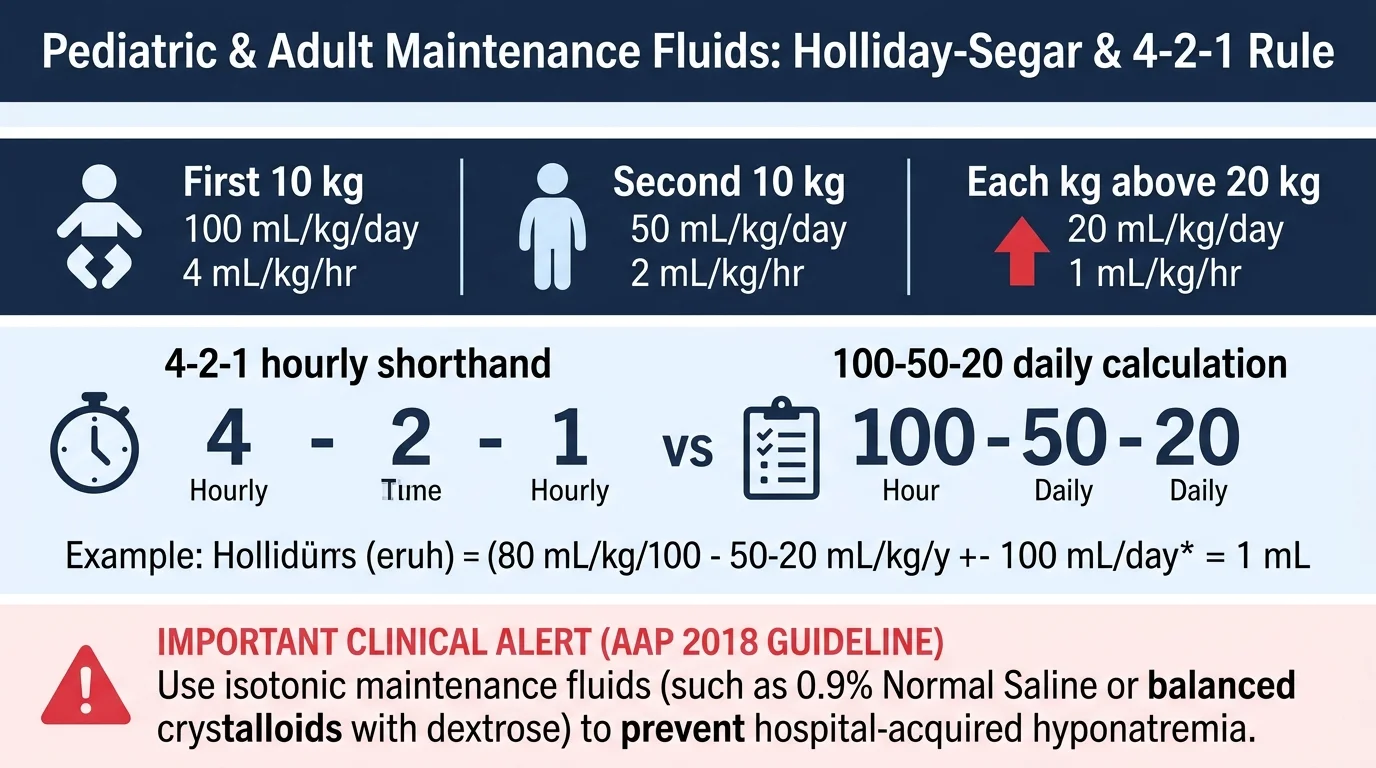
Maintenance Fluid Formulas: 4-2-1 Rule vs. 100-50-20 Method
Two mathematical approaches are used in clinical practice: the 24-hour Holliday-Segar formula and the hourly 4-2-1 shorthand rule. Although closely related, they exhibit a small but clinically relevant mathematical distinction:
First 10 kg: 100 mL/kg/day (up to 1,000 mL)
11 to 20 kg: 1,000 mL + 50 mL/kg/day for kg > 10
Above 20 kg: 1,500 mL + 20 mL/kg/day for kg > 20
First 10 kg: 4 mL/kg/hour (up to 40 mL/hr)
11 to 20 kg: 40 mL/hr + 2 mL/kg/hour for kg > 10
Above 20 kg: 60 mL/hr + 1 mL/kg/hour for kg > 20
- 4 mL/kg/hr × 24 hrs = 96 mL/kg/day (vs. 100 mL/kg/day in Holliday-Segar; a 4% reduction).
- 2 mL/kg/hr × 24 hrs = 48 mL/kg/day (vs. 50 mL/kg/day in Holliday-Segar; a 4% reduction).
- 1 mL/kg/hr × 24 hrs = 24 mL/kg/day (vs. 20 mL/kg/day in Holliday-Segar; a 20% increase).
Step-by-Step Clinical Calculation Protocol
-
1
Confirm Maintenance Indication
Verify that the patient requires baseline physiological maintenance fluids rather than emergency resuscitation boluses (e.g., septic or hypovolemic shock), burn resuscitation, or rapid dehydration rehydration.
-
2
Obtain Measured Weight in Kilograms
Weigh the patient directly whenever possible. If weight is measured in pounds, divide by 2.20462. Never estimate weight visually in pediatric resuscitation.
-
3
Allocate Weight into Three Sequential Tiers
Segment total mass: allocate up to the first 10 kg into Tier 1, up to the next 10 kg (10.1–20.0 kg) into Tier 2, and all weight beyond 20 kg into Tier 3.
-
4
Compute Daily or Hourly Rate
Multiply each weight band by its corresponding coefficient (100 / 50 / 20 for 24-hour volume, or 4 / 2 / 1 for hourly pump rate) and sum the products.
-
5
Select Isotonic IV Crystalloid with Dextrose
In accordance with AAP guidelines, select an isotonic fluid (such as 0.9% Normal Saline or Lactated Ringer's) containing 5% dextrose to avoid hypoglycemia, and add 20 mEq/L KCl once renal output is confirmed.
-
6
Adjust for Clinical Stressors & Monitor
Increase maintenance volume by 10% to 12% for each 1°C elevation in body temperature above 38°C. Restrict volume by 20% to 40% in conditions with high ADH secretion, such as CNS injury or mechanical ventilation.
Worked Calculation Examples
Let us examine two typical pediatric clinical presentations to demonstrate step-by-step weight allocation across the formula tiers:
- 1
Tier 1 (First 10 kg): 10 kg × 4 mL/kg/hr = 40 mL/hr (Daily: 10 × 100 = 1,000 mL/day)
- 2
Tier 2 (Next 5 kg): 5 kg × 2 mL/kg/hr = 10 mL/hr (Daily: 5 × 50 = 250 mL/day)
- 3
Tier 3 (Weight > 20 kg): 0 kg × 1 mL/kg/hr = 0 mL/hr (Daily: 0 mL/day)
- 4
4-2-1 Hourly Rate: 40 + 10 = 50 mL/hour (Daily equivalent: 1,200 mL/day)
- 5
Holliday-Segar Daily Total: 1,000 + 250 = 1,250 mL/day (Averaging 52.1 mL/hr)
- 1
Tier 1 (First 10 kg): 10 kg × 4 mL/kg/hr = 40 mL/hr (Daily: 10 × 100 = 1,000 mL/day)
- 2
Tier 2 (Next 10 kg): 10 kg × 2 mL/kg/hr = 20 mL/hr (Daily: 10 × 50 = 500 mL/day)
- 3
Tier 3 (Remaining 8 kg): 8 kg × 1 mL/kg/hr = 8 mL/hr (Daily: 8 × 20 = 160 mL/day)
- 4
4-2-1 Hourly Rate: 40 + 20 + 8 = 68 mL/hour (Daily equivalent: 1,632 mL/day)
- 5
Holliday-Segar Daily Total: 1,000 + 500 + 160 = 1,660 mL/day (Averaging 69.2 mL/hr)
Clinical Case Scenarios: Real-World IV Fluid Management
Case Scenario 1: Pediatric Post-Operative Appendectomy
Patient Presentation: A 7-year-old male weighing 24 kg undergoes an uncomplicated laparoscopic appendectomy for acute appendicitis. He is admitted to the pediatric surgical floor resting comfortably. Because of post-anesthetic nausea, he will be kept strictly NPO (nothing by mouth) overnight until bowel sounds return.
Clinical Decision-Making & Fluid Selection: Post-operative pediatric patients experience potent non-osmotic stimulation of Antidiuretic Hormone (ADH) triggered by surgical tissue injury, perioperative opioid administration, pain, and nausea. If this child were prescribed historical hypotonic fluids (such as 5% Dextrose with 0.2% Normal Saline), unexcretable free water would be reabsorbed by the renal collecting ducts, causing acute dilutional hyponatremia and risk of cerebral herniation. In strict alignment with the AAP 2018 guideline, the team orders D5 0.9% Normal Saline with 20 mEq/L KCl at 64 mL/hr after confirming spontaneous urination on the surgical ward. Urine output is logged via the Urine Output Calculator, and fluid balance is audited every 8 hours.
Case Scenario 2: Adult Pre-Procedure NPO Hydration with Comorbid Heart Failure
Patient Presentation: A 62-year-old female weighing 68 kg is admitted for an elective colonoscopy and polypectomy. She has a history of mild heart failure with preserved ejection fraction (HFpEF, EF 52%) and stage 2 chronic kidney disease. She is placed on NPO status starting at 22:00.
Clinical Decision-Making & Fluid Restriction: Applying the pediatric 4-2-1 rule blindly to adult patients is a common clinical pitfall. Adults have a lower metabolic rate per kilogram than children, and elderly patients frequently suffer from diminished diastolic compliance and reduced renal reserve. Prescribing 108 mL/hr overnight in this patient would deliver over 1.3 liters of fluid prior to the morning procedure, risking pulmonary congestion, dyspnea, and peripheral edema. The medical team appropriately restricts IV infusion to Lactated Ringer's at 75 mL/hr, continuously monitors perfusion pressure with the Mean Arterial Pressure Calculator, and verifies baseline renal clearance with the GFR Calculator.
Clinical Reference Tables: Weight Bands & IV Solution Chemistry
The following matrices outline weight-based titration bands and the biochemical electrolyte composition of common intravenous crystalloid solutions:
| Patient Weight Band | Hourly 4-2-1 Rate | Daily 100-50-20 Volume | Clinical Titration Guidelines |
|---|---|---|---|
| 1 to 10 kg (Infants & Toddlers) |
4 mL/kg/hr | 100 mL/kg/day | Highest metabolic rate per kg; highly susceptible to hypoglycemia. Always incorporate 5% dextrose unless contraindicated. |
| 11 to 20 kg (Young Children) |
40 mL/hr + 2 mL/kg/hr for kg > 10 | 1,000 mL + 50 mL/kg/day for kg > 10 | Transition zone where caloric demand per kg begins steep decline. Confirm spontaneous voiding before adding potassium. |
| 21 to 70 kg (Older Children / Adolescents) |
60 mL/hr + 1 mL/kg/hr for kg > 20 | 1,500 mL + 20 mL/kg/day for kg > 20 | Cumulative third tier. At 50 kg, hourly rate is 90 mL/hr; at 70 kg, hourly rate is 110 mL/hr. |
| Above 70 kg (Adult Cap) |
Cap at 100–110 mL/hr | Cap at 2,400–2,500 mL/day | Standard adult maximum maintenance cap. Do not continue scaling 1 mL/kg/hr indefinitely in obese patients to prevent hypervolemia. |
Choosing the correct crystalloid carrier requires understanding its electrolyte concentrations, osmolality, and tonicity relative to human plasma:
| Intravenous Solution | Na⁺ (mEq/L) | Cl⁻ (mEq/L) | K⁺ (mEq/L) | Osmolarity (mOsm/L) | In Vivo Tonicity | Clinical Recommendation |
|---|---|---|---|---|---|---|
| 0.9% Sodium Chloride (Normal Saline) | 154 | 154 | 0 | 308 | Isotonic | AAP Standard: Preferred base crystalloid for pediatric maintenance; protects against dilutional hyponatremia. |
| Lactated Ringer's (LR) | 130 | 109 | 4 | 273 | Isotonic (Balanced) | Excellent balanced crystalloid; lower chloride reduces risk of hyperchloremic metabolic acidosis during prolonged infusion. |
| Plasma-Lyte 148 / Normosol-R | 140 | 98 | 5 | 295 | Isotonic (Balanced) | Physiological electrolyte composition with acetate/gluconate buffers; ideal for prolonged surgical or ICU maintenance. |
| 0.45% Sodium Chloride (Half-Normal Saline) | 77 | 77 | 0 | 154 | Hypotonic | Contraindicated for routine pediatric MIVF: High risk of hospital-acquired hyponatremia under stress-induced ADH secretion. |
| 5% Dextrose in Water (D5W) | 0 | 0 | 0 | 252 | Hypotonic (in vivo) | Dextrose is rapidly metabolized by erythrocytes and liver, leaving solute-free water. Contraindicated as a sole maintenance fluid. |
The Great Pediatric Paradigm Shift: Why AAP Mandates Isotonic Fluids
For more than six decades following Holliday and Segar's original 1957 paper, standard pediatric teaching dictated the use of hypotonic intravenous fluids—typically 0.2% Normal Saline with 5% Dextrose or 0.45% Normal Saline—for maintenance hydration. Holliday and Segar's calculations were grounded in the physiology of healthy, ambulatory children, whose normal renal solute clearance produces hypotonic urine.
However, modern hospital medicine revealed a catastrophic flaw in this approach: hospitalized children are not healthy outpatients. Hospitalized children almost universally experience potent non-osmotic stimulation of Antidiuretic Hormone (ADH / arginine vasopressin). Stimuli that trigger ADH release independently of serum osmolality include:
- Physical and Emotional Stressors: Severe pain, anxiety, unfamiliar hospital environment, and nausea.
- Perioperative Factors: Anesthetic agents, surgical tissue trauma, mechanical ventilation, and opioid analgesics.
- Systemic Pathology: Fever, pulmonary infections (bronchiolitis, pneumonia), central nervous system infections (meningitis), and inflammatory cytokines.
When ADH is elevated, the collecting ducts of the kidney become highly permeable to water, preventing the excretion of free water. If a child receives hypotonic IV fluids during this state, the free water is retained while sodium continues to be lost in urine, precipitating acute hospital-acquired hyponatremia. A sudden drop in serum sodium below 130 mEq/L creates an osmotic gradient that shifts water across the blood-brain barrier into astrocyte brain cells, causing cerebral edema, increased intracranial pressure, uncal herniation, permanent neurological disability, and fatal respiratory arrest.
In response to hundreds of documented preventable deaths and extensive multicenter randomized controlled trials, the American Academy of Pediatrics (AAP) published its definitive Clinical Practice Guideline in 2018. The guideline established an unambiguous clinical standard: patients aged 28 days to 18 years requiring intravenous maintenance fluids must receive isotonic solutions with appropriate dextrose and potassium chloride. Isotonic fluids (such as 0.9% Normal Saline or balanced crystalloids) preserve intravascular osmolarity, effectively eliminating hospital-acquired hyponatremic encephalopathy.
To evaluate solute concentration changes in high-risk patients, utilize our Serum Osmolality Calculator, and calculate fractional sodium clearance using the FENa Calculator.
The Five Critical Components of Intravenous Fluid Therapy
A frequent error among clinicians is treating intravenous fluid as a single monolithic order. In clinical reality, fluid prescribing must be compartmentalized into five distinct physiologic components:
- 1. Resuscitation (Emergency Bolus): Immediate intravascular volume expansion for shock, severe hypovolemia, or severe hypotension (e.g., 20 mL/kg of 0.9% Normal Saline or Lactated Ringer's pushed over 10–20 minutes). Maintenance rates must never be used for resuscitation.
- 2. Routine Maintenance: The baseline water, glucose, and electrolytes needed to cover normal insensible evaporative and urinary losses under basal conditions (calculated via the 4-2-1 or 100-50-20 formulas).
- 3. Dehydration Deficit Replacement: The quantified volume of water and electrolytes lost prior to admission due to vomiting, diarrhea, diabetic ketoacidosis, or starvation. Deficits are calculated separately and replaced gradually over 24 to 48 hours.
- 4. Replacement of Abnormal Ongoing Losses: Dynamic volume-for-volume replacement of active ongoing losses, such as nasogastric suction drainage, high-output surgical drains, chest tubes, or profuse secretory diarrhea.
- 5. Nutritional & Electrolyte Repletion: Ensuring adequate dextrose (preventing catabolism and ketosis) and specific electrolyte repletion (potassium, phosphate, magnesium, and calcium) tailored to serum chemistries.
High-Risk Clinical Populations Requiring Fluid Restriction
Standard weight-based maintenance formulas assume normal cardiac, renal, and endocrine physiology. In the following clinical conditions, infusing full 100% maintenance fluids can cause dangerous volume overload, pulmonary edema, or electrolyte collapse:
- Syndrome of Inappropriate ADH Secretion (SIADH): In true SIADH (commonly seen in encephalitis, severe pneumonia, or head trauma), free water retention occurs despite euvolemia. Maintenance fluids must be restricted to 50% to 70% of standard maintenance volume using strictly isotonic solutions.
- Congestive Heart Failure & Cardiomyopathy: Impaired systolic or diastolic function reduces cardiac output, activating compensatory RAAS and fluid retention. Maintenance fluids should be minimized or restricted to medications only.
- Acute Kidney Injury (AKI) & Oliguria: When renal filtration falls below 0.5 mL/kg/hr, the kidneys cannot excrete urinary volume. Infusing full maintenance causes rapidly escalating hypervolemia and hypertension. Evaluate renal health using our BUN:Creatinine Ratio Calculator and monitor glomerular filtration via the GFR Calculator.
- Elevated Intracranial Pressure (Traumatic Brain Injury / Neurosurgical Patients): Hypotonic fluids are strictly contraindicated. Mild hyperosmolar therapy or isotonic maintenance with strict euvolemic targets is required to avoid worsening cerebral edema.
- Early Postnatal Neonates (< 28 Days): The Holliday-Segar formula is unsafe for neonates due to transitional renal nephrogenesis and shifting extracellular fluid compartments. Neonatal fluid prescribing requires day-of-life and birth-weight titration.
Common Prescribing Errors & Diagnostic Pitfalls
- Pounds vs. Kilograms Unit Errors: Entering body weight in pounds without dividing by 2.20462 causes a 220% volume overdose, a catastrophic error in small infants that can lead to rapid pulmonary edema.
- Non-Cumulative Weight Banding: Multiplying the total weight by a single band rate (e.g., calculating a 16 kg child as 16 × 2 mL/kg/hr = 32 mL/hr, rather than 40 + [6 × 2] = 52 mL/hr) significantly underdoses maintenance fluids.
- Adding Potassium Before Confirming Urine Output: Infusing potassium chloride to a child with unrecognized acute tubular necrosis, bilateral ureteral obstruction, or anuria can cause lethal hyperkalemic cardiac dysrhythmias. Always confirm urination first.
- Failure to Cap Adult Maintenance Rates: Continuing to apply 1 mL/kg/hr uncapped to adolescents or adults weighing 100 kg to 140 kg results in excessive infusion rates (140 mL/hr / 3,360 mL/day). Maintenance should generally be capped at 100 to 110 mL/hr (2,400–2,500 mL/day).
- Omitting Dextrose in NPO Pediatric Patients: Pediatric patients have limited hepatic glycogen reserves. Fasting without dextrose leads to rapid hypoglycemia, lipolysis, and starvation ketoacidosis within 12 to 24 hours. Always include 5% dextrose for NPO maintenance.
- Isotonic IV Fluid Standard: In accordance with AAP 2018 guidelines, children aged 28 days to 18 years requiring maintenance IV fluids must receive isotonic crystalloids (0.9% Normal Saline or balanced solutions) to prevent hospital-acquired hyponatremic encephalopathy.
- The 4-2-1 Shorthand Rule: Allocate 4 mL/kg/hr for the first 10 kg, 2 mL/kg/hr for the next 10 kg (11–20 kg), and 1 mL/kg/hr for each kilogram beyond 20 kg.
- Recognize Method Divergence: Multiplying 4-2-1 by 24 hours yields 96-48-24 mL/kg/day, which is 2.5% to 4% lower than the 100-50-20 daily Holliday-Segar formula. Both values are clinically sound when recognized.
- Cap Adult & Adolescent Rates: Adult daily fluid needs are lower (25–30 mL/kg/day). Cap pediatric maintenance rates at 100 to 110 mL/hr (2,400–2,500 mL/day) in older or obese patients.
- Compartmentalize Fluid Orders: Never use maintenance rates for shock resuscitation boluses, dehydration deficit replacement, or ongoing gastrointestinal drainage replacement.
Maintenance Fluid Calculator FAQs
How do you calculate pediatric maintenance fluids using the 4-2-1 rule?
Use patient weight in kilograms divided into three sequential weight bands: allocate 4 mL/kg/hour for the first 10 kg of body weight, 2 mL/kg/hour for the next 10 kg (11 to 20 kg), and 1 mL/kg/hour for every kilogram above 20 kg. For example, a 25 kg child receives (10 × 4) + (10 × 2) + (5 × 1) = 40 + 20 + 5 = 65 mL/hour.
What is the mathematical difference between the 4-2-1 hourly rule and the 100-50-20 daily method?
Both methods utilize the same three weight tiers, but the hourly 4-2-1 rule is a simplified shorthand. Multiplying 4-2-1 by 24 hours yields 96, 48, and 24 mL/kg/day, which is approximately 2.5% to 4% lower than the original Holliday-Segar daily values of 100, 50, and 20 mL/kg/day. This calculator reports both figures separately so clinicians can audit differences.
Why did the AAP 2018 guideline change pediatric maintenance fluids from hypotonic to isotonic solutions?
For decades, hypotonic fluids (such as 0.2% or 0.45% sodium chloride) were standard. However, hospitalized children frequently experience non-osmotic secretion of antidiuretic hormone (ADH) stimulated by pain, stress, fever, surgery, and pulmonary illness. Non-osmotic ADH prevents free-water excretion by the kidneys. Infusing hypotonic fluids in this state causes rapid water retention, acute dilutional hyponatremia, cerebral edema, herniation, and death. The American Academy of Pediatrics (AAP) 2018 clinical guideline mandates isotonic solutions (such as 0.9% Normal Saline or balanced crystalloids) with appropriate dextrose and potassium for patients 28 days to 18 years.
Can the 4-2-1 maintenance fluid rule be applied safely to adult patients?
The arithmetic can calculate a rate for any weight, but applying the 4-2-1 rule uncapped to adults frequently results in fluid overload. Adult guidelines (such as UK NICE Guideline CG174) recommend 25 to 30 mL/kg/day of water (equivalent to approximately 70 to 85 mL/hr for a 70 kg adult). In contrast, 4-2-1 yields 110 mL/hr (2,640 mL/day). In elderly or frail adults with heart, kidney, or liver disease, standard pediatric rates can induce pulmonary edema.
Does this maintenance fluid calculation include dehydration deficits or abnormal ongoing losses?
No. This tool calculates baseline physiological maintenance water only—the volume needed to replace expected insensible losses and baseline urine production. It strictly excludes emergency resuscitation boluses (e.g., 20 mL/kg normal saline for shock), pre-existing dehydration deficits (which must be calculated and rehydrated separately), and ongoing abnormal gastrointestinal, surgical drain, or fever losses.
Why is this calculator contraindicated for neonates younger than 28 days?
Neonates during the first 28 days of life undergo dynamic postnatal physiological changes, including physiological extracellular fluid contraction, low glomerular filtration rates, and evolving renal tubular sodium handling. Neonatal fluid requirements typically begin around 60 to 80 mL/kg/day on day 1 of life and advance by 10 to 20 mL/kg/day each day, guided by birth weight and daily weight changes. The 4-2-1 rule is dangerously excessive for early neonates.
How should potassium and dextrose additives be selected for maintenance IV fluids?
Standard pediatric maintenance IV fluids typically incorporate 5% dextrose (D5) to provide baseline calories, prevent hypoglycemia, and suppress starvation ketoacidosis. Potassium chloride (usually 20 mEq/L) is added to cover obligatory renal potassium losses once adequate urine output and renal function are confirmed. Potassium should never be administered to anuric or oliguric patients or in acute kidney injury before serum electrolytes are measured.
Evidence and Clinical Guidelines
- Holliday MA, Segar WE. The Maintenance Need for Water in Parenteral Fluid Therapy. Pediatrics. 1957;19(5):823-832.
- Feld LG, Neuspiel DR, Foster BA, et al. Clinical Practice Guideline: Maintenance Intravenous Fluids in Children. Pediatrics. 2018;142(6):e20183083.
- National Institute for Health and Care Excellence (NICE). Intravenous fluid therapy in adults in hospital (Clinical Guideline CG174). Published December 2013; Updated May 2020.
- Moritz ML, Ayus JC. Prevention of hospital-acquired hyponatremia: a case for using isotonic saline. Pediatrics. 2003;111(2):227-230.
- National Institute for Health and Care Excellence (NICE). Intravenous fluid therapy in children and young people in hospital (NICE Guideline NG29). Published December 2015; Updated August 2020.
Editorial review completed September 11, 2026. Formulas and clinical thresholds verified against AAP, NICE, and published physiologic literature. Calculations are computed locally in your web browser.