What Is the TIMI Risk Score and How Does It Function?
The TIMI (Thrombolysis in Myocardial Infarction) Risk Score is an established clinical risk stratification model developed by the TIMI Study Group at Brigham and Women's Hospital and Harvard Medical School. Introduced by Antman et al. (JAMA 2000), the scoring system was developed to provide emergency physicians and cardiologists with an objective, bed-side arithmetic tool to predict adverse outcomes in patients presenting with Unstable Angina (UA) and Non-ST-Segment Elevation Myocardial Infarction (NSTEMI).
In patients with acute coronary syndrome (ACS), physical symptoms alone cannot reliably distinguish between individuals who can be managed conservatively and those who face imminent myocardial necrosis or death. The TIMI score synthesizes seven readily accessible clinical variables into a 0 to 7 point integer scale. Each point corresponds directly to a statistically validated probability of suffering a major adverse cardiac event (MACE) within 14 days of presentation.
While the UA/NSTEMI score guides hospital admission and the timing of cardiac catheterization, a distinct 14-point model—the TIMI Risk Score for STEMI (Morrow et al., Circulation 2000)—is employed for ST-Elevation Myocardial Infarction to predict 30-day all-cause mortality and direct intensive post-reperfusion care. Both scores serve as cornerstones of the American College of Cardiology (ACC), American Heart Association (AHA), and European Society of Cardiology (ESC) coronary care guidelines.
How Is the TIMI Score for UA/NSTEMI Calculated? (AMERICA Mnemonic)
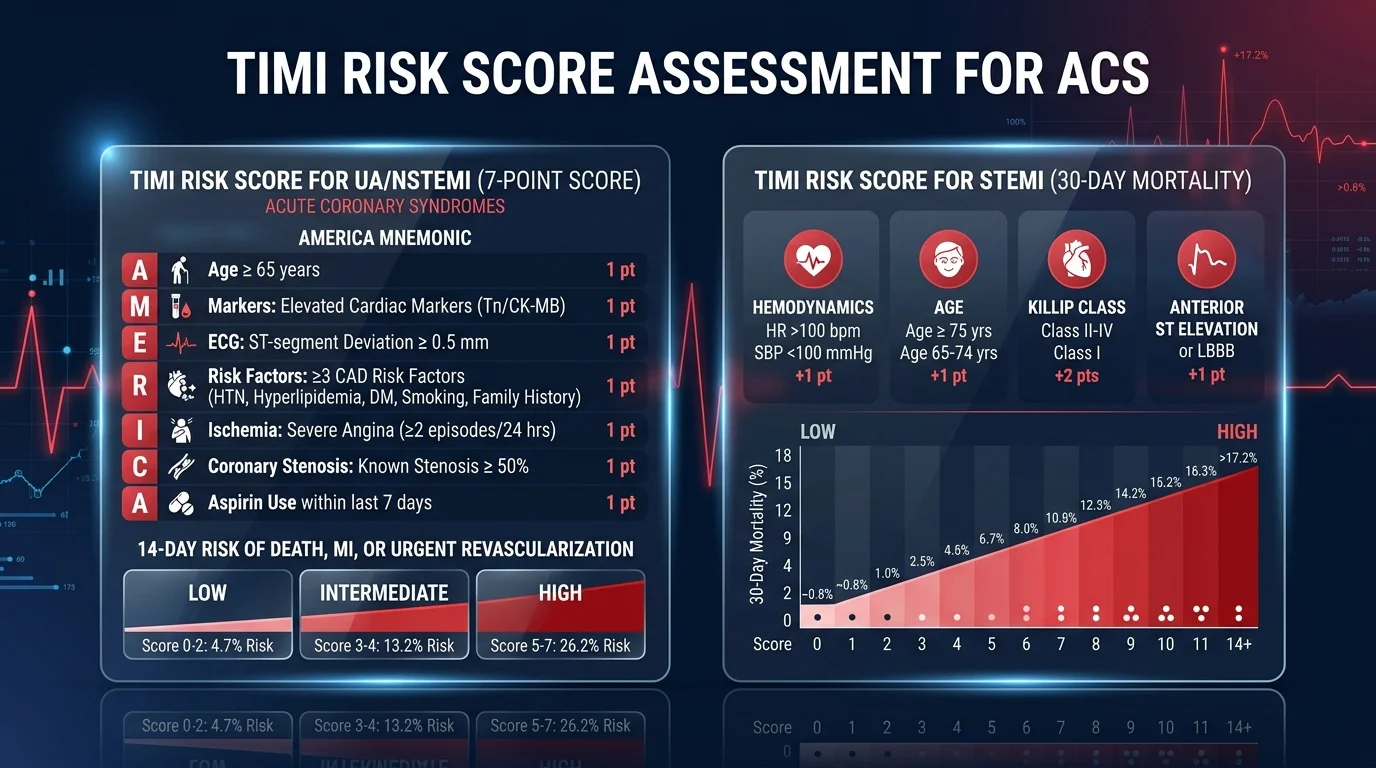
The TIMI score for Unstable Angina and NSTEMI awards exactly 1 point for each of seven independent clinical predictors. Medical clinicians and students frequently memorize these variables using the validated AMERICA mnemonic:
| Mnemonic | Clinical Variable | Diagnostic Definition & Criteria | Points Awarded |
|---|---|---|---|
| A | Age ≥ 65 Years | Biological age reflects diminished physiological vascular reserve, higher coronary calcification, and comorbid renal impairment. | +1 Point |
| M | Markers Elevated | Cardiac Troponin I, Troponin T, or CK-MB elevated above the diagnostic laboratory upper reference limit (URL). | +1 Point |
| E | ECG ST Deviation | ST-segment depression or transient ST-elevation ≥ 0.5 mm (0.05 mV) on the presenting 12-lead electrocardiogram. | +1 Point |
| R | Risk Factors (≥ 3) | Presence of at least 3 traditional coronary artery disease risk factors: Family history of premature CAD (<55 male, <65 female), Hypertension, Hypercholesterolemia, Diabetes, or Current Smoker. | +1 Point |
| I | Ischemia Episodes | At least 2 distinct episodes of severe anginal chest pain occurring at rest within the preceding 24 hours. | +1 Point |
| C | Coronary Stenosis | Documented prior coronary artery disease with angiographic luminal stenosis ≥ 50% on historical catheterization. | +1 Point |
| A | Aspirin Use (7 Days) | Self-reported or confirmed oral aspirin ingestion within the 7 days prior to emergency department arrival. | +1 Point |
Why Does Prior Aspirin Ingestion Add a Point?
A frequent point of confusion among medical learners is why aspirin—a cardioprotective medication—adds a risk point. In the TIMI 11B and ESSENCE trials, patients who developed unstable angina or acute myocardial infarction while already adhering to daily aspirin therapy were found to have biologically more aggressive, resistant atherothrombotic plaques. In essence, the ischemic event represents a "breakthrough" thrombotic failure of first-line antiplatelet therapy, signaling higher refractory ischemia and greater benefit from potent dual antiplatelet therapy and early revascularization.
TIMI Risk Stratification & 14-Day Adverse Event Rates Table
In the original clinical validation cohort of 7,081 patients across the TIMI 11B and ESSENCE clinical trials, the composite primary endpoint was defined as all-cause mortality, new or recurrent myocardial infarction, or severe recurrent ischemia requiring urgent coronary revascularization by day 14. As the integer score increases, the 14-day event rate demonstrates a linear, dose-response escalation:
| Total TIMI Score | Risk Category Tier | 14-Day Composite MACE Rate | Clinical Action & Triage Pathway |
|---|---|---|---|
| 0 to 1 Point | Low Risk | 4.7% | Non-invasive ischemia testing (Stress ECG, Echo, or Coronary CTA); telemetry observation; medical management. |
| 2 Points | Low Risk | 8.3% | Inpatient or observation telemetry; serial high-sensitivity troponin monitoring; elective outpatient evaluation if stable. |
| 3 Points | Intermediate Risk | 13.2% | Early invasive strategy (< 24 hours); diagnostic coronary catheterization; inpatient telemetry monitoring. |
| 4 Points | Intermediate Risk | 19.9% | Early invasive catheterization (< 24 hours); initiate dual antiplatelet therapy (DAPT) and therapeutic anticoagulation. |
| 5 Points | High Risk | 26.2% | Urgent coronary angiography (< 24 hours); coronary care unit (CCU) admission; continuous hemodynamic monitoring. |
| 6 to 7 Points | High Risk | 40.9% | Immediate or urgent angiography; aggressive revascularization planning (PCI vs. CABG); intensive medical therapy. |
Clinicians evaluate long-term primary cardiovascular prevention in outpatient settings using tools such as the Framingham Risk Score Calculator. However, when acute coronary symptoms develop, emergency decision-making shifts entirely to acute risk stratification models like the TIMI score to evaluate the immediate 14-day window.
Early Invasive Strategy vs. Ischemia-Guided Management
The primary clinical value of the TIMI Risk Score in modern emergency cardiology is resolving the management dilemma: Should this NSTE-ACS patient proceed directly to the cardiac catheterization laboratory for an early invasive strategy, or can they be managed with a conservative, ischemia-guided medical approach?
In pivotal clinical trials (including TACTICS-TIMI 18, FRISC II, and RITA 3), an early invasive strategy—defined as diagnostic coronary angiography and percutaneous coronary intervention (PCI) or coronary artery bypass graft (CABG) surgery within 24 to 48 hours—demonstrated profound mortality and recurrent MI reductions specifically in higher-risk patients:
- Low Risk (TIMI 0 to 2): Clinical trials demonstrated no statistically significant reduction in 1-year death or recurrent MI from routine early invasive catheterization compared to medical stabilization. An ischemia-guided approach (non-invasive stress testing or coronary CT angiography prior to hospital discharge) is safe and recommended.
- Intermediate Risk (TIMI 3 to 4): Patients exhibit a 13.2% to 19.9% short-term event rate. Routine early invasive angiography within 24 hours significantly reduces recurrent hospitalization and subsequent ischemic injury.
- High Risk (TIMI 5 to 7): Carries up to a 40.9% rate of death, new infarction, or urgent revascularization. ACC/AHA and ESC guidelines assign a Class I recommendation for an early invasive catheterization strategy, typically executed within 24 hours or sooner if hemodynamic instability, refractory angina, or life-threatening arrhythmias emerge.
TIMI Risk Score for STEMI: 30-Day Mortality Prediction
For patients presenting with acute ST-Elevation Myocardial Infarction, Morrow et al. (Circulation 2000) analyzed 14,114 STEMI patients enrolled in the InTIME II trial to develop a specialized 14-point mortality index. Unlike the UA/NSTEMI score which focuses on plaque instability markers, the STEMI score focuses heavily on hemodynamics, myocardial territory, and pump failure:
| Historical & Hemodynamic Predictor | Pathophysiological Mechanism | Points Awarded |
|---|---|---|
| Systolic Blood Pressure < 100 mmHg | Systemic hypoperfusion, extensive myocardial necrosis, impending cardiogenic shock | +3 Points |
| Age ≥ 75 Years | Markedly increased vulnerability to mechanical complications, stroke, and mortality | +3 Points |
| Age 65 to 74 Years | Moderate biological age-related risk escalation | +2 Points |
| Heart Rate > 100 beats/minute | Compensatory tachycardia secondary to severe pump failure or neurohormonal surge | +2 Points |
| Killip Class II to IV | Rales, S3 gallop, acute pulmonary edema, or cardiogenic shock on initial physical examination | +2 Points |
| History of DM, HTN, or Angina | Underlying microvascular disease, impaired collateral circulation, prior myocardial injury | +1 Point |
| Weight < 67 kg (< 147.7 lbs) | Lower vascular volume, higher relative dosing toxicity, increased bleeding with fibrinolytics | +1 Point |
| Anterior ST-Elevation OR LBBB | Involvement of the left anterior descending (LAD) coronary artery, threatening large anterior wall mass | +1 Point |
| Time to Treatment > 4 Hours | Prolonged myocardial ischemic time leading to irreversible transmural tissue necrosis | +1 Point |
STEMI 30-Day Mortality Rates Table (InTIME II Cohort)
The total STEMI score ranges from 0 to 14 points, illustrating a profound mortality gradient:
| TIMI STEMI Score | 30-Day All-Cause Mortality (%) | Clinical Risk Stratum |
|---|---|---|
| Score 0 | 0.8% | Low Risk (0.8%–2.2%) |
| Score 1 | 1.6% | |
| Score 2 | 2.2% | |
| Score 3 | 4.4% | Intermediate Risk (4.4%–12.4%) |
| Score 4 | 7.3% | |
| Score 5 | 12.4% | |
| Score 6 | 16.1% | High Risk (16.1%–35.9%) |
| Score 7 | 23.4% | |
| Score 8 | 26.8% | |
| Score > 8 (9 to 14) | 35.9% |
Comparative Decision Matrix: TIMI vs. HEART Score vs. GRACE
In acute care, emergency physicians and cardiologists select between three dominant scoring systems: the HEART Score for Chest Pain, the TIMI Risk Score, and the GRACE (Global Registry of Acute Coronary Events) Score. While all three evaluate acute ischemic risk, they serve distinct operational roles:
| Clinical Feature | HEART Score | TIMI Risk Score (UA/NSTEMI) | GRACE Score 2.0 |
|---|---|---|---|
| Primary Clinical Setting | Emergency Department triage for undifferentiated chest pain | Acute care / Cardiology for suspected or confirmed NSTE-ACS | Inpatient cardiology and coronary care units (CCU/ICU) |
| Primary Objective | Safely identify low-risk patients eligible for rapid ED discharge (< 2% MACE) | Determine need and timing of early invasive catheterization vs. medical therapy | Precise in-hospital and 6-month mortality estimation using multivariable regression |
| Calculation Complexity | Very simple bedside integer score (0 to 10 points) | Simple integer checklist (0 to 7 points, AMERICA mnemonic) | Complex multivariable model requiring online nomogram or calculator software |
| Time Horizon | 6-week Major Adverse Cardiac Events (MACE) | 14-day composite (Death, MI, or Urgent Revascularization) | In-hospital mortality and 6-month post-discharge mortality |
| Variables Evaluated | History, ECG, Age, Risk factors, Troponin | Age, CAD RFs, Stenosis, Aspirin, Angina, ST deviation, Biomarkers | Age, HR, SBP, Creatinine, Killip class, Cardiac arrest, ST deviation, Troponin |
In clinical practice, the HEART Score is the gold standard for "ruling out" chest pain in the emergency department, whereas the TIMI Score provides rapid stratification for admitted patients to determine if catheterization is urgently warranted.
TIMI Flow Grade vs. TIMI Risk Score: Understanding the Difference
Healthcare professionals and trainees frequently confuse the TIMI Risk Score with the TIMI Myocardial Perfusion / Flow Grade. Although both originated from the Harvard TIMI Study Group, they measure fundamentally different clinical entities:
- TIMI Risk Score: A bedside clinical scoring index (0 to 7 points for UA/NSTEMI; 0 to 14 points for STEMI) calculated from patient demographics, medical history, vitals, biomarkers, and surface ECG findings to estimate future event rates.
- TIMI Flow Grade (0 to 3): An angiographic classification scale evaluated visually by the interventional cardiologist during coronary angiography to assess the velocity and completeness of dye clearance through an epicardial coronary artery:
- TIMI Grade 0 (No Perfusion): Complete absence of antegrade flow beyond the site of coronary occlusion.
- TIMI Grade 1 (Faint Penetration): Contrast material passes beyond the obstruction but fails to opacify the entire coronary bed.
- TIMI Grade 2 (Partial Perfusion): Contrast opacifies the entire distal territory, but rate of entry and clearance is distinctly slower than normal vessels.
- TIMI Grade 3 (Complete Perfusion): Normal, brisk antegrade flow into the distal capillary bed with rapid clearance. Achieving TIMI 3 flow is the universal gold standard goal of primary PCI.
Clinical Limitations, Confounders & Secondary Prevention (TRS 2°P)
While the TIMI score is an exceptionally robust decision-support tool, clinicians must recognize several important limitations in real-world acute practice:
- High-Sensitivity Cardiac Troponin (hs-cTn) Impact: The original Antman 2000 model was derived using conventional fourth-generation troponin and CK-MB assays. Contemporary high-sensitivity troponin assays detect sub-nanogram levels of myocardial injury, potentially shifting patients previously classified as unstable angina into the NSTEMI category. Clinicians must distinguish acute delta elevations (infarction) from baseline chronic elevations secondary to renal failure or heart failure.
- Equal Weighting of Predictors: The 7-point UA/NSTEMI score treats all criteria with an equal weight of 1 point. In clinical reality, dynamic ST-segment depression and marked troponin elevation carry greater immediate prognostic hazard than a family history of premature CAD.
- Atypical Presentations in Older Adults and Women: Diabetic and elderly patients frequently present with anginal equivalents (dyspnea, nausea, fatigue) rather than classic severe rest angina, potentially undercounting the ischemia criterion.
- Secondary Prevention TIMI Score (TRS 2°P): For post-MI patients stabilized in outpatient cardiology, Bohula et al. (Circulation 2016) developed the 9-variable TIMI Risk Score for Secondary Prevention (evaluating congestive heart failure, hypertension, age ≥ 75, diabetes, prior stroke, prior CABG, peripheral artery disease, eGFR < 60, and smoking) to guide extended dual pathway antithrombotic therapy.
When assessing long-term stroke prevention in patients presenting with concurrent atrial fibrillation, clinicians incorporate the CHA₂DS₂-VASc Score Calculator alongside acute coronary scores to balance anticoagulation against bleeding hazards.
Realistic Clinical Worked Case Scenarios
Case 1: Intermediate-Risk UA/NSTEMI Presentation
Patient Presentation: A 67-year-old female presents to the emergency department complaining of two episodes of substernal tightness at rest over the past 12 hours. Medical history is notable for long-standing hypertension, hyperlipidemia, and type 2 diabetes. She currently takes daily aspirin 81 mg and rosuvastatin. The 12-lead ECG reveals normal sinus rhythm without acute ST-segment deviation. Initial high-sensitivity troponin I is within the normal reference range.
TIMI Arithmetic Breakdown:
- Age ≥ 65 Years (Age 67): +1 point
- ≥ 3 CAD Risk Factors (HTN, Hyperlipidemia, DM): +1 point
- Known CAD with Stenosis ≥ 50%: 0 points (no prior cath)
- Aspirin Use in Prior 7 Days: +1 point
- Severe Angina (2 episodes in 24h): +1 point
- ECG ST Deviation ≥ 0.5 mm: 0 points (normal ECG)
- Elevated Cardiac Biomarkers: 0 points (troponin normal)
Total TIMI Score: 4 Points (Intermediate Risk Tier)
Clinical Interpretation & Management Plan: With a score of 4, the patient's predicted 14-day risk of death, recurrent MI, or urgent revascularization is 19.9%. In accordance with ACC/AHA guidelines, the patient is admitted to a monitored cardiology telemetry bed, started on therapeutic subcutaneous enoxaparin and dual antiplatelet therapy, and scheduled for an early invasive coronary angiogram within 24 hours.
Case 2: High-Risk NSTEMI Presentation
Patient Presentation: A 71-year-old male with a history of coronary stenting (LAD stent 3 years ago) presents with severe, crushing retrosternal pain radiating to the left arm. He experienced three distinct episodes of rest angina throughout the morning. Baseline 12-lead ECG demonstrates 1.5 mm horizontal ST depression in leads V4–V6. Admission cardiac troponin T is markedly elevated at 0.18 ng/mL (upper limit of normal 0.01 ng/mL). He takes daily aspirin 81 mg, metoprolol, and lisinopril for hypertension.
TIMI Arithmetic Breakdown:
- Age ≥ 65 Years (Age 71): +1 point
- ≥ 3 CAD Risk Factors (HTN, Prior CAD, Ex-smoker): +1 point
- Known CAD with Stenosis ≥ 50% (Prior LAD stent): +1 point
- Aspirin Use in Prior 7 Days: +1 point
- Severe Angina (3 episodes in 24h): +1 point
- ECG ST Deviation ≥ 0.5 mm (1.5 mm depression in V4–V6): +1 point
- Elevated Cardiac Biomarkers (Elevated Troponin T): +1 point
Total TIMI Score: 7 Points (High Risk Tier)
Clinical Interpretation & Management Plan: A TIMI score of 7 represents the highest risk stratum, corresponding to a 40.9% 14-day risk of death, recurrent MI, or urgent revascularization. The patient is immediately initiated on parenteral anticoagulation, dual antiplatelets, high-intensity statin, and transferred to the cardiac catheterization laboratory for urgent coronary angiography and revascularization.
Frequently Asked Questions (PAA Optimized)
What does the TIMI Risk Score calculate?
The TIMI Risk Score calculates short-term adverse outcomes in acute coronary syndrome. In the UA/NSTEMI model, it calculates the 14-day composite risk of all-cause mortality, new or recurrent myocardial infarction, and urgent coronary revascularization. In the STEMI model, it calculates 30-day all-cause mortality.
What is considered a high-risk TIMI score?
In the UA/NSTEMI score (0 to 7 scale), a score of 5 to 7 is considered High Risk, conferring a 26.2% to 40.9% 14-day event rate. In the STEMI score (0 to 14 scale), a score of 6 or higher is high risk, with 30-day mortality rates ranging from 16.1% to 35.9%.
What is the AMERICA mnemonic for TIMI score in UA/NSTEMI?
The AMERICA mnemonic represents the 7 clinical criteria: A for Age ≥ 65; M for Markers elevated (Troponin/CK-MB); E for ECG ST deviation ≥ 0.5 mm; R for Risk factors for CAD (≥ 3 present); I for Ischemia (≥ 2 anginal episodes in last 24h); C for Coronary stenosis ≥ 50% known; A for Aspirin use in the previous 7 days.
Why does prior aspirin use add a point to the TIMI Risk Score?
Prior aspirin use adds a point because developing acute coronary plaque rupture while already compliant with daily aspirin indicates that the thrombus broke through first-line antiplatelet therapy. This reflects more biologically aggressive coronary disease with higher observed recurrence rates.
How does the TIMI Risk Score differ from the HEART Score?
The HEART Score is utilized in the emergency department to evaluate undifferentiated chest pain to safely rule out acute myocardial infarction for rapid discharge. The TIMI score is used for patients with confirmed or suspected acute coronary syndromes to guide inpatient catheterization timing.
What is the difference between TIMI Risk Score and TIMI Flow Grade?
The TIMI Risk Score is an arithmetic clinical bedside risk calculator. TIMI Flow Grade (Grades 0 to 3) is an angiographic visual measure evaluated during cardiac catheterization to determine how rapidly blood flows through an epicardial coronary artery.
When should an early invasive strategy be chosen based on TIMI score?
Under ACC/AHA and ESC guidelines, patients with an intermediate (TIMI 3–4) or high (TIMI 5–7) score should receive an early invasive strategy with diagnostic coronary catheterization within 24 hours of hospital presentation.
Peer-Reviewed Citations & Guidelines
- Antman EM, Cohen M, Bernink PJ, et al. The TIMI risk score for unstable angina/non-ST elevation MI: A method for prognostication and therapeutic decision making. JAMA. 2000;284(7):835-842. doi:10.1001/jama.284.7.835.
- Morrow DA, Antman EM, Charlesworth A, et al. TIMI risk score for ST-elevation myocardial infarction: A convenient, bedside, clinical score for risk assessment at presentation. Circulation. 2000;102(17):2031-2037. doi:10.1161/01.cir.102.17.2031.
- Amsterdam EA, Wenger NK, Brindis RG, et al. 2014 AHA/ACC Guideline for the Management of Patients with Non-ST-Elevation Acute Coronary Syndromes: A Report of the American College of Cardiology/American Heart Association Task Force on Practice Guidelines. Circulation. 2014;130(25):e344-e426. doi:10.1161/CIR.0000000000000134.
- Byrne RA, Rossello X, Coughlan JJ, et al. 2023 ESC Guidelines for the management of acute coronary syndromes. European Heart Journal. 2023;44(38):3720-3826. doi:10.1093/eurheartj/ehad191.
- Bohula EA, Morrow DA, Giugliano RP, et al. Atherothrombotic Risk Stratification and the Efficacy of Vorapaxar in Patients With Stable Ischemic Heart Disease: Evaluation of the TIMI Risk Score for Secondary Prevention (TRS 2°P). Circulation. 2016;134(4):304-313. doi:10.1161/CIRCULATIONAHA.115.019861.
- Cannon CP, Weintraub WS, Demopoulos LA, et al. Comparison of early invasive and conservative strategies in patients with unstable coronary syndromes treated with the glycoprotein IIb/IIIa inhibitor tirofiban (TACTICS-TIMI 18). N Engl J Med. 2001;344(25):1879-1887. doi:10.1056/NEJM200106213442501.