Understanding Total Daily Energy Expenditure (TDEE)
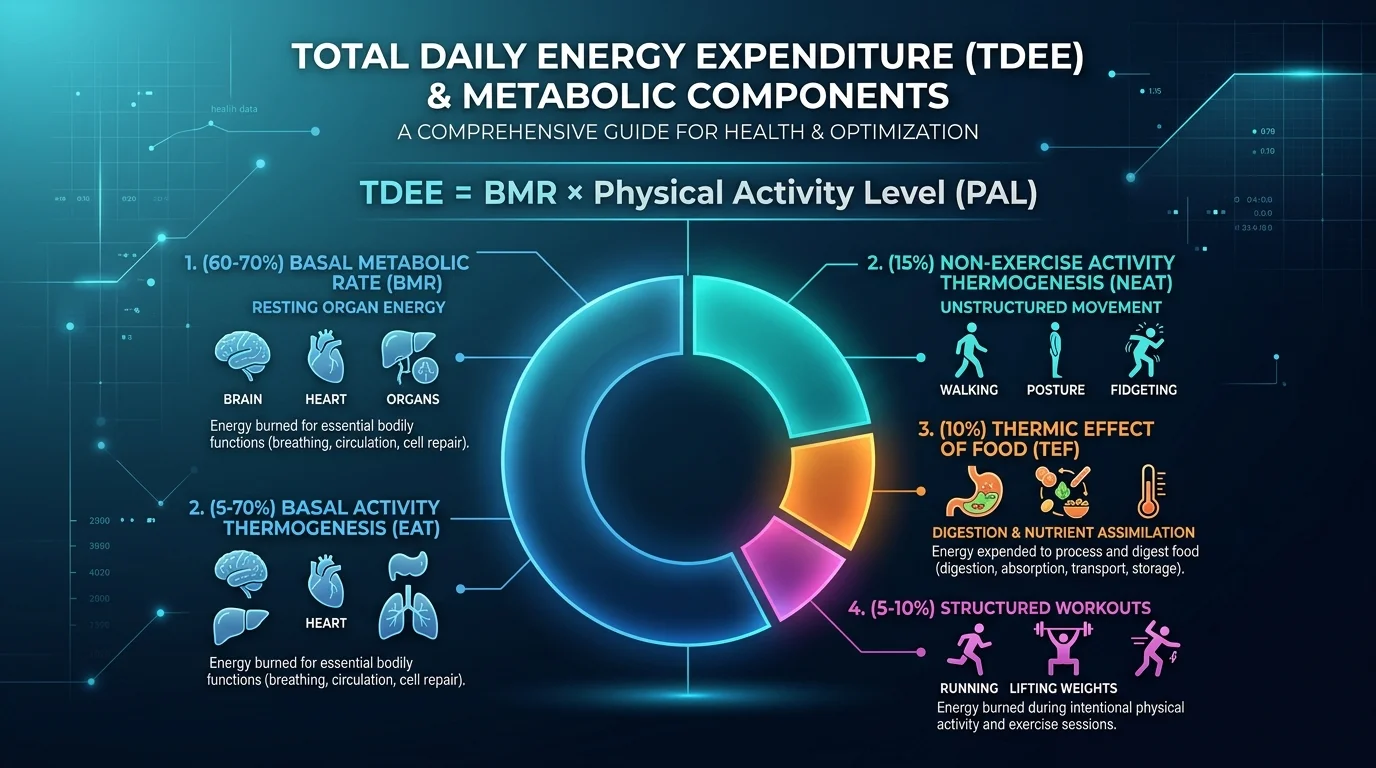
Total Daily Energy Expenditure (TDEE) defines the cumulative energy, measured in kilocalories (kcal), expended by the human body across a 24-hour period. Energy balance governs biological mass regulation: consuming energy equivalent to TDEE preserves stable body composition, whereas consuming below or above this threshold induces tissue catabolism (weight loss) or anabolism (weight gain), respectively.
TDEE is not a static number derived solely from physical exertion. Rather, it represents the dynamic summation of four distinct physiological compartments:
The Four Pillars of Human Metabolism
- Basal Metabolic Rate (BMR, 60–70%): The obligatory baseline energy required to sustain autonomic cellular viability at complete physical, thermal, and digestive rest. Major internal organs account for the vast majority of BMR despite representing a small fraction of body weight: the liver utilizes approximately 27%, the brain 19%, skeletal muscle 18%, kidneys 10%, and the myocardium 7%. Active ion pumping ($\text{Na}^+/\text{K}^+$ ATPase enzymes) and continuous protein synthesis constitute the primary cellular energy drains.
- Non-Exercise Activity Thermogenesis (NEAT, 15%): Energy expended for all movement outside structured exercise, including typing, pacing, domestic tasks, occupational ambulation, and spontaneous postural adjustments. NEAT displays the highest inter-individual variance, differing by up to 800–1,000 kcal/day between sedentary desk workers and active manual laborers.
- Thermic Effect of Food (TEF, 8–10%): The metabolic cost of ingestion, enzymatic digestion, intestinal absorption, and biochemical transport of nutrients. TEF varies substantially across macronutrients: dietary protein demands 20–30% of its energy content for processing, carbohydrates require 5–10%, and dietary lipids demand only 0–3%.
- Exercise Activity Thermogenesis (EAT, 5–10%): The energy consumed during deliberate, structured physical conditioning and cardiovascular exercise. In typical sedentary populations, EAT constitutes the smallest component of total daily expenditure, though high-performance endurance athletes can elevate this compartment markedly.
Validated Mathematical Models: Equation Analysis
Mathematical TDEE calculation proceeds in two sequential phases: estimating Basal Metabolic Rate (BMR), followed by the application of a standardized Physical Activity Level (PAL) coefficient.
Physical Activity Level (PAL) Multipliers
Clinicians quantify daily lifestyle movement using validated PAL coefficients established by the Food and Agriculture Organization (FAO) and World Health Organization (WHO):
- Sedentary ($\text{PAL} = 1.200$): Desk-bound occupation with negligible intentional physical conditioning.
- Lightly Active ($\text{PAL} = 1.375$): Light recreational activity, brisk walking, or structured exercise 1 to 3 days weekly.
- Moderately Active ($\text{PAL} = 1.550$): Moderate exercise sessions 3 to 5 days weekly, or an active standing occupational routine.
- Very Active ($\text{PAL} = 1.725$): High-intensity physical training 6 to 7 days weekly, or rigorous manual labor.
- Extremely Active ($\text{PAL} = 1.900$): Twice-daily athletic training, competitive endurance sports, or heavy industrial physical labor.
1. Mifflin-St Jeor Equation (Clinical Standard)
Formulated in 1990 by Mifflin and St Jeor, this model is recognized by the Academy of Nutrition and Dietetics as the most reliable predictive equation for general and overweight non-athletic cohorts, yielding results within 10% of indirect calorimetry in over 82% of validated subjects:
$$\text{BMR}_{\text{Male}} = (10 \times \text{weight}_{\text{kg}}) + (6.25 \times \text{height}_{\text{cm}}) - (5 \times \text{age}_{\text{years}}) + 5$$
$$\text{BMR}_{\text{Female}} = (10 \times \text{weight}_{\text{kg}}) + (6.25 \times \text{height}_{\text{cm}}) - (5 \times \text{age}_{\text{years}}) - 161$$
2. Katch-McArdle Formula (Body-Composition Specific)
When body fat percentage is accurately measured via hydrostatic weighing, dual-energy X-ray absorptiometry (DEXA), or air displacement plethysmography (BodPod), the Katch-McArdle equation provides enhanced metabolic precision. Because skeletal muscle tissue consumes markedly more resting energy per kilogram than inactive adipose tissue, this model calculates metabolic demand directly from Lean Body Mass (LBM):
$$\text{LBM}_{\text{kg}} = \text{Total Weight}_{\text{kg}} \times \left(1 - \frac{\text{Body Fat } \%}{100}\right)$$
$$\text{BMR} = 370 + (21.6 \times \text{LBM}_{\text{kg}})$$
3. Revised Harris-Benedict Equation
Originally formulated in 1919 and recalibrated by Roza and Shizgal in 1984 to adjust for modernized body mass indexes, this equation remains widely referenced in clinical archives:
$$\text{BMR}_{\text{Male}} = 88.362 + (13.397 \times \text{weight}_{\text{kg}}) + (4.799 \times \text{height}_{\text{cm}}) - (5.677 \times \text{age}_{\text{years}})$$
$$\text{BMR}_{\text{Female}} = 447.593 + (9.247 \times \text{weight}_{\text{kg}}) + (3.098 \times \text{height}_{\text{cm}}) - (4.330 \times \text{age}_{\text{years}})$$
Clinical Case Scenarios: Practical Energy Balance Applications
Case Scenario 1: Moderate Deficit in a Sedentary Male with Cardiometabolic Risk
Patient Presentation: A 44-year-old male corporate executive presents for preventive cardiometabolic assessment. He reports a sedentary desk routine with minimal leisure-time physical activity ($\text{PAL} = 1.200$). Laboratory evaluation reveals borderline fasting hyperglycemia (108 mg/dL) and early stage-1 hypertension.
- Height: 178 cm (5 ft 10 in)
- Weight: 94 kg (207 lbs) — Body Mass Index 29.7 kg/m²
- BMR Calculation (Mifflin-St Jeor): $(10 \times 94) + (6.25 \times 178) - (5 \times 44) + 5 = 940 + 1112.5 - 220 + 5 = 1837.5\text{ kcal/day}$
- Maintenance TDEE: $1837.5 \times 1.200 \approx 2205\text{ kcal/day}$
Clinical Intervention & Rationale: Rather than prescribing an aggressive low-calorie regimen that risks lean muscle loss and rapid compliance failure, the clinician prescribes a moderate deficit of 450 kcal/day (Daily intake target: 1,755 kcal/day). To preserve nitrogen balance and support arterial compliance, dietary protein is set at 1.8 g/kg of target lean mass (145 g/day = 580 kcal). The patient is also encouraged to increase occupational ambulation to elevate NEAT. Long-term cardiovascular risk can be tracked alongside baseline metrics using our Heart Risk Score Calculator and BMI Calculator.
Case Scenario 2: Collegiate Female Endurance Athlete Preventing Energy Deficiency (REDs)
Patient Presentation: A 20-year-old female collegiate cross-country runner presents with persistent fatigue, performance stagnation, and secondary amenorrhea (3 missed cycles). She runs 65 miles weekly and incorporates structured resistance training ($\text{PAL} = 1.900$).
- Height: 167 cm (5 ft 6 in)
- Weight: 54 kg (119 lbs)
- BMR Calculation (Mifflin-St Jeor): $(10 \times 54) + (6.25 \times 167) - (5 \times 20) - 161 = 540 + 1043.75 - 100 - 161 = 1322.75\text{ kcal/day}$
- Maintenance TDEE: $1322.75 \times 1.900 \approx 2513\text{ kcal/day}$
Clinical Intervention & Rationale: Dietary recall indicates she consumes only 1,800 kcal/day, creating a 700 kcal chronic daily deficit. The sports medicine team identifies Relative Energy Deficiency in Sport (REDs). Energy Availability ($EA$) is calculated below the critical physiological threshold of $30\text{ kcal/kg FFM/day}$, suppressing the hypothalamic-pituitary-ovarian axis and bone turnover markers. Her caloric target is restored to full maintenance (2,500–2,600 kcal/day) with carbohydrate prioritization (6–8 g/kg/day = 324–432 g/day) to restore glycogen repletion and ovulatory function. Aerobic conditioning progress can be monitored using our VO2 Max Calculator.
Physiological Factors and Adaptive Thermogenesis
Mathematical calculations assume energy expenditure operates in a closed linear system. In clinical practice, human metabolism is regulated by complex neuroendocrine feedback loops that actively adapt to caloric alterations.
The Biology of Adaptive Thermogenesis
During prolonged hypocaloric dieting, the body invokes evolutionary starvation responses termed adaptive thermogenesis (metabolic adaptation). Measured resting metabolic rate frequently drops by 100 to 300 kcal/day below what is mathematically expected from lost adipose and lean tissue mass alone. This adaptation is mediated by several concurrent hormonal shifts:
- Thyroid Hormone Downregulation: Prolonged caloric restriction suppresses hepatic deiodinase activity, diminishing the peripheral conversion of thyroxine ($\text{T}_4$) to active triiodothyronine ($\text{T}_3$), reducing basal cellular respiration rate.
- Leptin Collapse & Ghrelin Surge: As adipocytes empty of triglycerides, circulating leptin levels drop precipitously. This blunts satiety signaling in the hypothalamic arcuate nucleus, while gastric ghrelin secretion increases, driving intense appetite.
- Spontaneous NEAT Reduction: Subconsciously, the central nervous system suppresses fidgeting, postural muscle tone, and spontaneous daily movement to conserve fuel reserves.
- Mitochondrial Coupling Efficiency: Mitochondrial uncoupling protein-1 (UCP-1) downregulates, making ATP production more biochemically efficient and reducing heat dissipation per gram of oxidized fuel.
Endocrine & Clinical Pathologies Affecting TDEE
Certain pathological conditions disrupt standardized TDEE calculations, requiring clinical laboratory investigation and tailored medical management:
- Overt or Subclinical Hypothyroidism: Insufficient circulating free $\text{T}_3/\text{T}_4$ slows mitochondrial turnover and reduces resting energy expenditure by 10% to 25%.
- Polycystic Ovary Syndrome (PCOS): Hyperinsulinemia and peripheral insulin resistance frequently alter basal metabolic rates, requiring tighter macronutrient balance and structured resistance training.
- Age-Related Sarcopenia: Natural age-related loss of skeletal muscle mass reduces BMR by approximately 2% to 3% per decade after age 30, unless counteracted by progressive resistance exercise and adequate protein pacing.
Macronutrient Distribution Strategies for Energy Balance
Once your total caloric target is established—whether for maintenance, deficit, or surplus—dividing energy across specific macronutrients directly impacts body composition, satiety, and athletic recovery.
| Macronutrient | Energy Density | Clinical Deficit Intake | Primary Physiological Role |
|---|---|---|---|
| Protein | 4 kcal/g | 1.6 – 2.2 g/kg (0.73 – 1.0 g/lb) | Muscle protein synthesis, nitrogen retention, TEF enhancement, satiety stimulation (GLP-1 & PYY). |
| Dietary Fats | 9 kcal/g | 0.6 – 1.0 g/kg (20–30% of total cals) | Steroidogenesis (testosterone, estrogen), fat-soluble vitamin absorption (A, D, E, K), cellular membrane stability. |
| Carbohydrates | 4 kcal/g | Remaining caloric balance | Intramuscular glycogen replenishment, central nervous system fuel, thyroid ($\text{T}_3$) axis maintenance. |
Frequently Asked Questions
What is Total Daily Energy Expenditure (TDEE)?
Which TDEE formula is the most clinically accurate?
How does adaptive thermogenesis affect weight loss calculations?
What is a safe and sustainable daily calorie deficit?
Why does calculated TDEE differ from commercial fitness trackers?
How much protein should be consumed during a caloric deficit?
How often should TDEE be recalculated?
Peer-Reviewed Clinical References
- Mifflin MD, St Jeor ST, Hill LA, Scott BJ, Daugherty SA, Koh YO. (1990). A new predictive equation for resting energy expenditure in healthy individuals. The American Journal of Clinical Nutrition, 51(2), 241–247.
- Hall KD, Heymsfield SB, Kemnitz JW, Klein S, Schoeller DA, Speakman JR. (2012). Energy balance and its components: implications for body weight regulation. The American Journal of Clinical Nutrition, 95(4), 989–994.
- Mountjoy M, Sundgot-Borgen JK, Burke LM, et al. (2018). IOC consensus statement on relative energy deficiency in sport (RED-S): 2018 update. British Journal of Sports Medicine, 52(11), 687–697.
- Trexler ET, Smith-Ryan AE, Norton LE. (2014). Metabolic adaptation to weight loss: implications for the athlete. Journal of the International Society of Sports Nutrition, 11(1), 7.
- Roza AM, Shizgal HM. (1984). The Harris Benedict equation reevaluated: resting energy requirements and the body cell mass. The American Journal of Clinical Nutrition, 40(1), 168–182.