mg to mL Calculator:
Convert Medicine
Doses Instantly
Whether you need to convert a prescription dose, calculate how many ml in a mg of liquid medication, or work out a weight-based pediatric dose — this is the most complete free mg to mL calculator available. Supports medication concentration, liquid density, and mg/kg weight-based dosing. Fully bidirectional: mg → mL and mL → mg.
Most calculators only handle water or a single formula. Ours gives you 3 modes: medication concentration (with 20+ drug presets), liquid density, and weight-based dosing (mg/kg). Plus a syringe visualisation, equivalent measurements in tsp/tbsp/fl oz, and full bidirectional conversion — all free, no sign-up.
This calculator is for educational and informational purposes only. Always verify the concentration on your specific medication label before administering any dose. Medication errors can be life-threatening. When in doubt, consult your pharmacist or prescribing physician. Do not use this tool as a substitute for professional clinical judgment.
mg ↔ mL Calculator
USP Formula💡 Find the concentration on your medication label, e.g. "250 mg/5 mL" = 50 mg/mL. Divide label mg by label mL to get mg/mL.
Enter milligrams (mg)
Always verify against your organization's dosing guidelines. Maximum dose limits are not checked by this tool.
Always confirm the concentration on your specific product label before use. The same drug may come in multiple concentrations. This tool does not check for maximum safe doses, drug interactions, or patient-specific contraindications.
mg to mL Quick Reference Table (Water / 1000 mg/mL)
The table below shows how many ml in a mg of pure water — the baseline for understanding the conversion. Because water has a density of 1 g/mL (1,000 mg/mL), dividing any mg value by 1,000 gives you the equivalent volume in mL. For medications, you must use the drug-specific concentration from your label instead.
| Milligrams (mg) | mL (Water) | Teaspoons (tsp) | Common Use |
|---|---|---|---|
| 1 mg | 0.001 mL | 0.0002 tsp | Very small dose (e.g. some hormones) |
| 5 mg | 0.005 mL | 0.001 tsp | Low-dose medication |
| 50 mg | 0.05 mL | 0.01 tsp | Paediatric single dose |
| 100 mg | 0.1 mL | 0.02 tsp | Common OTC dose |
| 250 mg | 0.25 mL | 0.05 tsp | Antibiotic single dose |
| 500 mg | 0.5 mL | 0.1 tsp | Standard adult dose |
| 1,000 mg (1 g) | 1 mL | 0.2 tsp | High-dose adult medication |
| 2,500 mg | 2.5 mL | 0.5 tsp | ½ teaspoon equivalent |
| 5,000 mg (5 g) | 5 mL | 1 tsp | One teaspoon of water |
| 15,000 mg | 15 mL | 3 tsp / 1 tbsp | One tablespoon of water |
Important: The table above applies to pure water only. For any medication, the conversion depends entirely on the concentration printed on the label. A 500 mg dose of amoxicillin suspension at 250 mg/5 mL (50 mg/mL) equals 10 mL — not 0.5 mL. Never use the water formula for medicines.
Common Medication mg to mL Reference Table
The following table shows how to calculate mg to mL for the most frequently dispensed liquid medications in the United States. These concentrations reflect standard commercial formulations — always check your specific product label, as concentrations can vary by manufacturer and formulation strength.
| Medication | Label Concentration | mg/mL | Example: 250 mg dose |
|---|---|---|---|
| Acetaminophen (Tylenol) Oral | 160 mg / 5 mL | 32 mg/mL | 7.8 mL |
| Acetaminophen Drops | 80 mg / 0.8 mL | 100 mg/mL | 2.5 mL |
| Ibuprofen (Advil) Oral | 100 mg / 5 mL | 20 mg/mL | 12.5 mL |
| Ibuprofen Drops | 50 mg / 1.25 mL | 40 mg/mL | 6.25 mL |
| Amoxicillin Suspension | 250 mg / 5 mL | 50 mg/mL | 5 mL |
| Amoxicillin Suspension (strong) | 400 mg / 5 mL | 80 mg/mL | 3.1 mL |
| Azithromycin Suspension | 200 mg / 5 mL | 40 mg/mL | 6.25 mL |
| Diphenhydramine (Benadryl) Oral | 12.5 mg / 5 mL | 2.5 mg/mL | 100 mL |
| Cetirizine (Zyrtec) Oral | 5 mg / 5 mL | 1 mg/mL | 250 mL |
| Morphine Sulfate Oral | 20 mg / mL | 20 mg/mL | 12.5 mL |
| Dexamethasone Injection | 4 mg / mL | 4 mg/mL | 62.5 mL |
| Furosemide Injection | 10 mg / mL | 10 mg/mL | 25 mL |
| Metformin Oral Solution | 500 mg / 5 mL | 100 mg/mL | 2.5 mL |
Source: Standard US commercial formulations. Concentrations may vary. Always verify on your specific product label before administration.
How to Calculate mg to mL: The Formula Explained
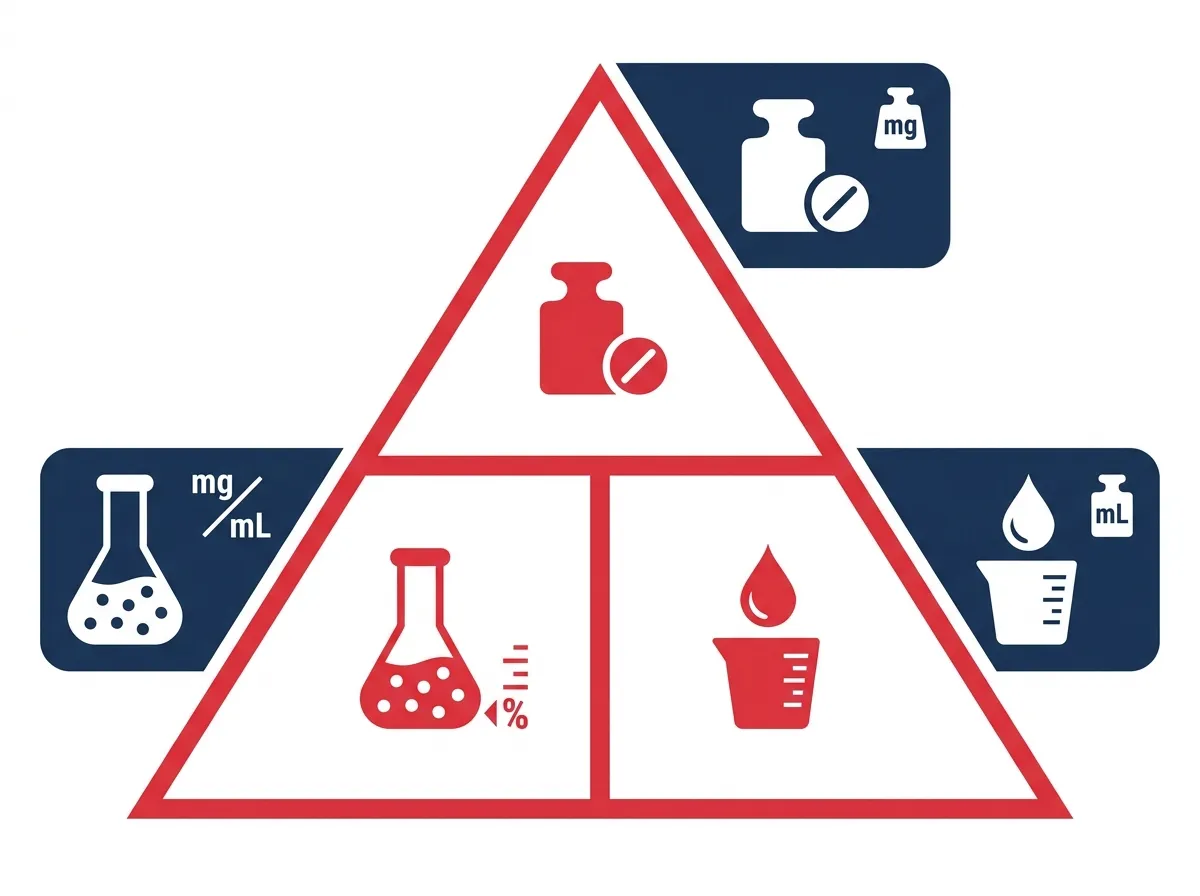
The mg to mL calculation involves two fundamentally different types of measurement — mass (mg) and volume (mL) — which means you always need a third piece of information to bridge them: either the medication concentration (for drugs) or the liquid density (for plain liquids).
For Medications: Using Concentration
When a doctor prescribes a dose in milligrams and the medicine is a liquid, the label will show the concentration in mg per mL (or mg per given volume such as mg/5 mL). To find how many mL to give, use the standard pharmaceutical dose calculation formula — the same formula used by nurses, pharmacists, and the United States Pharmacopeia (USP General Chapter 1160):
For Plain Liquids: Using Density
When you need to convert the mass of a plain liquid (not a medication) to a volume, the conversion factor is the liquid's density. Water has a density of 1 g/mL, which is exactly 1,000 mg/mL. This is where the common (but often misunderstood) claim that "1 mL = 1 gram" comes from — it only applies to water at standard temperature and pressure.
How to Calculate Dosage Concentration from Percentage to mg/mL
Medication labels sometimes express concentration as a percentage (e.g. "2% solution" or "0.9% w/v"). Converting percentage concentration to mg/mL is straightforward:
Weight-Based Dosing: mg/kg to mL
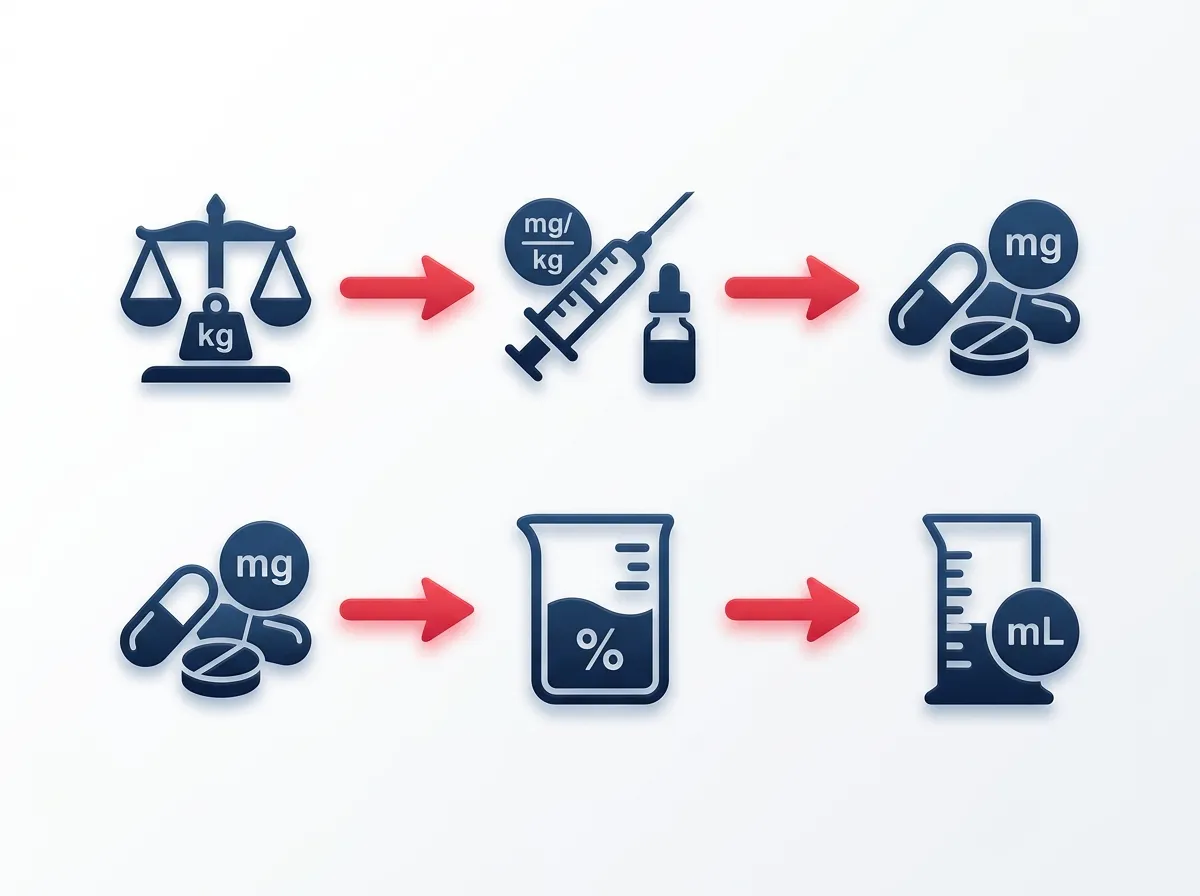
Pediatric prescriptions and many critical care medications are ordered using a weight-based dose — typically expressed in mg per kilogram of patient body weight (mg/kg). Calculating from a weight-based order to a volume in mL requires two steps:
Practical Tips for Safe mg to mL Conversions
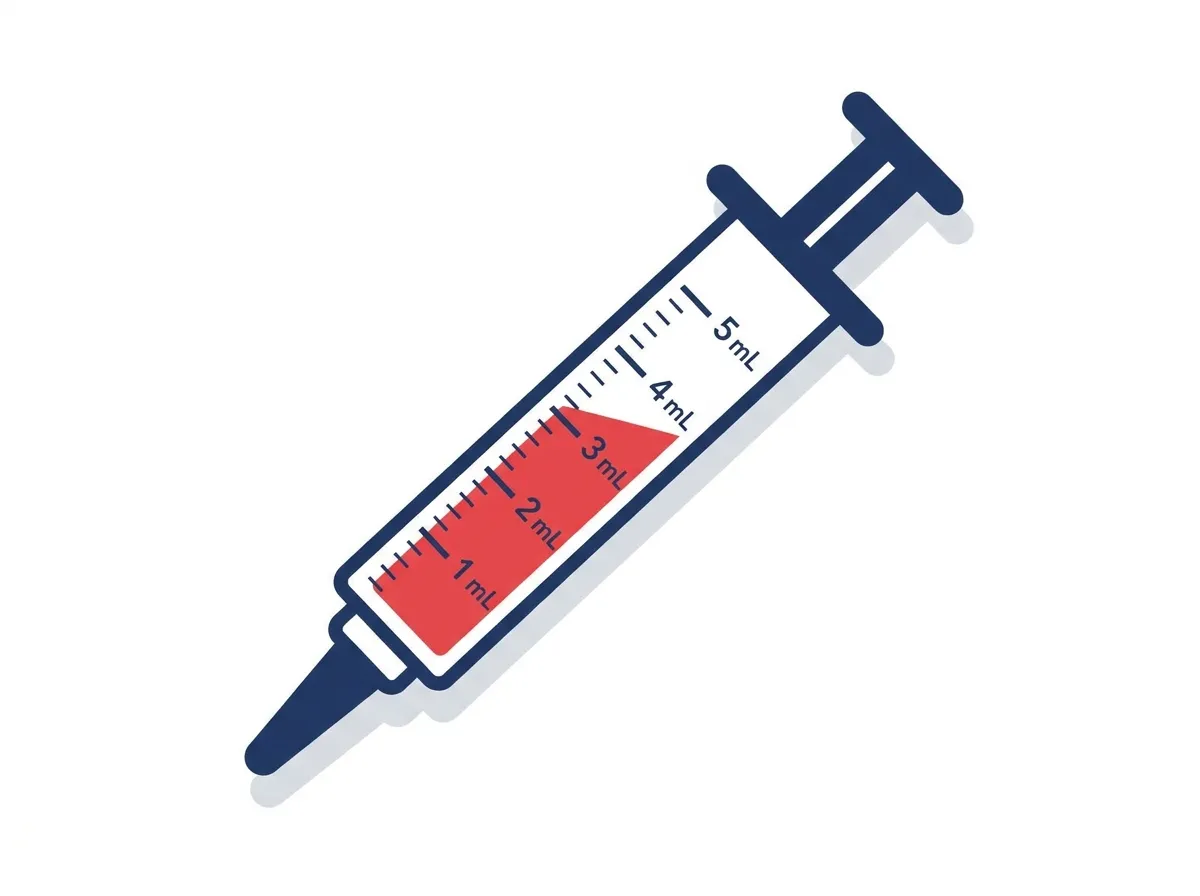
Medication dosing errors are among the most common preventable adverse events in healthcare. The following practical principles help reduce the risk of calculation mistakes when converting between milligrams and milliliters for liquid medications.
Never assume the concentration. The same medication — ibuprofen, amoxicillin, acetaminophen — is sold in multiple concentrations. Infant drops are often 2–4× more concentrated than children's liquid formulations. A dosing error from using the wrong concentration can be dangerous, especially for infants.
Many labels show concentration as "X mg per 5 mL" rather than mg/mL directly. Always convert this first: divide the mg figure by the mL figure. For example, 400 mg/5 mL = 80 mg/mL. Then divide your prescribed dose by this number to get your volume.
For volumes under 5 mL, household teaspoons and tablespoons are not reliable — they can hold 3–7 mL, creating significant dose variation. Use a calibrated oral syringe (available free at most pharmacies) for any volume under 5 mL, especially for paediatric doses.
In clinical settings, the standard practice for high-alert medications is independent double-checking — two healthcare professionals each calculate the dose independently, then compare results before administration. For home use, always have a second person verify the calculation for any medication given to infants or elderly patients.
Common Liquid Densities for mg to mL Conversion
When converting mg to mL for plain liquids — not medications — you need the density of the specific liquid. Here is a reference table for common household and clinical liquids at room temperature (approximately 20°C). Note that density changes slightly with temperature.
| Liquid | Density (g/mL) | Density (mg/mL) | 1,000 mg equals |
|---|---|---|---|
| Water (20°C) | 0.998 g/mL | 998 mg/mL | ~1.002 mL |
| Normal Saline (0.9%) | 1.005 g/mL | 1,005 mg/mL | ~0.995 mL |
| Whole Milk | 1.030 g/mL | 1,030 mg/mL | ~0.971 mL |
| Skim Milk | 1.035 g/mL | 1,035 mg/mL | ~0.966 mL |
| Ethanol / Alcohol | 0.789 g/mL | 789 mg/mL | ~1.267 mL |
| Olive Oil | 0.910 g/mL | 910 mg/mL | ~1.099 mL |
| Glycerin | 1.261 g/mL | 1,261 mg/mL | ~0.793 mL |
| Honey | 1.430 g/mL | 1,430 mg/mL | ~0.699 mL |