What Is FENa?
FENa means fractional excretion of sodium. It estimates the percentage of filtered sodium that appears in the urine rather than being reabsorbed by the renal tubules. The calculation compares sodium clearance with creatinine clearance, which corrects the urine sodium concentration for how concentrated or dilute the urine sample is.
Clinicians may review FENa during an acute rise in creatinine or low urine output to add context to renal sodium handling. In a sodium-avid state, the kidneys retain more sodium and FENa tends to be low. When tubular sodium reabsorption is impaired, FENa may be higher. Neither pattern identifies a cause by itself.
FENa is not an AKI severity score, eGFR, or direct measurement of kidney perfusion. The GFR Calculator estimates filtration and answers a different question.
FENa Calculation Formula
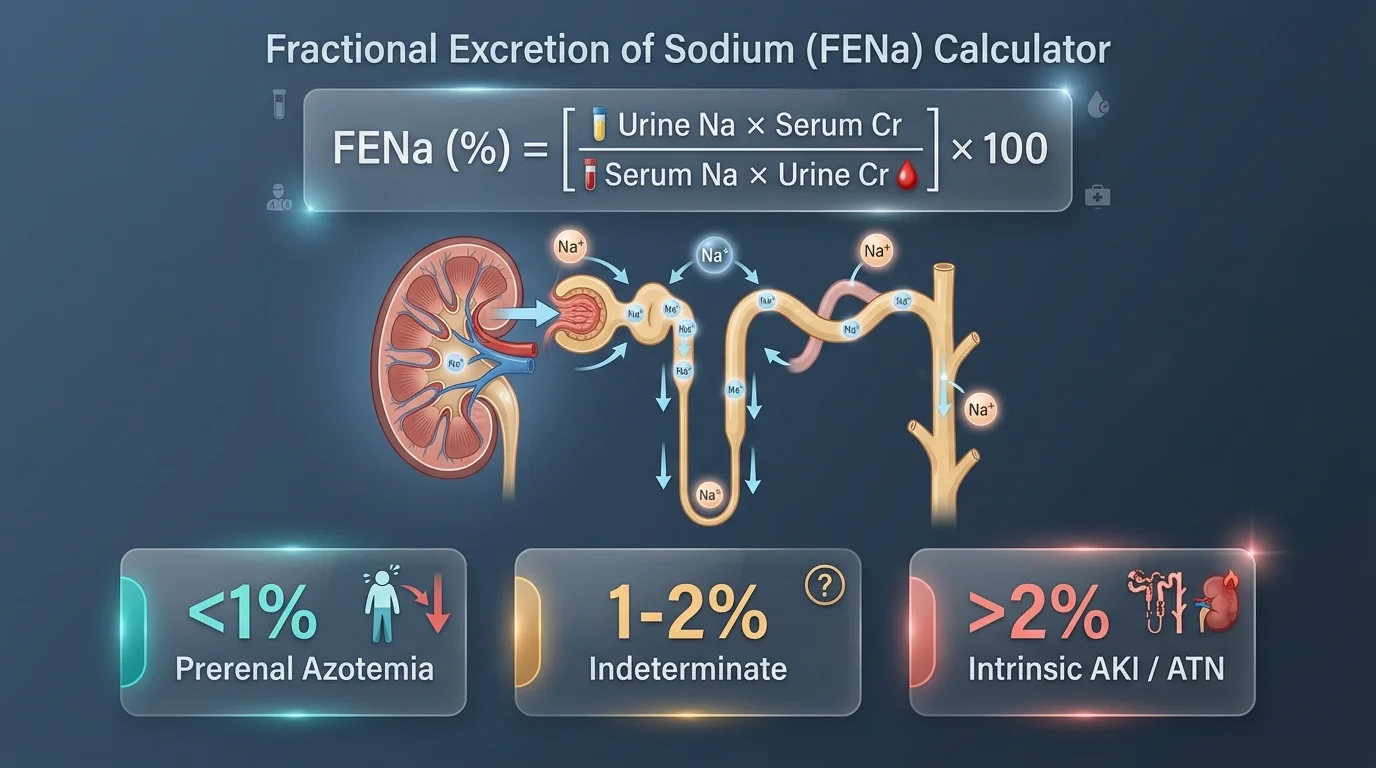
- UNa: urine sodium concentration.
- SNa: serum or plasma sodium concentration.
- UCr: urine creatinine concentration.
- SCr: serum or plasma creatinine concentration.
How to Calculate FENa
- 1
Obtain paired samples
Use a spot urine sodium and creatinine with serum sodium and creatinine collected at approximately the same time.
- 2
Check interventions and timing
Record recent diuretics, IV fluids, changing hemodynamics, and any delay between the blood and urine specimens.
- 3
Match the units
Keep both sodium values in mmol/L or mEq/L and both creatinine values in mg/dL or µmol/L.
- 4
Multiply the numerator
Multiply urine sodium by serum creatinine.
- 5
Multiply the denominator
Multiply serum sodium by urine creatinine.
- 6
Divide and multiply by 100
The resulting percentage is the fractional excretion of sodium.
FENa Calculation Examples
UNa 10, SNa 140, SCr 2.0, UCr 80
(10 × 2.0) ÷ (140 × 80) × 100 = 0.18%The value is below 1%. In a properly selected oliguric patient without major confounders, this can support a sodium-retaining pattern—but it cannot prove volume depletion.
UNa 100, SNa 140, SCr 2.0, UCr 60
(100 × 2.0) ÷ (140 × 60) × 100 = 2.38%The result is above 2% and enters the higher teaching band. Diuretics, CKD, sample timing, and the complete acute kidney injury evaluation still determine how much weight it deserves.
Clinical Case Scenarios & Decision Pathways
The following real-world clinical presentations illustrate how healthcare professionals interpret FENa alongside history, physical exam findings, and medication exposure:
Dehydration in an Elderly Patient
Patient Presentation: A 74-year-old female presents with a 3-day history of poor oral intake, intractable diarrhea, orthostatic hypotension, and an abrupt drop in urine output.
Laboratory Findings: Serum Na 142 mmol/L, Serum Cr 2.4 mg/dL; Spot Urine Na 8 mmol/L, Urine Cr 95 mg/dL. No recent diuretic therapy.
FENa = (8 × 2.4) ÷ (142 × 95) × 100 = 0.14%
Clinical Interpretation: The FENa is 0.14% (<1%), indicating intact, avid renal tubular sodium reabsorption driven by neurohormonal activation (RAAS) to defend circulating plasma volume. Following isotonic fluid administration, the creatinine trend and hourly urine output improve promptly.
Ischemic Acute Tubular Necrosis
Patient Presentation: A 68-year-old male develops worsening oliguria and rising serum creatinine 48 hours following complex abdominal aortic aneurysm repair with significant intraoperative hypotension.
Laboratory Findings: Serum Na 137 mmol/L, Serum Cr 3.2 mg/dL; Spot Urine Na 65 mmol/L, Urine Cr 42 mg/dL. The patient has received no diuretics.
FENa = (65 × 3.2) ÷ (137 × 42) × 100 = 3.60%
Clinical Interpretation: A FENa of 3.60% (>2%) reflects tubular epithelial dysfunction with failure of normal sodium reabsorption. The management pathway emphasizes avoidance of fluid overload, discontinuation of nephrotoxic medications, and renal monitoring rather than repeated volume challenges.
FENa Interpretation
Traditionally supports sodium retention or prerenal physiology in the right context.
Overlap zone; does not reliably separate prerenal from intrinsic processes.
May support impaired tubular sodium reabsorption or an intrinsic tubular process.
These bands are teaching patterns, not diagnostic labels. The original 1976 report studied patients in the oliguric phase of acute renal failure and found values below 1% in prerenal azotemia and above 3% in acute tubular necrosis. Modern bedside teaching often uses below 1%, 1–2%, and above 2% bands, but broader populations produce substantial overlap.
A 2022 systematic review found FENa performed best in oliguric patients without chronic kidney disease or diuretic exposure. Diagnostic performance fell when CKD or diuretics were present. That population dependence is why this calculator changes its warning rather than turning the percentage into a diagnosis.
What Does FENa Below 1% Mean?
A value below 1% indicates that a relatively small fraction of filtered sodium is being excreted. In classic prerenal physiology, reduced effective perfusion activates sodium-retaining mechanisms while tubular reabsorption remains intact. Volume loss is one possible setting, but a low value is not synonymous with dehydration.
- Prerenal physiology: fluid loss, hypotension, or reduced effective circulating volume may produce a low result.
- Heart or liver disease: heart failure, cirrhosis, and hepatorenal physiology can remain sodium avid without simple whole-body dehydration.
- Intrinsic processes with low FENa: acute glomerulonephritis, pigment nephropathy, contrast-associated states, early obstruction, transplant-related processes, and some acute tubular injury can show values below 1%.
- Sepsis: urinary sodium indices can be low even when the physiology is not a straightforward volume-responsive prerenal state.
What Does FENa Above 2% Mean?
A value above 2% indicates greater fractional sodium excretion. In classic teaching, this can support impaired tubular sodium reabsorption, including acute tubular injury. The result does not prove acute tubular necrosis and cannot identify whether the process is renal, medication related, chronic, or evolving.
- Diuretics: loop and thiazide agents deliberately increase urine sodium and can elevate FENa.
- Chronic kidney disease: altered nephron adaptation can reduce the specificity of classic cutoffs.
- Non-oliguric AKI: the index performs less consistently outside the original oliguric setting.
- Changing treatment: fluids, hemodynamics, and medication timing can change serum and urine values between samples.
What If the Patient Received Diuretics?
Loop diuretics (such as furosemide or bumetanide) inhibit the Na⁺-K⁺-2Cl⁻ cotransporter in the thick ascending limb of Henle, while thiazides block sodium-chloride cotransport in the distal convoluted tubule. By directly impairing renal tubular sodium reabsorption, these medications artificially elevate urinary sodium excretion, causing FENa to rise above 2% even when severe prerenal hypoperfusion exists.
When diuretic exposure confounds sodium handling, clinicians evaluate the Fractional Excretion of Urea (FEUrea) Calculator. Because urea reabsorption occurs primarily through passive and facilitated transport in the proximal tubule and collecting duct, FEUrea is substantially less affected by loop-acting diuretics. However, clinical judgment, hemodynamic status, and urinalysis remain essential components of the diagnostic evaluation.
Which Laboratory Values Are Needed?
Serum sodium and creatinine
These may come from a metabolic panel or renal chemistry panel collected near the urine sample time.
Spot urine sodium and creatinine
A timed 24-hour collection is not required for the standard fractional-excretion calculation.
Do not use a serum creatinine from one clinical state and urine measurements from another. A fluid bolus, diuretic dose, changing blood pressure, obstruction relief, or several hours of delay can make the values less physiologically comparable.
Urine volume is not part of the FENa equation. If the measured rate also needs standardization by weight and time, use the Urine Output Calculator separately.
FENa vs Renal Failure Index
The renal failure index (RFI) uses urine sodium multiplied by serum creatinine and divided by urine creatinine. FENa then divides that relationship by serum sodium and expresses the answer as a percentage. Both arise from the same paired chemistry data, so they are not independent confirmations.
Normalizes to serum sodium
FENa = RFI ÷ serum sodium × 100.
Related urinary index
RFI = urine sodium × serum creatinine ÷ urine creatinine.
The calculator reports RFI as transparent arithmetic, not as a second diagnosis. Modern interpretation should prioritize the full clinical picture over stacking related cutoffs.
FENa Is Not Total Sodium Excretion
A 24-hour urine sodium result estimates the amount of sodium excreted over a day. FENa is different: it expresses urine sodium relative to the filtered sodium load by comparing sodium and creatinine clearances. It can be calculated from paired spot samples and does not report dietary sodium intake or milligrams of sodium lost per day.
FENa is also different from the serum BUN-to-creatinine relationship. The BUN Creatinine Ratio Calculator uses two blood measurements and has its own limitations.
Important FENa Limitations and Common Errors
- Calling a low result dehydration: sodium retention occurs in several non-volume-depleted states.
- Calling a high result ATN: diuretics and CKD can raise FENa without proving tubular necrosis.
- Mixing creatinine units: serum mg/dL cannot be divided against urine µmol/L without conversion.
- Using mismatched samples: serum and urine should represent approximately the same clinical moment.
- Ignoring interventions: IV fluids, diuretics, vasopressors, and obstruction relief can alter the index.
- Applying it as a CKD screen: FENa was developed for selected acute diagnostic contexts.
- Ignoring urine sediment: microscopy, urinalysis, and the complete workup may provide more direct clues.
- Treating a calculated percentage as treatment advice: FENa does not prescribe fluids, diuretics, dialysis, imaging, or medication changes.
When Kidney Symptoms Need Urgent Assessment
Seek prompt medical evaluation for markedly reduced or absent urine, rapidly rising creatinine, new swelling, vomiting or diarrhea with weakness, blood in urine, flank pain, difficulty passing urine, confusion, or a sudden change during serious illness.
FENa Calculator FAQs
How do you calculate FENa?
Multiply urine sodium by serum creatinine, divide by serum sodium multiplied by urine creatinine, and multiply by 100. Sodium values must use matching concentration units (mmol/L or mEq/L), creatinine values must use matching units (mg/dL or µmol/L), and the urine and serum specimens must be drawn at approximately the same time.
What does a FENa below 1% mean?
A FENa below 1% indicates a sodium-retaining pattern that characteristically supports prerenal physiology in oliguric acute kidney injury. It indicates preserved tubular integrity conserving sodium in response to decreased renal perfusion, though it does not exclude early obstruction, acute glomerulonephritis, or hepatorenal syndrome.
What does a FENa above 2% mean?
A FENa above 2% indicates impaired tubular sodium reabsorption and classically supports intrinsic acute kidney injury, such as acute tubular necrosis (ATN). However, recent diuretic use, chronic kidney disease, and osmotic diuresis also elevate FENa.
Can FENa be used in patients taking diuretics?
Loop and thiazide diuretics inhibit tubular sodium reabsorption, falsely elevating FENa and rendering classic diagnostic cutoffs unreliable. In diuretic-exposed patients, clinicians frequently assess Fractional Excretion of Urea (FEUrea) as an alternative index.
What is the difference between FENa and FEUrea?
FENa evaluates sodium handling, which is directly altered by loop and thiazide diuretics. FEUrea measures urea clearance, which occurs primarily in the proximal tubule and collecting duct, making it less confounded by diuretics that act on the loop of Henle or distal tubule.
Why must urine and serum samples be collected at approximately the same time?
Renal hemodynamics, hydration, and medication concentrations fluctuate rapidly in acute illness. Mismatched specimen timing introduces significant kinetic error, distorting the mathematical clearance relationship.
Is FENa reliable in patients with chronic kidney disease (CKD)?
In chronic kidney disease, surviving nephrons undergo compensatory solute diuresis, chronically elevating baseline FENa. Consequently, a FENa above 1% or 2% cannot be assumed to represent de novo acute tubular necrosis in pre-existing CKD.
Evidence and Editorial Notes
The equation, historical bands, diagnostic-performance statements, and limitations were checked against the original FENa report and later systematic evidence.
- Espinel CH. The FENa test: use in the differential diagnosis of acute renal failure. JAMA. 1976.
- Abdelhafez M, et al. Diagnostic Performance of Fractional Excretion of Sodium for the Differential Diagnosis of Acute Kidney Injury: A Systematic Review and Meta-Analysis. Clin J Am Soc Nephrol. 2022.
- Abdelhafez MO, et al. Utility of fractional excretion of urea in acute kidney injury with comparison to fractional excretion of sodium. Am J Med Sci. 2024.
- Zarich S, Fang LS, Diamond JR. Fractional excretion of sodium: exceptions to its diagnostic value. Arch Intern Med. 1985.
Last formula and source review: August 12, 2026. Calculations run in your browser; values entered in this form are not sent to our server.