What Is the CHA₂DS₂-VASc Score?
The CHA₂DS₂-VASc score is the international gold standard clinical prediction rule used to estimate the annual risk of ischemic stroke and systemic thromboembolism in adult patients diagnosed with non-valvular atrial fibrillation (AFib) or atrial flutter. Developed by Professor Gregory Y.H. Lip and colleagues in 2010, the score directly informs one of the most critical decisions in cardiology: whether a patient requires lifelong oral anticoagulation (OAC) therapy.
In non-valvular atrial fibrillation, erratic electrical activity prevents organized mechanical atrial contraction. Blood stagnates in the left atrium—predominantly within the left atrial appendage (LAA)—facilitating thrombus formation. If an LAA thrombus dislodges, it enters systemic arterial circulation, frequently embolizing into the cerebral vasculature and causing severe, debilitating cardioembolic stroke.
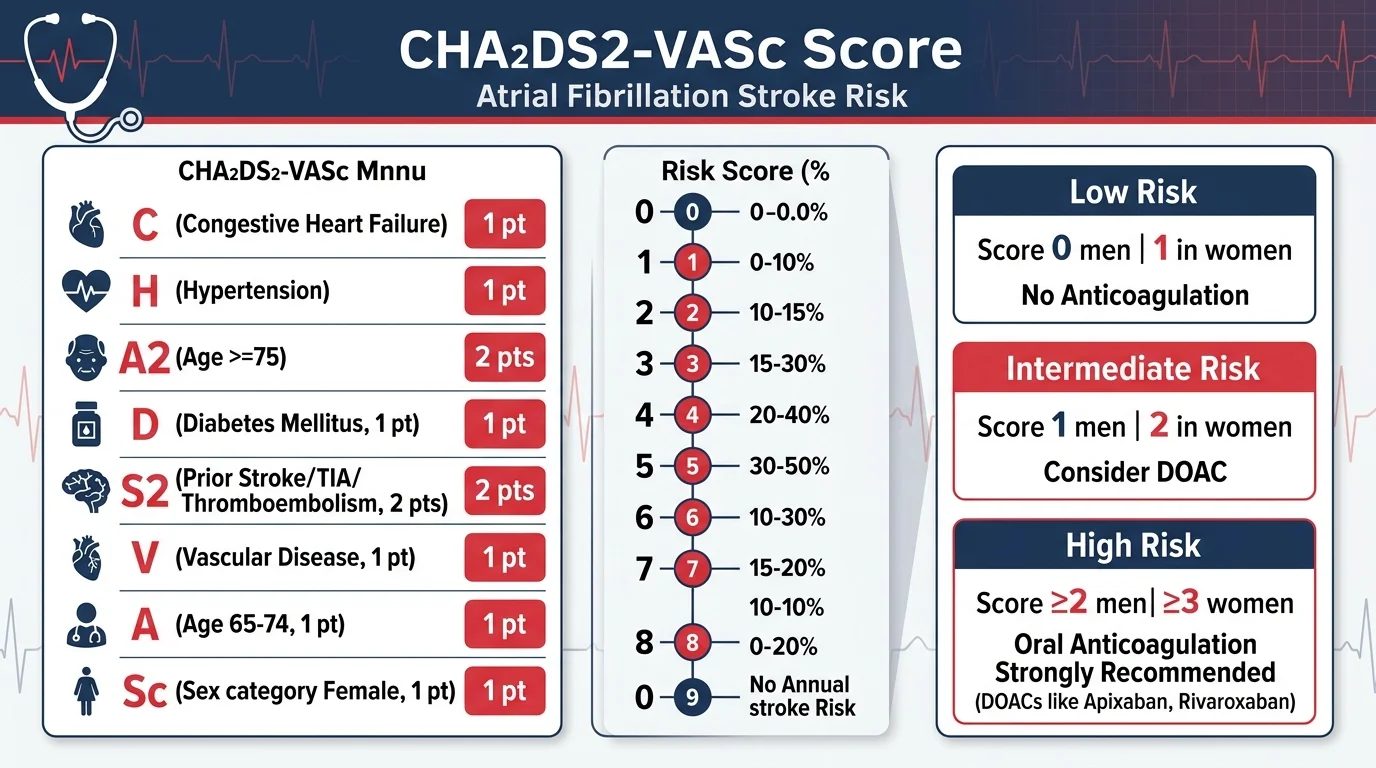
The CHA₂DS₂-VASc scoring model refines thromboembolic risk assessment by assigning weighted point values to eight clinical risk factors, producing a total score ranging from 0 to 9 points.
CHA₂DS₂-VASc Criteria & Point Breakdown
The mnemonic CHA₂DS₂-VASc details the exact clinical criteria and point values used in modern cardiovascular practice:
| Letter | Clinical Risk Factor | Diagnostic Definition | Points |
|---|---|---|---|
| C | Congestive Heart Failure | Signs or symptoms of clinical heart failure, or objective imaging confirmation of left ventricular ejection fraction (LVEF) ≤ 40%. | +1 |
| H | Hypertension | Resting systolic BP > 140 mmHg or diastolic BP > 90 mmHg on at least two separate occasions, or current treatment with antihypertensive medications. | +1 |
| A₂ | Age ≥ 75 Years | Patient age of 75 years or older at the time of evaluation (carries double weight due to profound age-dependent thromboembolic risk). | +2 |
| D | Diabetes Mellitus | Fasting plasma glucose > 125 mg/dL (7.0 mmol/L), HbA1c ≥ 6.5%, or active treatment with insulin or oral hypoglycemic agents. | +1 |
| S₂ | Prior Stroke / TIA / TE | History of ischemic stroke, transient ischemic attack (TIA), or systemic thromboembolism (the strongest independent predictor of recurrent stroke). | +2 |
| V | Vascular Disease | Documented prior myocardial infarction (MI), peripheral artery disease (PAD, e.g., intermittent claudication, prior revascularization), or complex aortic plaque. | +1 |
| A | Age 65–74 Years | Patient age between 65 and 74 years inclusive. (Note: Age categories are mutually exclusive; patients receive either 0, 1, or 2 points for age). | +1 |
| Sc | Sex Category (Female) | Female biological sex. (Important: Female sex acts as a risk modifier rather than an independent risk factor in isolation; see clinical nuances below). | +1 |
When assessing patients presenting with palpitations, chest discomfort, or suspected cardiac ischemia, clinicians frequently calculate short-term major adverse cardiac event probability via the HEART Score for Chest Pain and check baseline repolarization intervals on ECG using the QTc Calculator.
Annual Ischemic Stroke Rates by Score
The table below summarizes the original validation cohort data (Lip et al., Chest 2010) alongside contemporary registry data reflecting adjusted annual ischemic stroke rates without anticoagulation:
| CHA₂DS₂-VASc Score | Adjusted Stroke Rate (% / year) | Risk Category | ACC/AHA & ESC Recommendation |
|---|---|---|---|
| 0 (Men) / 1 (Women) | 0.0% – 0.2% | Low Risk | No oral anticoagulation recommended. Aspirin not recommended. |
| 1 (Men) / 2 (Women) | 0.6% – 1.3% | Intermediate Risk | Oral anticoagulation (prefer DOAC) may be considered. |
| 2 (Men) / 3 (Women) | 1.6% – 2.2% | High Risk | Oral anticoagulation STRONGLY RECOMMENDED (Class I, Level A). |
| 3 (Men) / 4 (Women) | 3.2% – 3.5% | High Risk | Oral anticoagulation STRONGLY RECOMMENDED. |
| 4 | 4.0% – 4.8% | High Risk | Oral anticoagulation STRONGLY RECOMMENDED. |
| 5 | 6.7% – 7.2% | Very High Risk | Oral anticoagulation STRONGLY RECOMMENDED. |
| 6 | 9.7% – 10.0% | Very High Risk | Oral anticoagulation STRONGLY RECOMMENDED. |
| 7 | 10.5% – 11.2% | Extreme Risk | Oral anticoagulation STRONGLY RECOMMENDED. |
| 8 | 12.0% – 12.5% | Extreme Risk | Oral anticoagulation STRONGLY RECOMMENDED. |
| 9 | 15.2% – 18.0% | Maximum Risk | Oral anticoagulation STRONGLY RECOMMENDED. |
For patients requiring aggressive fluid resuscitation or hemodynamic monitoring alongside antiarrhythmic therapy, clinicians assess tissue perfusion via the Mean Arterial Pressure Calculator and Cardiac Output Calculator.
CHADS₂ vs. CHA₂DS₂-VASc: What Changed?
Prior to 2010, the original CHADS₂ score (Congestive HF, Hypertension, Age ≥75, Diabetes, Stroke [2 pts]) was widely utilized. However, clinical registries demonstrated significant limitations in CHADS₂:
| Clinical Feature | Legacy CHADS₂ Score | Modern CHA₂DS₂-VASc Score | Clinical Advantage |
|---|---|---|---|
| Score Range | 0 to 6 points | 0 to 9 points | Greater risk discrimination across intermediate groups. |
| Age Scoring | Age ≥ 75 = 1 point | Age 65–74 = 1 point Age ≥ 75 = 2 points |
Reflects exponential rise in thromboembolism with advancing age. |
| Vascular Disease | Not included | Prior MI, PAD, or aortic plaque = +1 point | Recognizes systemic atherothrombotic burden as a stroke risk amplifier. |
| Low-Risk Accuracy | CHADS₂ = 0 still had 1.5% annual stroke rate | CHA₂DS₂-VASc = 0 has <0.2% annual stroke rate | Safely identifies patients who truly do NOT need anticoagulation. |
Real-World Clinical Case Scenarios
Case 1: 71-Year-Old Male with New-Onset AFib, Hypertension, and Diabetes
- 1
Age Factor: Age 71 falls in the 65–74 range = +1 Point.
- 2
Sex Factor: Male = 0 Points.
- 3
Comorbidities: Hypertension = +1 Point; Diabetes Mellitus = +1 Point.
- 4
Total CHA₂DS₂-VASc Score: 1 + 1 + 1 = 3 Points (High Risk).
- 5
Guideline Treatment Plan: With a score of 3 in a male patient, annual adjusted ischemic stroke risk is approximately 3.2% per year. Under 2023 ACC/AHA and 2024 ESC guidelines, oral anticoagulation is strongly recommended (Class I, Level A). The patient was initiated on Apixaban (Eliquis) 5 mg orally twice daily after baseline renal function was confirmed normal via the GFR Calculator.
Case 2: 62-Year-Old Female with Paroxysmal AFib and Isolated Female Sex
- 1
Age Factor: Age 62 is <65 years = 0 Points.
- 2
Sex Factor: Female biological sex = +1 Point.
- 3
Comorbidities: None = 0 Points.
- 4
Total CHA₂DS₂-VASc Score: 1 Point.
- 5
Crucial Clinical Nuance: While her numerical score is 1, modern guidelines emphasize that female sex alone in the absence of other stroke risk factors carries a near-zero stroke risk (0.2% per year). Therefore, oral anticoagulation is NOT recommended. Prescribing aspirin as an alternative is also contraindicated because antiplatelet therapy provides negligible stroke reduction while significantly increasing gastrointestinal bleeding risks.
Balancing Stroke Risk with Bleeding: The HAS-BLED Score
Initiating oral anticoagulation requires balancing stroke prevention against the risk of major bleeding. Clinicians utilize the HAS-BLED score (0 to 9 points) to quantify 1-year major hemorrhage risks:
- H – Hypertension (Uncontrolled systolic BP > 160 mmHg): +1 pt
- A – Abnormal renal or liver function: +1 pt each (up to +2 pts)
- S – Stroke history: +1 pt
- B – Bleeding history or predisposition: +1 pt
- L – Labile INRs (for patients taking warfarin): +1 pt
- E – Elderly (Age > 65 years): +1 pt
- D – Drugs (concurrent antiplatelets/NSAIDs) or excess Alcohol: +1 pt each (up to +2 pts)
- Definitive OAC Thresholds: Oral anticoagulation is strongly indicated (Class I, Level A) for men with a score ≥ 2 and women with a score ≥ 3.
- DOACs First-Line: Direct Oral Anticoagulants (Apixaban, Rivaroxaban, Dabigatran, Edoxaban) are preferred over Warfarin due to superior safety (50% reduction in fatal intracranial hemorrhage).
- Isolated Female Sex: A score of 1 in a woman solely due to female sex carries very low risk (~0.2%/yr) and does not justify anticoagulation.
- No Aspirin Monotherapy: Antiplatelet therapy is explicitly contraindicated as a substitute for stroke prevention in non-valvular AFib.
- Annual Reassessment: Risk factors accumulate as patients age. Re-evaluate CHA₂DS₂-VASc scores annually during routine clinical follow-up.
Frequently Asked Questions (PAA)
What is the CHA2DS2-VASc score used for?
The CHA2DS2-VASc score is a validated clinical risk stratification tool used worldwide to calculate the annual risk of ischemic stroke and systemic thromboembolism in adult patients with non-valvular atrial fibrillation (AFib) or atrial flutter. It guides clinical decisions regarding when to initiate oral anticoagulation therapy.
What CHA2DS2-VASc score requires oral anticoagulation?
Under current ACC/AHA/ACCP/HRS and ESC guidelines, oral anticoagulation (strongly favoring Direct Oral Anticoagulants, or DOACs) is recommended for men with a score of 2 or greater and women with a score of 3 or greater (Class I, Level A). For men with a score of 1 or women with a score of 2, anticoagulation may be considered based on shared decision-making (Class IIa/IIb).
What does a CHA2DS2-VASc score of 1 mean?
A score of 1 carries different clinical implications depending on sex. In men, a score of 1 indicates an intermediate risk driven by a single non-sex clinical risk factor (such as hypertension or diabetes), where anticoagulation is generally considered. In women, a score of 1 solely due to female sex without any other risk factors carries a very low stroke risk (approximately 0.2% per year), and anticoagulation is not recommended.
What does a CHA2DS2-VASc score of 2 mean?
In men, a score of 2 indicates high thromboembolic risk (annual stroke risk of ~2.2%), and oral anticoagulation is definitively recommended by major cardiology guidelines. In women, a score of 2 reflects one clinical risk factor plus female sex, placing them in the intermediate category where anticoagulation is reasonable to consider after evaluating bleeding risk.
What is the difference between CHADS2 and CHA2DS2-VASc?
The older CHADS2 score (0 to 6 points) failed to identify truly low-risk patients, frequently categorizing patients with a score of 0 or 1 who still experienced significant stroke rates. The CHA2DS2-VASc score refined this by adding vascular disease (+1), age 65–74 (+1), age >=75 (+2 points instead of 1), and female sex (+1), creating a 0 to 9 scale that excels at identifying patients who genuinely do not require anticoagulation.
Why are DOACs preferred over Warfarin for atrial fibrillation stroke prevention?
Direct Oral Anticoagulants (DOACs: Apixaban/Eliquis, Rivaroxaban/Xarelto, Dabigatran/Pradaxa, Edoxaban/Savaysa) are preferred over Warfarin (Coumadin) because large randomized clinical trials demonstrated equal or superior stroke prevention, a 50% reduction in catastrophic intracranial hemorrhage, fixed dosing without dietary restrictions, and no requirement for routine INR blood monitoring.
How is bleeding risk balanced against stroke risk using HAS-BLED?
Clinicians use the HAS-BLED score alongside CHA2DS2-VASc to identify modifiable bleeding risk factors (such as uncontrolled hypertension, labile INRs, concurrent NSAID/antiplatelet use, and heavy alcohol intake). A high HAS-BLED score (≥ 3) is not a reason to withhold anticoagulation in high-stroke-risk patients, but rather flags the need for closer clinical monitoring and aggressive correction of bleeding hazards.
Evidence & Peer-Reviewed References
- Lip GY, Nieuwlaat R, Pisters R, Lane DA, Crijns HJ. Refining clinical risk stratification in elderly patients with atrial fibrillation: the CHA2DS2-VASc score. Chest. 2010;137(2):263-272.
- Joglar JA, Chung MK, Armbruster AL, et al. 2023 ACC/AHA/ACCP/HRS Guideline for the Diagnosis and Management of Atrial Fibrillation. Circulation. 2024;149(1):e1-e156.
- Van Gelder IC, Rienstra M, Bunting KV, et al. 2024 ESC Guidelines for the management of atrial fibrillation. European Heart Journal. 2024;45(39):4255-4348.
- Lane DA, Lip GY. Use of the CHA(2)DS(2)-VASc and HAS-BLED scores to aid decision making for thromboprophylaxis in nonvalvular atrial fibrillation. Circulation. 2012;126(7):860-865.
- Hindricks G, Potpara T, Dagres N, et al. 2020 ESC Guidelines for the diagnosis and management of atrial fibrillation. European Heart Journal. 2021;42(5):373-498.
Clinical scoring algorithms validated against 2023 ACC/AHA/HRS and 2024 ESC international cardiology consensus recommendations. Local browser calculation preserves patient privacy under HIPAA and GDPR compliance.