Heart Score Calculator
3 Calculation Methods · ACE Categories · Lean Mass & Goal Weight

Body Fat Calculator:
Calculate Your Body
Fat Percentage Free

Your body weight alone tells an incomplete story. Two people can weigh the same and look completely different because body fat percentage — how much of your total weight is fat versus lean muscle, bone, and organs — is what truly shapes your body composition, metabolic health, and fitness progress. This free body fat percentage calculator gives you three validated estimation methods, ACE health categories, lean body mass breakdown, and a goal weight estimate. No gym equipment, no DEXA scan, no sign-up.

Why This Is the Most Complete Free Body Fat Calculator

Most calculators give you one number from one formula. Ours provides three validated methods (U.S. Navy circumference, BMI-based Deurenberg formula, YMCA method), ACE body fat category with colour classification, fat mass and lean body mass in both kg and lb, a goal weight for the fitness body fat range, and a health risk flag when clinically relevant. Imperial and metric. For men and women. All free.

3
Calc Methods
5
ACE Categories
LBM
Lean Mass Output
Free
No Sign-up

Body Fat % Calculator

ACE Standard

Most accurate at-home method. Uses waist, neck (+ hip for women), and height. Measure at natural narrowest/widest points with a flexible tape.

Measure at narrowest point

Measure below larynx

Uses height, weight, age, and sex. Quickest method — no tape measure needed. Less accurate for very muscular individuals (overestimates body fat).

Simplest method — waist circumference and body weight only. Useful for tracking trends over time when full measurements aren't available.

At narrowest point / navel level

Body Fat %
Fat Mass
Lean Body Mass
BMI
ACE Body Fat Classification Spectrum
▲ —
Essential Athlete Fitness Average Obese
⚠️ Health Risk Considerations
🎯 Goal Weight for Fitness Body Fat Range
Target BF%
Goal Weight (kg)
Goal Weight (lb)

Assumes lean body mass is preserved. Actual results depend on diet, training, and individual response.

All methods are estimates — not clinical measurements. Accuracy improves with careful measurement technique. Use the same method consistently when tracking changes over time. Consult a healthcare provider for clinical body composition assessment.

Body Fat Percentage Categories — The ACE Standard

The most widely referenced body fat classification system for general health and fitness comes from the American Council on Exercise (ACE). Unlike BMI, which lumps fat and muscle together, the ACE categories reflect actual body composition — making them far more meaningful for tracking fitness progress, identifying health risks, and setting realistic goals. The Heart Score Calculator uses ACE categories as the primary classification system for all body fat results.

CategoryMen (% Body Fat)Women (% Body Fat)What It Means
Essential Fat 2–5% 10–13% Minimum required for physiological function. Not sustainable long-term.
Athletes 6–13% 14–20% Highly lean. Common in competitive sport. Visible muscle definition.
Fitness 14–17% 21–24% Optimal health range for most active adults. Low metabolic risk.
Average 18–24% 25–31% Typical for sedentary adults. Modest metabolic risk begins in upper range.
Obese 25%+ 32%+ Elevated risk of metabolic disease, cardiovascular disease, and type 2 diabetes.

Why women carry more essential fat: Women naturally have higher essential fat percentages (10–13% vs 2–5% for men) due to sex hormones, reproductive function, and the physiological demands of pregnancy. This is not excess fat — it is biologically necessary. Comparing a woman's body fat percentage to male standards creates clinically misleading results and can contribute to unhealthy expectations. ACE categories account for this sex difference throughout the classification range.

How to Calculate Body Fat Percentage — Three Validated Methods

Each of the three methods in our body fat calculator uses a validated, peer-reviewed formula. Understanding how they work helps you choose the most appropriate one for your situation and interpret results correctly. All three are estimates — not clinical measurements — but they are accurate enough to track meaningful changes in body composition over time.

Developed by Hodgdon and Beckett (1984) for the United States Navy as a practical field measurement, this method uses the logarithmic relationship between body circumferences and body density to estimate body fat percentage. It is the most accurate of the three at-home methods — particularly for people with average-to-high muscle mass — because it directly measures where fat is stored rather than relying on weight and height ratios.

U.S. Navy Method (Hodgdon & Beckett, 1984)
Men: %BF = 86.010 × log₁₀(waist − neck) − 70.041 × log₁₀(height) + 36.76
Women: %BF = 163.205 × log₁₀(waist + hip − neck) − 97.684 × log₁₀(height) − 78.387
// All measurements in centimetres
// Example (male): waist 81cm, neck 38cm, height 178cm
// %BF = 86.010×log₁₀(43) − 70.041×log₁₀(178) + 36.76 ≈ 17.4%

BMI-Based Estimation (Deurenberg et al., 1991)

This method estimates body fat percentage from BMI, age, and sex using a regression equation developed by Deurenberg and colleagues. It requires only height, weight, and age — no measuring tape needed — making it the most accessible option. However, it is less accurate for muscular individuals (it overestimates body fat in athletes) and for very elderly populations. Useful as a quick screen or when measurements are not available.

BMI-Based Body Fat Estimation (Deurenberg et al., 1991)
%BF = 1.2 × BMI + 0.23 × Age − 10.8 × Sex − 5.4
// Sex: 1 for male, 0 for female
// BMI = weight(kg) ÷ height(m)²
// Example: BMI 24, age 35, male: 1.2×24 + 0.23×35 − 10.8×1 − 5.4 = 17.85%

YMCA Method — Waist and Weight Only

The YMCA method, described by McArdle et al. (1996), provides a simple waist-and-weight estimate. It uses fewer inputs than the Navy method but is correspondingly less precise (error rate ±5–7%). Its main value is simplicity — when only a scale and tape measure are available — and as a quick trend-tracking tool across repeated measurements under identical conditions.

YMCA Method (McArdle et al., 1996) — Imperial Units
Men: %BF = −98.42 + 4.15 × waist_in − 0.082 × weight_lb
Women: %BF = −76.76 + 4.15 × waist_in − 0.082 × weight_lb
// Example (male): 32" waist, 175lb: −98.42 + 4.15×32 − 0.082×175 = 18.3%

How to Take Body Measurements for the Navy Body Fat Calculator
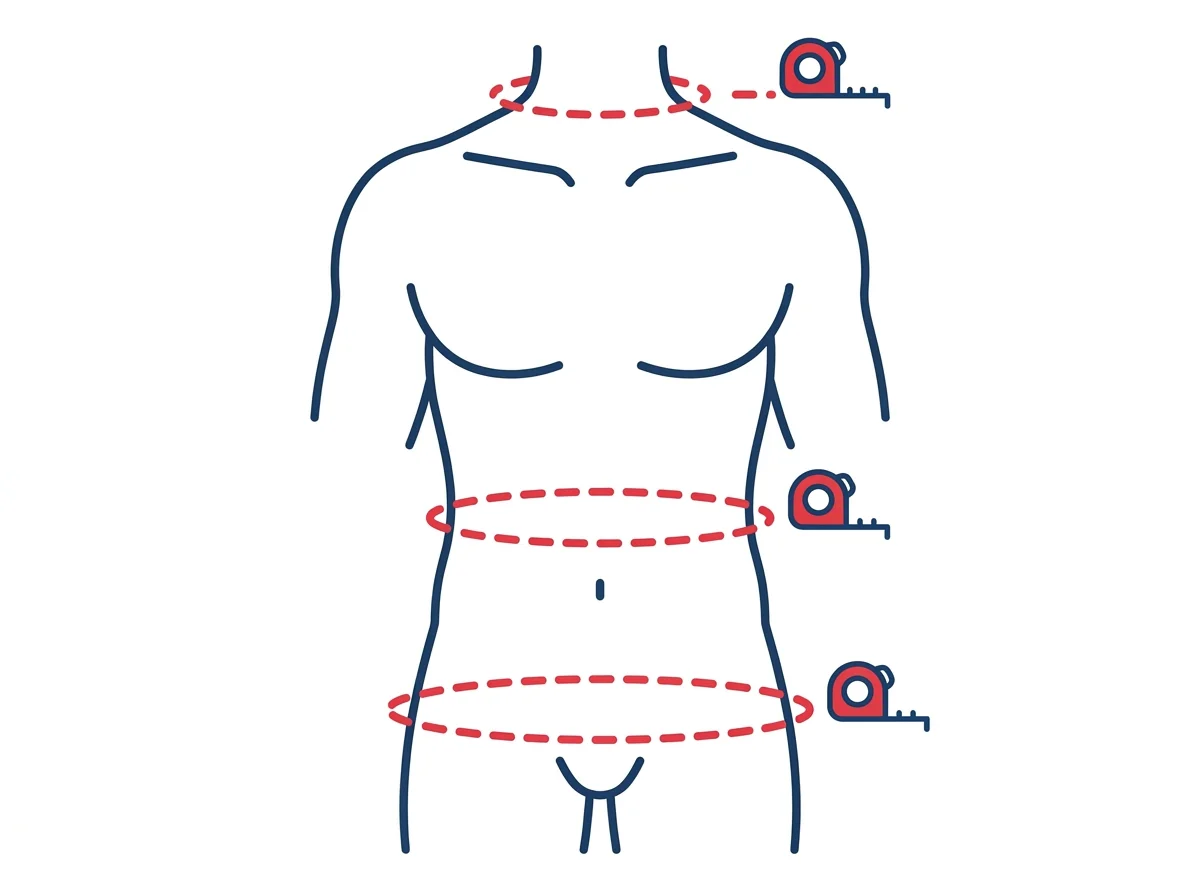
Measurement accuracy is the single biggest variable in at-home body fat estimation. The formula is precise — the main source of error is inconsistent or incorrect measurement technique. Taking 2–3 readings and averaging them, always measuring at the same time of day (morning, before eating), gives the most reliable results for tracking progress over time.

1
Height

Stand barefoot with your back against a flat wall. Look straight ahead. Have someone mark the highest point of your head and measure from the floor to that point with a rigid ruler or tape measure. Avoid measuring in the evening when spinal compression slightly reduces your height.

2
Waist Circumference

Measure at the narrowest point of your torso — typically just above the navel and below the rib cage. Keep the tape horizontal, parallel to the floor. Measure at the end of a normal exhale, with muscles relaxed (do not suck in your stomach). Take the measurement after breathing out naturally.

3
Neck Circumference

Measure just below the larynx (Adam's apple) with the head straight and eyes looking forward. The tape should be horizontal and perpendicular to the long axis of the neck. Do not compress the skin — let the tape lie flat but snug. This measurement tends to be more consistent than waist, so small errors matter more.

4
Hip Circumference (Women Only)

Measure at the widest point of the hips and buttocks — typically about 7–9 inches below the navel. Stand with feet together and measure while wearing thin clothing or no clothing. Keep the tape horizontal and parallel to the floor. Take the measurement from the side to ensure it is level, and measure at the peak of the gluteal muscle protrusion.

Body Fat Percentage vs BMI — Why Body Composition Matters More
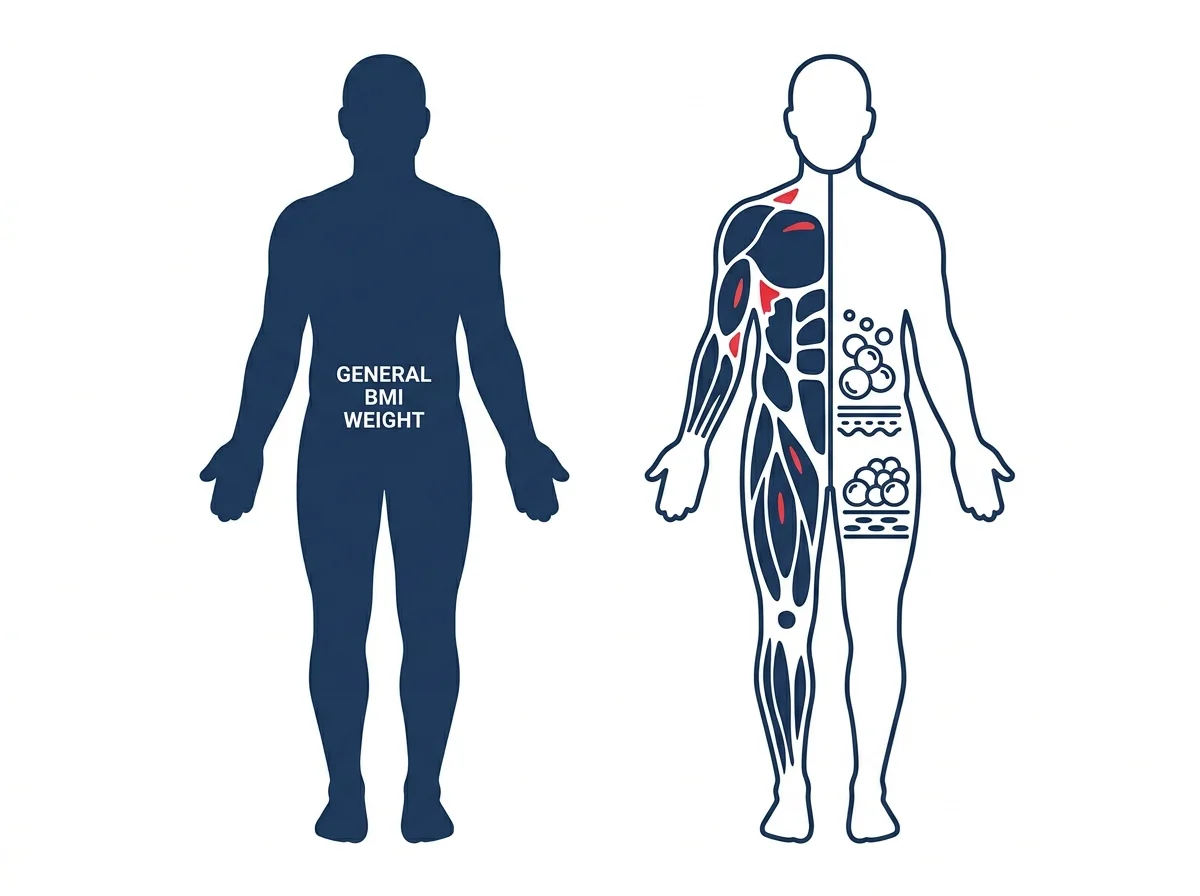
BMI (Body Mass Index) is the ratio of your weight in kilograms to your height in metres squared. It was designed as a population-level epidemiological screening tool — not as an individual health assessment. The problem is that BMI cannot distinguish between fat and muscle, which creates systematic misclassification for a significant portion of the population.

A professional athlete with 10% body fat and high muscle mass can have a BMI in the "overweight" or "obese" range. A sedentary person with low muscle mass and high fat mass (sometimes called "skinny fat" or "normal weight obesity") can have a healthy BMI while carrying metabolically dangerous fat levels. Research published in the European Journal of Clinical Nutrition found that approximately 20% of people with a "normal" BMI had obesity-level body fat percentages when measured directly. This is the classic "normal weight obesity" — and it carries similar cardiovascular and metabolic risks to conventional obesity. Pairing a BMI Calculator result with body fat percentage gives a far more complete picture of where you actually stand.

🏋️
Why Muscular People Need Body Fat %

Someone who trains seriously with weights typically has significantly more muscle mass than average. Their BMI may flag as overweight, but a body fat measurement will show them in the athlete or fitness category. Using BMI alone to assess an active, muscular person systematically misclassifies them as unhealthy. Body fat percentage correctly identifies their actual body composition.

🪑
Normal Weight Obesity — The Hidden Risk

Normal weight obesity describes people with a healthy BMI but elevated body fat percentage, often combined with low muscle mass. This pattern — common in sedentary adults, older individuals, and those who have lost muscle from crash dieting — carries similar metabolic risks to conventional obesity. Body fat percentage measurement catches this where BMI cannot.

📊
Tracking Progress Accurately

When you add resistance training and lose fat simultaneously (body recomposition), the scale barely moves. BMI does not change. But body fat percentage drops while lean body mass increases — a health-positive transformation that only body fat tracking captures. Measuring lean body mass alongside fat mass gives you the full picture of what your training is actually achieving.

❤️
Cardiovascular Risk Connection

High body fat — particularly visceral fat captured by waist circumference measurement — is a stronger predictor of cardiovascular disease risk than BMI in most studies. The waist measurement component of the Navy method in our calculator directly addresses this. If you are tracking cardiovascular health more broadly, our Heart Risk Score Calculator integrates multiple cardiovascular risk factors into a single 10-year risk estimate.

How to Reduce Body Fat Percentage — Evidence-Based Principles
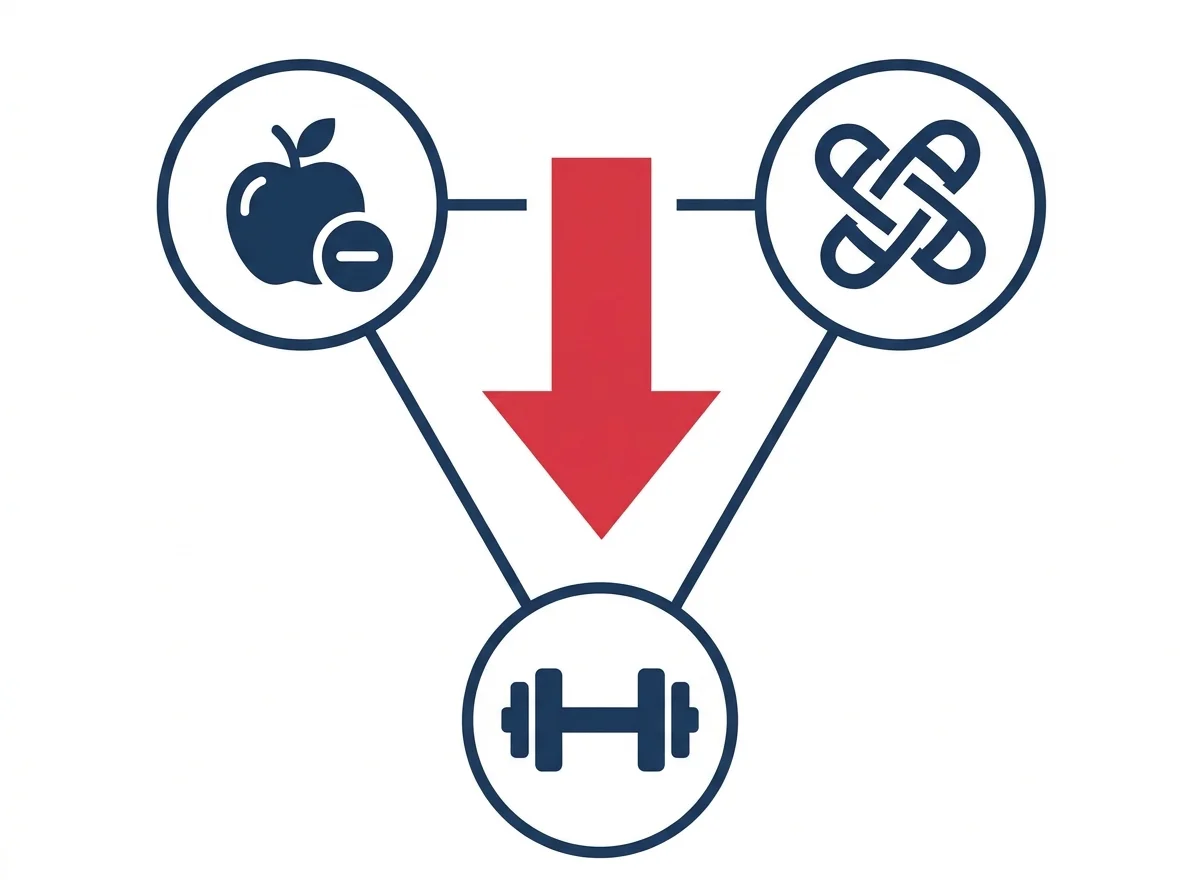
Reducing body fat percentage requires a sustained calorie deficit combined with adequate protein intake and, ideally, resistance training to preserve lean body mass. The specifics matter — crash diets without protein and exercise produce significant muscle loss alongside fat loss, which worsens the fat-to-lean ratio even as the scale drops. Smart fat loss protects muscle while targeting the fat mass.

Your total daily energy expenditure (TDEE) is the starting point for any fat loss strategy. Our TDEE Calculator estimates your daily calorie needs based on body weight, height, age, and activity level — giving you the maintenance calories from which you subtract your deficit. A deficit of 300–500 kcal/day is generally considered sustainable for fat loss while preserving muscle, assuming adequate protein intake.

Protein is essential during fat loss — it is the primary dietary signal for muscle retention. Research consistently supports protein targets of 1.6–2.2g per kg of body weight (or per kg of lean body mass, which is even more precise) for individuals in a calorie deficit. Knowing your lean body mass from this body fat calculator gives you a more accurate protein target than using total body weight alone. For research on weight loss peptide compounds that have gained attention for supporting fat loss, our Semaglutide Dosage Calculator provides detailed information on GLP-1 medication dosing.

The fat burning heart rate zone — 60–70% of your maximum heart rate — is the exercise intensity at which fat contributes the highest proportion of energy during cardio sessions. Our Fat Burning Heart Rate Calculator gives you your personalised fat burn zone based on age and resting heart rate, helping you structure cardio sessions for optimal fat oxidation alongside resistance training.

Body Fat Percentage Calculator — 12 Frequently Asked Questions

How do you calculate body fat percentage? +
Three accessible at-home methods exist. The U.S. Navy method uses body circumference measurements (waist + neck for men; waist + neck + hip for women) and height in a validated logarithmic formula — the most accurate at-home approach. The BMI-based Deurenberg method uses weight, height, age, and sex — quickest but less accurate for athletic bodies. The YMCA method uses only waist circumference and body weight — simplest but least precise. All three are available in our free body fat calculator above. Enter your measurements for instant results with ACE category classification and lean body mass breakdown.
What is a healthy body fat percentage for men and women? +
According to the American Council on Exercise (ACE): Men — Fitness range: 14–17% body fat. Women — Fitness range: 21–24% body fat. These ranges represent optimal body composition for active, health-conscious adults who are not competitive athletes. The Athlete category (6–13% men, 14–20% women) is appropriate for those doing high-volume training but is not necessary or sustainable for most people. The Average category (18–24% men, 25–31% women) carries modest metabolic risk, while the Obese category (25%+ men, 32%+ women) is associated with significantly elevated health risks.
What is the difference between body fat percentage and BMI? +
BMI measures the ratio of weight to height squared without distinguishing fat from muscle. Body fat percentage directly estimates what fraction of your body weight is fat tissue. The critical difference: a muscular person can have an "overweight" BMI with very low body fat (false positive for obesity), while a sedentary person can have a "normal" BMI with dangerously high body fat (false negative — the "normal weight obesity" pattern). For fitness assessment, body fat percentage is a more accurate and meaningful metric. Use both together for the most complete picture — our body fat calculator outputs your estimated BMI alongside body fat percentage when weight and height are provided.
How accurate is the U.S. Navy body fat calculator? +
The U.S. Navy circumference method has an error margin of approximately ±3–4% body fat compared to DEXA scanning — making it the most accurate of the common at-home formula methods. Accuracy improves significantly with careful measurement technique: measuring at the correct anatomical sites, keeping the tape horizontal and level, measuring at the end of a natural exhale for waist, and taking 2–3 readings and averaging them. The main limitations are that it is slightly less accurate for very lean individuals (below athlete-range body fat) and for people with unusual fat distribution patterns.
What is lean body mass and why does it matter? +
Lean body mass (LBM) is everything in your body that is not fat — muscle, bone, organs, water, and connective tissue. It is calculated as: LBM = Total weight × (1 − body fat% ÷ 100). Lean body mass matters for several reasons: it is the basis for precise protein intake calculations (1.6–2.2g per kg LBM for active individuals); it is the primary determinant of basal metabolic rate (more lean mass = higher resting calorie burn); and preserving it during fat loss is the difference between effective fat loss and muscle-wasting crash dieting. Our calculator provides lean body mass in both kg and lb when you enter your body weight.
How do I measure body fat at home without equipment? +
For the BMI-based or YMCA method, you only need a bathroom scale and a flexible tape measure — both available for under $10. For the Navy method (more accurate), you need only the tape measure. For men, measure waist circumference (at the narrowest point, after a normal exhale) and neck circumference (just below the Adam's apple), plus your height. For women, also measure hip circumference at the widest point. Take each measurement 2–3 times and use the average. Enter the values in our body fat calculator above. The Navy method can achieve ±3–4% accuracy with good measurement technique.
Is body fat percentage different for men and women? +
Yes — in several important ways. Women naturally carry 8–12% more body fat than men at equivalent fitness levels, primarily because essential fat is higher for women (10–13% vs 2–5% for men) due to hormonal and reproductive requirements. This biological difference is built into all ACE categories — the fitness range for women (21–24%) is higher than for men (14–17%), and the same is true for all categories. Comparing a woman's body fat percentage directly against male standards is clinically incorrect and can contribute to harmful body image expectations. Our calculator automatically applies sex-appropriate formulas and categories.
How often should I check my body fat percentage? +
Every 4–6 weeks is the ideal frequency for body fat percentage tracking when working toward fat loss or body recomposition goals. More frequent testing is unnecessary because meaningful body composition changes require weeks of consistent effort — and day-to-day fluctuations in hydration, hormones, and food intake can create misleading readings. Always measure under the same conditions: same time of day (morning is best, before eating or drinking), same level of hydration, and using the same method. Track the trend across multiple measurements rather than reacting to individual data points.
Can body fat percentage decrease without losing weight? +
Yes — this is called body recomposition, and it is a real and achievable outcome for many people, particularly those new to resistance training, returning to exercise after a break, or individuals with higher starting body fat. Body recomposition involves simultaneously losing fat mass and gaining lean muscle mass, which results in a lower body fat percentage without significant change in total body weight. It requires adequate protein (typically 1.6–2.2g/kg), a small calorie deficit or maintenance calories, and consistent progressive resistance training. The scale may barely move, but waist circumference decreases, and body fat percentage drops. This is why measuring body fat percentage is essential — the scale alone completely misses this form of progress.
What are visceral fat and subcutaneous fat? +
Subcutaneous fat sits just beneath the skin and is the fat you can pinch. It constitutes the majority of total body fat for most people. Visceral fat is stored deeper in the abdominal cavity, surrounding internal organs. While subcutaneous fat has relatively limited direct metabolic activity, visceral fat is highly active — it releases inflammatory cytokines, free fatty acids, and hormones that drive insulin resistance, dyslipidaemia, and cardiovascular disease. Waist circumference is the best proxy for visceral fat accumulation. The Navy and YMCA methods in our calculator both incorporate waist circumference, making them sensitive to visceral fat accumulation in a way that BMI is not.
What is essential body fat and what happens if you go below it? +
Essential fat is the minimum required for physiological survival — approximately 2–5% for men and 10–13% for women. It is found in bone marrow, the central nervous system, organs, and sex-specific locations in women. Going below essential fat levels causes serious health consequences: hormonal disruption (low testosterone in men, amenorrhea in women), immune dysfunction, bone density loss, cardiac complications from muscle breakdown, impaired organ function, and cognitive decline. Competitive bodybuilders briefly reach near-essential levels for competition but should not maintain them — these levels are achieved through extreme protocols and are not sustainable or healthy as a long-term state.
Does age affect body fat percentage even without weight gain? +
Yes. From around age 30, adults lose approximately 3–5% of their muscle mass per decade through the process called sarcopenia — even without changes in diet or body weight. This muscle loss is gradually replaced by fat tissue, shifting the fat-to-lean ratio upward and increasing body fat percentage even when the scale does not move. This is why the BMI-based Deurenberg formula includes age as a variable — older individuals tend to have higher body fat at the same BMI. It also underscores the importance of resistance training throughout life: maintaining lean body mass through progressive resistance exercise is the most effective strategy for preventing age-related increases in body fat percentage.

Body Fat Calculator — Key Takeaways

Body fat percentage is a more accurate measure of body composition and metabolic health than BMI alone — especially for muscular individuals and those with normal weight obesity.
The U.S. Navy circumference method (±3–4% error) is the most accurate at-home formula method. Use it consistently for tracking progress over time.
ACE fitness range: 14–17% for men, 21–24% for women. These ranges represent optimal health-performance balance for active adults.
Women naturally carry 8–12% more body fat than men due to essential fat differences — never compare female body fat against male standards.
Recheck every 4–6 weeks under the same conditions. Track the trend — individual measurements vary due to hydration, time of day, and measurement technique.
🩺
Dr. Heart (Health Observer)
Cardiovascular & Metabolic Health Specialist

All formulas in this body fat calculator are sourced from peer-reviewed research: Hodgdon & Beckett (1984, US Navy circumference method), Deurenberg et al. (1991, BMI-based estimation), and McArdle et al. (1996, YMCA method). ACE body fat categories follow American Council on Exercise classification standards. This tool is for educational and fitness tracking purposes — consult a healthcare provider for clinical body composition assessment.