Physiological Importance of Weight-Normalized Urine Output
Urinary excretion serves as a primary, real-time hemodynamic window into kidney perfusion, glomerular filtration pressure, and systemic neurohormonal activation. In healthy individuals, the kidneys receive approximately 20% to 25% of cardiac output, filtering roughly 180 liters of plasma daily through glomeruli. Through tightly regulated tubular reabsorption and secretion in the loop of Henle and collecting ducts, over 99% of this ultrafiltrate is conserved, generating between 1 and 2 liters of urine each day.
Relying exclusively on crude, absolute urine volumes (such as "30 mL per hour") frequently produces significant diagnostic errors. Body size fundamentally alters metabolic solute generation and baseline renal blood flow:
- In a 40 kg frail adult, a measured output of 30 mL/hr equals 0.75 mL/kg/hr, representing normal, physiological renal perfusion.
- In an 80 kg post-operative adult, that exact same volume of 30 mL/hr yields only 0.375 mL/kg/hr, representing clinically significant oliguria that meets acute kidney injury staging thresholds.
- In a 120 kg critically ill patient, 30 mL/hr plummets to 0.25 mL/kg/hr, indicating severe hypoperfusion or tubular failure requiring immediate hemodynamic intervention.
Standardizing urine volume by body weight and observation time ($\text{mL/kg/hr}$) eliminates this ambiguity. Weight normalization enables clinicians to detect subclinical renal hypoperfusion hours before serum creatinine begins its delayed rise. When evaluating renal function trajectory, pairing urinary excretion with filtration estimates from the GFR Calculator and perfusion pressures from the Mean Arterial Pressure Calculator provides a holistic clinical picture.
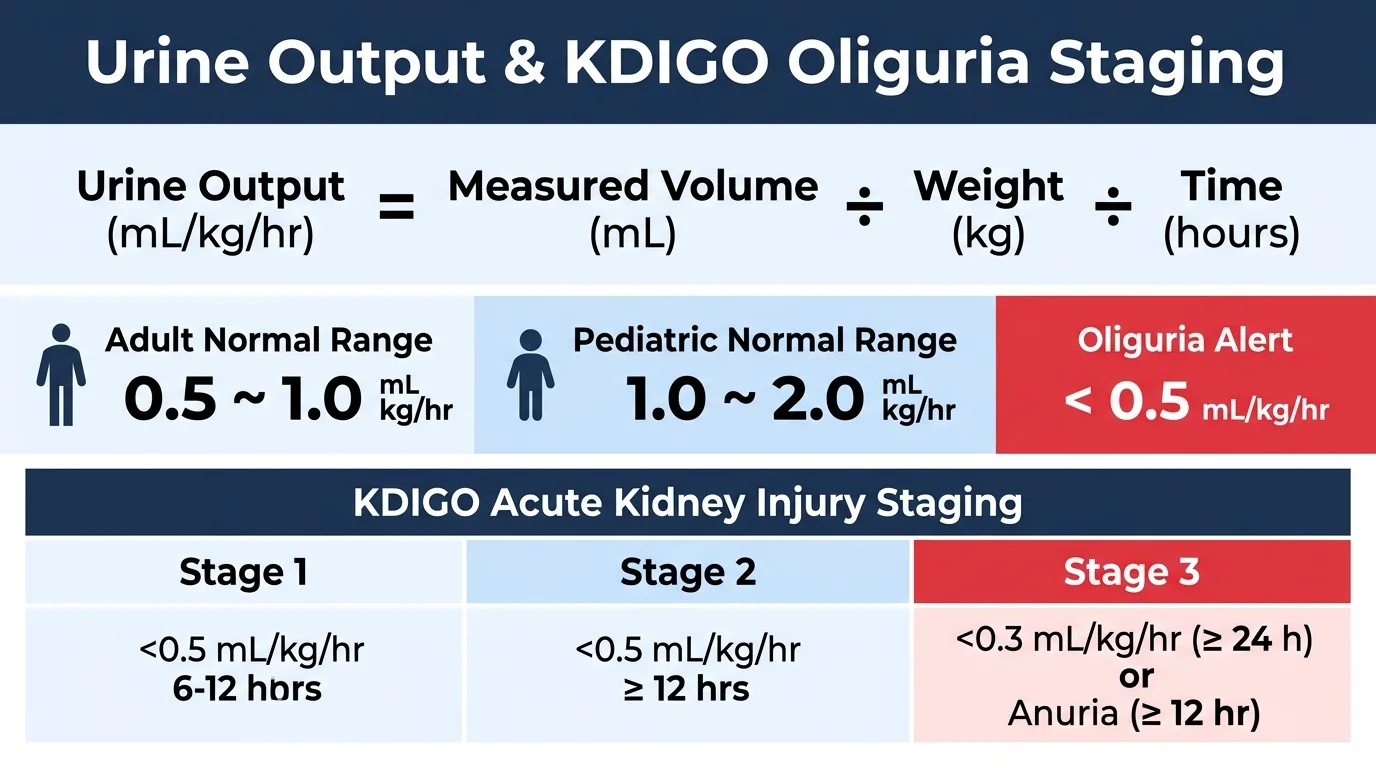
Urine Output Calculation Formula & Mathematical Mechanics
The mathematical normalization of urinary excretion standardizes volume against both body mass and the precise observation window. The standard clinical formula is expressed as:
Imperial Weight Conversion: When weight is documented in pounds (lb), the calculator converts pounds to metric kilograms using the exact clinical conversion factor ($1\text{ kg} = 2.2046226218\text{ lb}$):
Weight in kg = Weight in lb ÷ 2.20462
Step-by-Step Clinical Calculation Protocol
-
1
Measure Precise Collected Urine Volume
Accurately measure the drained volume using a graduated urometer cylinder or calibrated Foley drainage chamber. Document the exact quantity in milliliters (mL); avoid approximate bedside visual estimations.
-
2
Establish the Exact Elapsed Collection Window
Determine the time elapsed from the empty-bladder baseline to final collection. Convert fractions of hours into decimals (e.g., 45 minutes = 0.75 hours; 90 minutes = 1.5 hours; 6 hours = 6.0 hours).
-
3
Verify Current Actual or Baseline Body Weight
Enter the patient's measured dry or admission body weight. In fluid-overloaded states, using admission dry weight prevents falsely diluting the weight-normalized rate and masking genuine oliguria.
-
4
Execute the Double Division Calculation
Divide the total volume (mL) by body weight (kg), then divide the resulting quotient by elapsed hours. Example: $360\text{ mL} \div 80\text{ kg} = 4.5\text{ mL/kg}$; then $4.5 \div 6\text{ hours} = 0.75\text{ mL/kg/hr}$.
-
5
Correlate Excretion Rate with Duration & Clinical Context
Evaluate the calculated value against age-specific normative thresholds and KDIGO staging time criteria. Check catheter patency, mean arterial pressure, and nephrotoxic drug exposures before modifying fluid therapy.
Clinical Case Scenarios: Practical Bedside Applications
Case Scenario 1: Septic Shock with KDIGO Stage 2 Oliguria in an Elderly Post-Surgical Male
Patient Presentation: A 72-year-old male (weight: 80 kg) is admitted to the surgical ICU following an emergent exploratory laparotomy and bowel resection for perforated diverticulitis. He is intubated and maintained on a norepinephrine infusion for septic shock.
Clinical Interpretation & Action Plan: The patient's rate of $0.33\text{ mL/kg/hr}$ falls well below the $0.5\text{ mL/kg/hr}$ threshold. Because this depressed excretion has been sustained for 12 continuous hours, it meets the diagnostic criteria for KDIGO Stage 2 Acute Kidney Injury via the urine output arm. The clinical team immediately flushes the Foley catheter to rule out mechanical occlusion, titrates vasopressors to maintain a mean arterial pressure $\ge 65\text{ mmHg}$ using the Mean Arterial Pressure Calculator, and assesses fluid responsiveness via dynamic point-of-care echocardiography. Paired urine and serum electrolytes are drawn to compute fractional excretion of sodium using the FENa Calculator and baseline filtration trajectory using the GFR Calculator.
Case Scenario 2: Dehydration in a Pediatric Viral Gastroenteritis Patient
Patient Presentation: A 4-year-old female (weight: 16 kg) is evaluated in the pediatric emergency department with a 36-hour history of viral gastroenteritis, exhibiting frequent non-bloody vomiting and watery diarrhea. She appears mildly lethargic with tacky mucous membranes.
Clinical Interpretation & Action Plan: Despite notable mucosal dehydration, the calculated excretion rate of $1.46\text{ mL/kg/hr}$ confirms adequate end-organ renal perfusion, ruling out acute prerenal failure. Because the kidneys are actively filtering and concentrating urine, the pediatrician avoids rapid intravenous fluid boluses and initiates gentle oral rehydration therapy (ORT) with oral electrolyte solutions. Baseline fluid maintenance targets are verified using the Maintenance Fluid Calculator, and hypernatremic dehydration risk is tracked with the Free Water Deficit Calculator.
Normative Reference Ranges & Excretion Thresholds
Normal urinary excretion varies significantly across the human lifespan due to maturation of tubular concentrating capacity and body surface area dynamics:
| Clinical Classification | Adult Reference (Age ≥ 18) | Pediatric Reference (Age 1 mo–17 yr) | Physiological Implications |
|---|---|---|---|
| Anuria | < 50–100 mL / 24 hr | Complete absence of urine | Complete mechanical obstruction, catastrophic cortical necrosis, or severe shock. |
| Severe Oliguria | < 0.3 mL/kg/hr | < 0.5 mL/kg/hr | Matches KDIGO Stage 3 AKI criterion if sustained ≥ 24 hr; high risk of solute accumulation. |
| Oliguria | < 0.5 mL/kg/hr or < 500 mL/day | < 1.0 mL/kg/hr (infants/children) | Inadequate volume to excrete mandatory daily solute load (~600 mOsm/day). |
| Normal Euresis | 0.5–1.0 mL/kg/hr (1–2 L/day) | 1.0–2.0 mL/kg/hr | Physiological steady state; effective renal plasma flow and tubular equilibrium preserved. |
| Polyuria | > 3,000 mL / 24 hr or > 50 mL/kg/day | > 2.5–3.0 mL/kg/hr | Excessive solute diuresis, recovery phase of ATN, diabetes insipidus, or fluid over-resuscitation. |
For a typical 70 kg adult, a normal output rate of 0.5 to 1.0 mL/kg/hr translates to approximately 35 to 70 mL every hour. Daily totals fluctuate with ambient temperature, humidity, vigorous physical exertion, and dietary osmolar intake.
KDIGO 2012 / 2026 Consensus AKI Staging Matrix
The Kidney Disease: Improving Global Outcomes (KDIGO) clinical practice guidelines define Acute Kidney Injury by incorporating both functional filtration markers (serum creatinine) and kinetic volume markers (urine output). A patient is categorized according to whichever staging criterion is more severe:
| KDIGO Stage | Urine Output Criterion | Serum Creatinine Criterion |
|---|---|---|
| Stage 1 | < 0.5 mL/kg/hr for 6–12 hours | 1.5–1.9 times baseline OR increase ≥ 0.3 mg/dL (≥ 26.5 μmol/L) within 48 hr |
| Stage 2 | < 0.5 mL/kg/hr for ≥ 12 hours | 2.0–2.9 times baseline |
| Stage 3 | < 0.3 mL/kg/hr for ≥ 24 hours OR Anuria for ≥ 12 hours | 3.0 times baseline OR increase ≥ 4.0 mg/dL (≥ 353.6 μmol/L) OR initiation of RRT |
Differential Diagnosis of Low Urine Output (Oliguria & Anuria)
Oliguria is not a standalone diagnosis; it is a clinical symptom demanding systematic investigation across three anatomical compartments:
Reduced Renal Hemodynamics
Intravascular volume depletion from hemorrhage, GI losses, septic vasodilation, or cardiogenic shock. Kidneys preserve sodium and water avidly. Evaluate with the FENa Calculator and BUN/Creatinine Ratio Calculator.
Direct Tubular or Glomerular Damage
Acute Tubular Necrosis (ATN) from prolonged ischemia or nephrotoxins (aminoglycosides, IV contrast, NSAIDs), acute interstitial nephritis, or glomerulonephritis. Loss of tubular concentrating integrity occurs.
Urinary Tract Obstruction
Mechanical blockage: kinked or obstructed Foley catheters, bladder clots, bilateral ureteral calculi, benign prostatic hyperplasia, or pelvic malignancy. Catheter flushing and bedside bladder ultrasound are immediate first steps.
High Urine Output, Polyuria, and Solute Diuresis
Excretion rates significantly above the normal reference range (>2.0 mL/kg/hr in adults or >3,000 mL/24 hr) require careful diagnostic discrimination:
- Physiological Water Diuresis: Rapid excretion following large oral water intake or hypotonic intravenous maintenance fluid infusions.
- Post-ATN Diuretic Recovery Phase: As tubular epithelial cells regenerate, glomerular filtration recovers before the newly formed tubular cells regain full sodium and water concentrating capacity, resulting in profound polyuria and potential electrolyte depletion.
- Post-Obstructive Diuresis (POD): Severe, transient solute diuresis triggered by urea accumulation following the relief of bilateral urinary tract obstruction.
- Osmotic Solute Diuresis: Elevated tubular solute load exceeding reabsorptive transport capacity, frequently observed in uncontrolled diabetic ketoacidosis (hyperglycemia) or following therapeutic mannitol administration. Cross-check glucose-adjusted electrolyte balance with the Corrected Sodium Calculator and Serum Osmolality Calculator.
- Diabetes Insipidus (Central or Nephrogenic): Deficient pituitary secretion of arginine vasopressin (AVP/ADH) or renal receptor insensitivity, causing copious, dilute urinary excretion.
-
Normalize by Weight: Absolute output in mL is deceptive. Always divide volume by body mass and elapsed hours ($\text{mL/kg/hr}$) to accurately assess renal perfusion.
-
Recognize Target Ranges: Normal excretion is 0.5–1.0 mL/kg/hr for adults and 1.0–2.0 mL/kg/hr for infants and young children.
-
Apply KDIGO Duration Criteria: True AKI staging requires monitoring output duration: Stage 1 is <0.5 mL/kg/hr for 6–12h; Stage 2 is ≥12h; Stage 3 is <0.3 mL/kg/hr for ≥24h or anuria for ≥12h.
-
Rule Out Mechanical Obstruction First: In an acutely oliguric or anuric catheterized patient, always check catheter patency and perform a bladder scan before ordering fluid boluses or diuretics.
-
Triangulate Clinical Markers: Urine output changes faster than serum creatinine. Use both metrics alongside hemodynamic targets and fluid balance charts for reliable patient care.
Frequently Asked Questions
How do you calculate urine output in mL/kg/hr?
Divide the measured urine volume in milliliters by body weight in kilograms, and then divide that quotient by the collection duration in hours. Mathematically: Urine Output (mL/kg/hr) = Volume (mL) ÷ Weight (kg) ÷ Time (hours). For example, if a 70 kg adult produces 300 mL of urine over 6 hours, the calculation is 300 ÷ 70 ÷ 6 = 0.714 mL/kg/hr.
What is considered normal urine output per hour in adults?
The widely accepted normative physiological reference for adults is approximately 0.5 to 1.0 mL/kg/hr. For an average 70 kg adult, this corresponds to approximately 35 to 70 mL per hour, or roughly 800 to 1,680 mL across a full 24-hour period. However, normal excretion fluctuates dynamically based on fluid intake, ambient temperature, hormonal regulation, and non-renal losses.
What is the clinical definition of oliguria?
In clinical nephrology, oliguria is traditionally defined as urinary excretion below 400 to 500 mL in a 24-hour period in adults, or less than 0.5 mL/kg/hr when monitored over consecutive hours. In pediatric patients, oliguria is defined as excretion below 1.0 mL/kg/hr in infants and young children, or below 0.5 mL/kg/hr in older children and adolescents.
How does KDIGO use urine output to stage Acute Kidney Injury (AKI)?
The Kidney Disease: Improving Global Outcomes (KDIGO) guidelines define AKI staging using both urine output and serum creatinine criteria, with the patient assigned the higher (worse) stage. For urine output: Stage 1 is <0.5 mL/kg/hr for 6 to 12 hours; Stage 2 is <0.5 mL/kg/hr for 12 hours or longer; and Stage 3 is <0.3 mL/kg/hr for 24 hours or longer, or complete anuria for 12 hours or longer.
What is normal pediatric urine output?
For infants (beyond 1 month of age) and young children, normal baseline urine output is approximately 1.0 to 2.0 mL/kg/hr. As children mature through adolescence, normative values gradually align with the adult standard of 0.5 to 1.0 mL/kg/hr. Neonates (under 28 days) have distinct developmental renal physiology and require gestational age-specific assessment.
Why can an aggregate urine output calculation be misleading compared to hourly charting?
An aggregate calculation divides total cumulative volume by total elapsed hours, producing an arithmetic mean that can mask acute periods of severe oliguria or anuria. For example, a patient who excretes 360 mL over 12 hours has an aggregate rate of 30 mL/hr, but they may have produced 360 mL in the first 3 hours and 0 mL over the subsequent 9 hours. In critically ill patients, continuous hourly monitoring is essential to detect evolving renal hypoperfusion promptly.
What are the main causes of sudden low urine output (anuria or oliguria)?
Causes are clinically divided into three anatomical categories: (1) Prerenal, involving decreased renal perfusion from hypovolemia, hemorrhage, septic shock, or heart failure; (2) Intrinsic renal, resulting from acute tubular necrosis (ATN), nephrotoxic medications, glomerulonephritis, or interstitial nephritis; and (3) Postrenal, caused by mechanical urinary tract obstruction such as a kinked or clogged Foley catheter, urethral stricture, or prostatic enlargement.
Evidence & Clinical Guidelines
The calculation formulas, physiological reference intervals, oliguria definitions, and acute kidney injury criteria on this page are grounded in international nephrology consensus literature:
- Kidney Disease: Improving Global Outcomes (KDIGO) Acute Kidney Injury Work Group. KDIGO Clinical Practice Guideline for Acute Kidney Injury. Kidney International Supplements. 2012;2(1):1-138.
- Bellomo R, Ronco C, Kellum JA, Mehta RL, Palevsky P; ADQI workgroup. Acute renal failure - definition, outcome measures, animal models, fluid therapy and information technology needs: the Second International Consensus Conference of the Acute Dialysis Quality Initiative (ADQI) Group. Critical Care. 2004;8(4):R204-R212.
- Kellum JA, Lameire N, Aspelin P, et al. Kidney disease: improving global outcomes (KDIGO) consensus conference on acute kidney injury: summary of recommendations. Crit Care. 2013;17(1):204.
- Haider MZ, Aslam A. Renal Function Tests. StatPearls [Internet]. Treasure Island (FL): StatPearls Publishing; 2026.
- Merck Manual Professional Edition. Oliguria: Approach to the Critically Ill Patient. Reviewed October 2025.
Editorial review completed September 11, 2026. Computations are processed client-side in your local browser; patient health metrics and collection volumes are never stored or transmitted across our servers.