What Is a Free Water Deficit?
A free water deficit is an estimate of how much water is missing relative to the amount of body solute represented by serum sodium. Hypernatremia—commonly defined as serum sodium above 145 mmol/L—usually reflects too little water relative to sodium, although water loss, sodium gain, and mixed disorders can produce different volume states.
The formula translates body weight and serum sodium into an estimated number of liters. It is useful for understanding the size of a water-balance problem, but it does not identify the cause. Thirst and water access, urine concentration, medications, glucose, gastrointestinal loss, fever, kidney function, and clinical volume status remain important.
For the related concentration estimate based on sodium, glucose, and BUN, use the Serum Osmolality Calculator. Osmolality and free water deficit answer different questions.
Free Water Deficit Calculation Formula
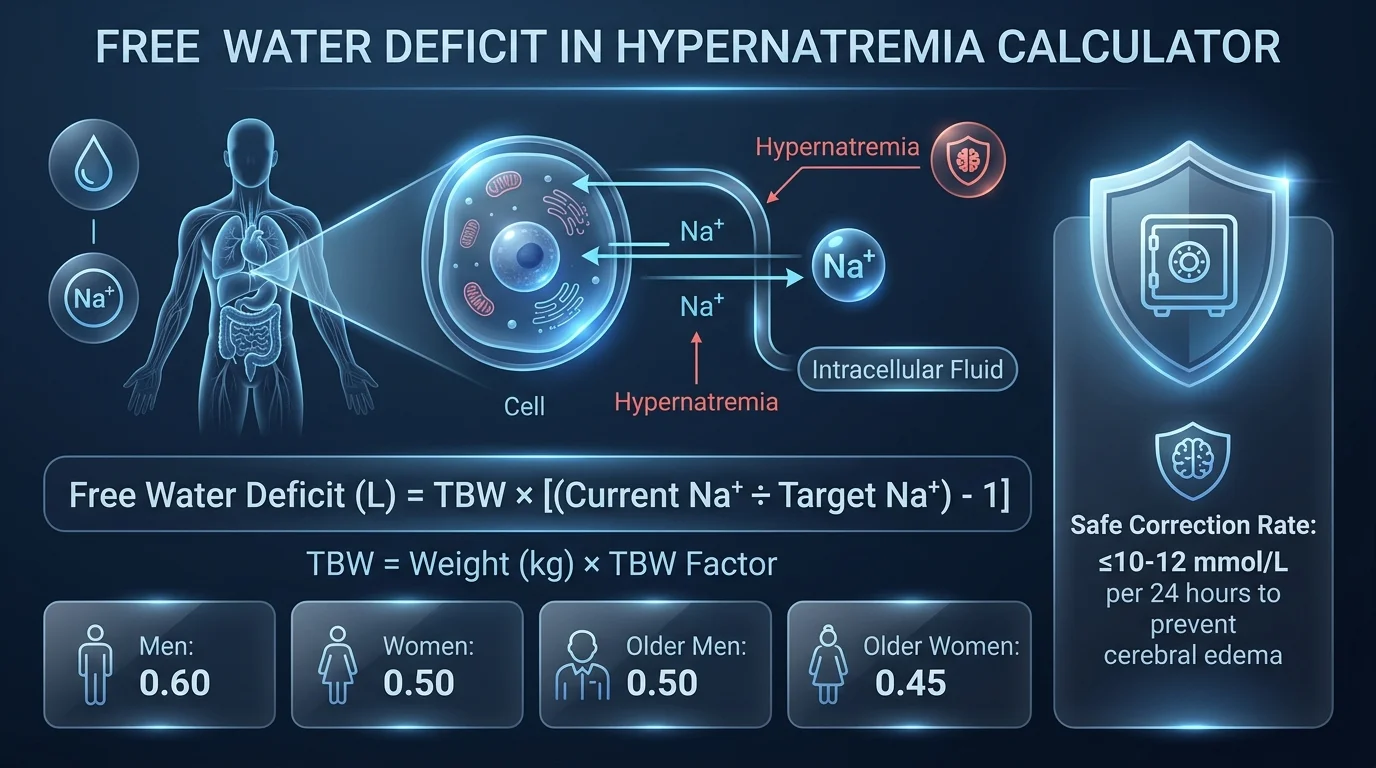
Total body water is estimated first:
Because one liter of water weighs approximately one kilogram, the estimated TBW in kilograms is treated numerically as liters. The calculator keeps full precision during the calculation and rounds the displayed deficit to two decimals.
How to Calculate Free Water Deficit
- 1
Choose an adult TBW profile
Select the profile that best matches the intended simplified factor, or choose a custom factor when a qualified clinical method specifies one.
- 2
Enter body weight
Use kilograms or pounds. The tool converts pounds to kilograms before estimating total body water.
- 3
Enter current and target sodium
Use mmol/L or mEq/L; sodium is numerically the same in both units. The target must remain below the current value.
- 4
Calculate estimated TBW
Multiply weight in kilograms by the visible TBW factor.
- 5
Apply the sodium ratio
Divide current sodium by target sodium, subtract one, and multiply by estimated TBW.
- 6
Interpret it as an estimate
Do not treat the result as a replacement order. Ongoing losses, volume status, and repeat sodium can change the real requirement.
Free Water Deficit Calculation Example
- 1
Selected TBW factor: 0.60
- 2
Estimated TBW: 70 × 0.60 = 42 L
- 3
Sodium ratio: 160 ÷ 140 = 1.1429
- 4
Ratio minus one: 1.1429 − 1 = 0.1429
- 5
Free water deficit: 42 × 0.1429 = 6.00 L
The six-liter result estimates the existing deficit under those assumptions. It does not mean six liters should be given immediately—or that six liters will be the final requirement after urine, stool, skin, respiratory, and treatment-related changes.
Clinical Case Scenarios & Decision Pathways
The following real-world clinical presentations illustrate how clinicians calculate free water deficit and structure safe fluid replacement strategies:
Severe Dehydration in an Elderly Resident
Patient Presentation: An 82-year-old female nursing home resident presents with obtundation, dry mucous membranes, poor skin turgor, and a 4-day history of decreased oral intake.
Laboratory & Vitals: Weight 50 kg; Serum Na 162 mmol/L; Serum Glucose 110 mg/dL; Target Na 140 mmol/L. Selected TBW factor: 0.45 (elderly female).
Calculation:
TBW = 50 kg × 0.45 = 22.5 L
Deficit = 22.5 × [(162 ÷ 140) − 1] = 3.54 L (3,540 mL)
Clinical Interpretation: The pre-existing water deficit is approximately 3.54 L. Because hypernatremia has developed over >48 hours, replacement is planned over 48 to 72 hours alongside maintenance fluids, targeting a safe decrease in sodium of ≤0.5 mmol/L/hr (max 10–12 mmol/L/day) to prevent cerebral edema.
Post-Neurosurgical Polyuria & Free Water Loss
Patient Presentation: A 46-year-old male develops copious dilute polyuria (>500 mL/hr) following transsphenoidal pituitary tumor resection, consistent with central diabetes insipidus.
Laboratory & Vitals: Weight 80 kg; Serum Na 155 mmol/L; Urine Osmolality 95 mOsm/kg; Target Na 140 mmol/L. Selected TBW factor: 0.60 (young adult male).
Calculation:
TBW = 80 kg × 0.60 = 48.0 L
Deficit = 48.0 × [(155 ÷ 140) − 1] = 5.14 L (5,140 mL)
Clinical Interpretation: In addition to replacing the 5.14 L deficit with hypotonic fluids (D5W or enteral water), desmopressin (dDAVP) is administered. Replacement must match active urinary output tracked on a Urine Output Calculator to prevent re-accumulation of the deficit.
Total Body Water Factors Used by the Calculator
Simplified starting estimate.
Simplified starting estimate.
Lower common estimate.
Lower common estimate.
These factors are approximations, not measured body-water percentages. Published clinical discussions vary: some subtract about five percentage points for older adults, while lower values may be used in water-depleted people. Body composition, adiposity, edema, recent weight change, frailty, and critical illness can make a simple factor less accurate.
That variation is why the calculator displays the factor instead of hiding it. The custom option accepts 0.35–0.70, but it should only be used when the intended method provides a justified factor. Changing the factor directly changes both TBW and the estimated deficit.
How to Read the Result
Existing estimated deficit
Uses one weight, one TBW assumption, one current sodium value, and one target sodium value.
Static formula estimateDynamic water balance
Also depends on ongoing losses and gains, extracellular volume, kidney response, cause, and repeat laboratory values.
Requires reassessmentA larger number does not independently measure illness severity, and a smaller number does not rule out a dangerous process. The speed at which sodium changed, symptoms, and the cause can matter as much as the numerical deficit.
Why the Selected Target Sodium Changes the Result
Target sodium is part of the denominator, so changing it changes the calculated deficit. Using the 70 kg adult-man example with current sodium of 160 mmol/L, a target of 140 produces an estimate of 6.00 L. With the same weight and TBW factor but a target of 145, the estimate becomes approximately 4.34 L.
Neither target is automatically appropriate for every situation. The calculator allows 135–145 mmol/L so the assumption is explicit, but it does not recommend a target or say how quickly it should be approached. Acute and chronic hypernatremia, uncertain duration, symptoms, glucose, volume status, and response to earlier treatment may change clinical decisions.
Free Water Deficit, Dehydration, and Volume Depletion
These terms are related but not interchangeable. In clinical fluid terminology, dehydration describes water depletion that raises tonicity and may raise serum sodium. Volume depletion refers more specifically to loss of extracellular fluid containing water and electrolytes. A person can have both at the same time, but the free water deficit equation does not measure extracellular volume.
Hypernatremia can be grouped by volume status. In hypovolemic hypernatremia, both water and sodium have been lost, with proportionally more water lost. Euvolemic hypernatremia may occur with relatively pure water loss, including water diuresis. Hypervolemic hypernatremia can occur with hypertonic sodium gain and may be accompanied by signs of fluid overload. The same calculated deficit cannot make these states clinically equivalent.
Blood pressure, heart rate, mucous membranes, edema, urine output, weight trend, intake and output, kidney measurements, and the history of losses or sodium exposure help establish context. The formula contains none of those variables. This is one reason an online result should support understanding of the arithmetic rather than replace examination and monitoring.
What the Formula Does Not Include
- Ongoing urine loss: polyuria, osmotic diuresis, and diabetes insipidus can continue to remove electrolyte-free water.
- Gastrointestinal loss: diarrhea, drains, or other losses can change water and electrolyte balance.
- Insensible loss: fever, sweating, rapid breathing, and environmental exposure can add water loss.
- Fluid and solute intake: oral, enteral, and intravenous inputs can alter sodium after the sampled value.
- Volume status: hypovolemic, euvolemic, and hypervolemic hypernatremia are not managed as interchangeable states.
- Kidney response: urine volume, urine osmolality, and kidney function influence the ongoing balance.
The GFR Calculator estimates filtration from different variables; it does not measure the ongoing free water loss used in this equation.
Measured Sodium, Corrected Sodium, and Hyperglycemia
Marked hyperglycemia can lower the measured sodium concentration through a water shift. Adult hypernatremia evaluation commonly includes checking a glucose-corrected sodium when glucose is elevated. This page does not perform that correction automatically because the appropriate input depends on the clinical question and collection time.
Use the Corrected Sodium Calculator for the separate Katz and Hillier estimates. If diabetic ketoacidosis or another acid-base disorder is suspected, the Anion Gap Calculator addresses a different calculation and cannot be replaced by the water-deficit result.
Common Free Water Deficit Calculation Errors
- Entering pounds as kilograms: this overstates TBW and the deficit by more than twofold.
- Hiding the TBW factor: a result is hard to audit when the body-water assumption is unknown.
- Using a target at or above current sodium: this does not produce a positive deficit for this formula.
- Mixing values from different times: weight and sodium can change during illness and treatment.
- Ignoring hyperglycemia: the sodium used may need separate clinical interpretation when glucose is high.
- Adding a correction rate: deficit volume and sodium correction rate are distinct clinical questions.
- Calling the result a prescription: the equation does not determine a safe route, fluid, rate, or schedule.
When an Online Calculation Is Not Enough
Hypernatremia can occur when thirst or access to water is impaired, with gastrointestinal or skin losses, osmotic diuresis, diabetes insipidus, kidney-related problems, or hypertonic sodium gain. Finding the cause and assessing extracellular volume are essential before using any deficit estimate.
Free Water Deficit Calculator FAQs
How do you calculate free water deficit?
Estimate total body water (TBW) by multiplying body weight in kilograms by an age- and sex-adjusted factor (e.g., 0.60 for adult men, 0.50 for adult women). Then calculate: Free Water Deficit (L) = TBW × [(Current Na ÷ Target Na) − 1].
Which total body water (TBW) factor should be used?
Standard clinical estimates are 0.60 for young adult men and 0.50 for young adult women. For elderly or chronically dehydrated patients with decreased muscle mass, lower factors of 0.50 (older men) and 0.45 (older women) are recommended to prevent overestimating water deficit.
What is the maximum safe rate of sodium correction in hypernatremia?
In chronic hypernatremia (>48 hours), serum sodium should be lowered gradually at a rate not exceeding 0.5 mmol/L per hour, or a maximum of 10–12 mmol/L in 24 hours. Rapid correction causes osmotic water influx into brain cells, risking cerebral edema, seizures, and herniation.
Does the free water deficit include ongoing fluid losses?
No. The formula calculates only the static pre-existing water deficit. Clinicians must separately measure and replace ongoing urinary losses, gastrointestinal output, and insensible respiratory/perspiratory losses.
Why must blood glucose be checked when evaluating hypernatremia?
Severe hyperglycemia shifts water from cells into the extracellular space, artificially lowering measured sodium. Clinicians use a Corrected Sodium Calculator to adjust for glucose before concluding whether hypernatremia or a free water deficit is present.
What is the difference between dehydration and volume depletion?
Dehydration refers strictly to pure water deficit with hypertonicity (hypernatremia). Volume depletion (hypovolemia) refers to loss of extracellular fluid and sodium. Patients may have pure dehydration, volume depletion, or a combination of both requiring isotonic saline before hypotonic free water.
Can this calculator be used for hyponatremia or children?
No. This calculator is strictly validated for adult hypernatremia where current sodium exceeds target sodium. Hyponatremia requires separate sodium-deficit calculations, and pediatric fluid management utilizes specialized body surface area or Holliday-Segar protocols.
Evidence and Editorial Notes
The formula, TBW assumptions, adult scope, and cautions about ongoing losses and volume status were checked against original and current clinical literature.
- Adrogué HJ, Madias NE. Hypernatremia. New England Journal of Medicine. 2000.
- Yun G, Baek SH, Kim S. Evaluation and management of hypernatremia in adults: clinical perspectives. Korean Journal of Internal Medicine. 2023.
- Chauhan K, et al. Rate of correction of hypernatremia and health outcomes in critically ill patients. Clinical Journal of the American Society of Nephrology. 2019.
- Feigin E, et al. Rate of correction and all-cause mortality in patients with severe hypernatremia. JAMA Network Open. 2023.
Last formula and source review: August 9, 2026. Calculations run in your browser. Values entered in this form are not sent to our server.