How to Lower Blood Pressure Naturally Without Medication
Clinical trials show that the DASH diet, sodium reduction, regular aerobic exercise, and weight loss can each lower blood pressure by several mmHg. This post reviews the evidence behind each method and the reductions researchers actually measured.
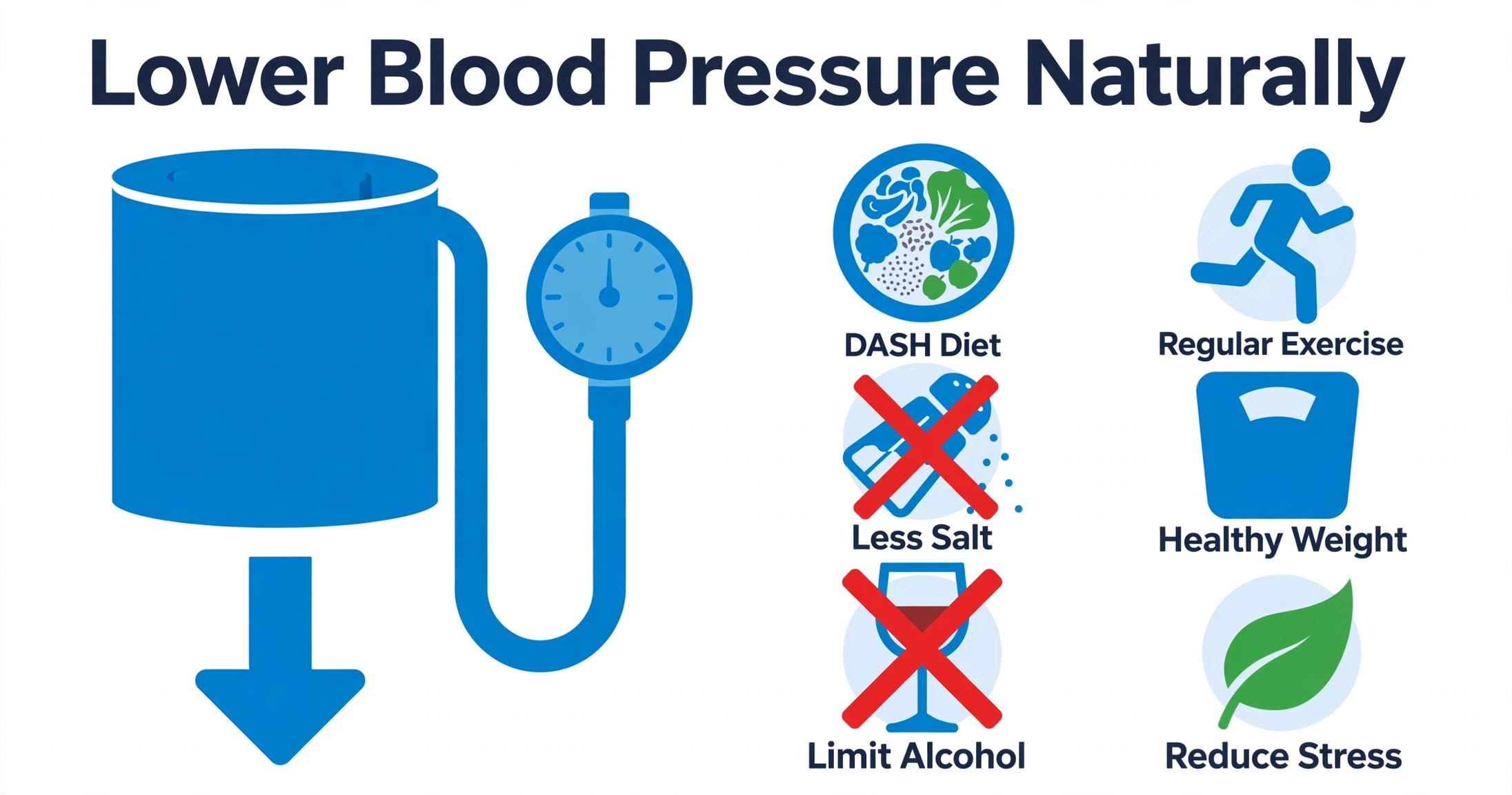
The DASH eating plan — rich in fruits, vegetables, whole grains, and low-fat dairy — has the strongest trial evidence for lowering blood pressure through diet.
Key Takeaways
- The DASH diet lowered systolic blood pressure by about 11 mmHg in trial participants with hypertension.
- Cutting sodium to around 1,500 mg per day lowers systolic pressure by roughly 5–6 mmHg, with larger effects when combined with DASH.
- At least 150 minutes per week of aerobic exercise is linked to systolic reductions of about 5–8 mmHg.
- Blood pressure falls by approximately 1 mmHg systolic for each kilogram of body weight lost.
- Guidelines still recommend medication for Stage 2 hypertension or Stage 1 with high cardiovascular risk — lifestyle changes remain the foundation in all cases.
Clinical trials show that several lifestyle changes can lower blood pressure without medication. The DASH eating plan reduced systolic pressure by about 11 mmHg in people with hypertension, sodium reduction lowers systolic pressure by roughly 5–6 mmHg, regular aerobic exercise by about 5–8 mmHg, and each kilogram of weight lost tracks with roughly 1 mmHg. The sections below review the evidence behind each method, the size of the effect researchers measured, and the situations where lifestyle steps are combined with medical care.
How Blood Pressure Works
Blood pressure is the force that circulating blood exerts against artery walls. Each heartbeat produces two pressure values. Systolic pressure, the upper number, reflects the force when the heart contracts and pushes blood out. Diastolic pressure, the lower number, reflects the force when the heart relaxes between beats. Both are measured in millimeters of mercury (mmHg), a unit that dates back to mercury-based pressure gauges.
Mean arterial pressure (MAP) represents the average pressure across one cardiac cycle. Because the heart spends more time in the relaxation phase than in contraction, MAP sits closer to the diastolic value than to the systolic one. A mean arterial pressure (MAP) calculator computes this average from systolic and diastolic readings. Clinicians track MAP in acute-care settings, where organ perfusion depends on the average driving pressure rather than the peaks.
Blood pressure categories come from the 2017 ACC/AHA hypertension guideline.[1] The guideline defines four categories for adults based on office readings:
| Category | Systolic (mmHg) | Diastolic (mmHg) |
|---|---|---|
| Normal | Below 120 | Below 80 |
| Elevated | 120–129 | Below 80 |
| Stage 1 Hypertension | 130–139 | 80–89 |
| Stage 2 Hypertension | 140 or higher | 90 or higher |
When systolic and diastolic values fall in different categories, the higher category applies. A reading of 132/78, for example, falls in Stage 1 because the systolic value meets that threshold even though the diastolic value sits in the normal range.
Readings vary throughout the day in response to activity, stress, caffeine, and posture. A single elevated reading does not establish a pattern; guidelines base categories on the average of multiple properly taken measurements.[1] Home and ambulatory monitoring capture this variation better than one office visit. Readers interested in how typical readings shift across the lifespan can see the companion post on normal blood pressure by age.
These categories matter for interpreting the trial evidence below. The expected benefit of lifestyle change scales with starting pressure: in the DASH trial, participants with hypertension saw reductions roughly three times larger than participants without it.[2]
The DASH Diet
The DASH eating plan — Dietary Approaches to Stop Hypertension — carries more randomized-trial evidence for blood pressure than any other dietary pattern. The plan emphasizes fruits, vegetables, whole grains, low-fat dairy products, poultry, fish, and nuts, while limiting saturated fat, red meat, sweets, and sugar-sweetened beverages.
The landmark trial enrolled 459 adults with systolic pressures below 160 mmHg and diastolic pressures between 80 and 95 mmHg. After a three-week run-in on a typical American control diet, participants were randomized to continue the control diet, switch to a fruits-and-vegetables diet, or adopt the full DASH combination diet for eight weeks. Sodium intake and body weight were held constant so the results would reflect the dietary pattern alone.[2]
The combination diet lowered systolic pressure by 5.5 mmHg and diastolic by 3.0 mmHg compared with the control diet. Among the 133 participants who met the criteria for hypertension, the effect was far larger: an 11.4 mmHg systolic and 5.5 mmHg diastolic reduction. Participants without hypertension still benefited, with reductions of 3.5 mmHg systolic and 2.1 mmHg diastolic.[2]
The trial also showed how quickly diet can act. Blood pressure differences appeared within two weeks of the diet change and persisted through the eight-week feeding period.[2] That speed suggests the mechanism involves more than gradual weight change — researchers point to higher intakes of potassium, calcium, magnesium, and fiber, along with lower saturated fat, as likely contributors.
A 2006 American Heart Association scientific statement reviewed the DASH evidence alongside other dietary trials and concluded that dietary patterns rich in fruits, vegetables, and low-fat dairy products lower blood pressure in both hypertensive and non-hypertensive adults.[5] Readers tracking cholesterol alongside blood pressure sometimes use an LDL cholesterol calculator to estimate a related risk factor, since the DASH pattern affects lipid levels as well.
What does the pattern look like in practice? A typical day includes 4–5 servings each of fruits and vegetables, 2–3 servings of low-fat dairy, 6–8 servings of whole grains, and limited sodium. Nuts, seeds, and legumes appear several times per week. Researchers describe DASH as an eating pattern rather than a short-term diet, and its blood pressure effects depend on sustained adherence.
Adherence is the main practical challenge. In free-living studies such as PREMIER, participants counseled on the DASH pattern achieved meaningful dietary changes but smaller blood pressure effects than the tightly controlled feeding trial — a gap that reflects the difference between ideal and real-world conditions.[4]
Reducing Sodium Intake
Sodium raises blood pressure in most adults, and average intakes far exceed recommended limits. The American Heart Association advises limiting sodium to no more than 2,300 mg per day — about one teaspoon of salt — and moving toward an ideal limit of 1,500 mg per day for most adults.
Roughly 70% of dietary sodium comes from processed and restaurant foods rather than the salt shaker, which is why label reading matters more than table salt for most people. Bread, soup, deli meats, cheese, and sauces rank among the largest contributors in typical diets.
The DASH-Sodium trial tested three sodium levels — approximately 3.3 g, 2.4 g, and 1.5 g per day — each combined with either a typical control diet or the DASH diet, in 412 adults. Lowering sodium from the highest to the lowest level reduced systolic pressure, and the effect was larger in participants with hypertension. The combination of the DASH diet with the lowest sodium level produced the largest reductions: among participants with hypertension, systolic pressure fell by about 11.5 mmHg compared with the high-sodium control diet.[3]
A meta-analysis of randomized trials by He and MacGregor found that modest salt reduction lowered blood pressure across diverse populations, with larger effects in people with hypertension.[9] The 2017 ACC/AHA guideline summarizes the expected effect of sodium reduction as roughly 5–6 mmHg systolic and 2–3 mmHg diastolic.[1]
Potassium intake interacts with sodium. Diets higher in potassium blunt some of sodium's pressor effect, which is one reason the potassium-rich DASH pattern pairs well with sodium reduction. The next sections cover potassium in more detail alongside the other contributing factors.
🧮 Check Your Blood Pressure Numbers
Convert your systolic and diastolic readings into mean arterial pressure, or estimate your 10-year cardiovascular risk.
Try the MAP Calculator → Try the ASCVD Calculator →Regular Aerobic Exercise
The 2017 ACC/AHA guideline recommends at least 150 minutes per week of moderate-intensity aerobic activity, 75 minutes of vigorous activity, or an equivalent combination. The guideline summarizes the expected blood pressure effect as roughly 5–8 mmHg systolic and 3–5 mmHg diastolic.[1]
A widely cited meta-analysis of 54 randomized controlled trials found that aerobic exercise lowered blood pressure by an average of 3.8 mmHg systolic and 2.6 mmHg diastolic across all participants, with larger reductions in those with hypertension.[7] The difference between the meta-analysis average and the guideline's 5–8 mmHg range reflects different study populations: the guideline figure emphasizes results in people with elevated pressures, where exercise has the most room to act.
Exercise lowers blood pressure through several mechanisms. Regular aerobic training improves endothelial function — the ability of blood vessels to dilate — reduces sympathetic nervous system activity, and supports weight control. A single bout of aerobic exercise also produces a temporary drop in blood pressure lasting several hours, a phenomenon researchers call post-exercise hypotension. The sustained trial effects reflect the accumulation of these acute responses over weeks and months of training.
Dynamic resistance training also lowers blood pressure, though its evidence base is smaller than the one for aerobic exercise. The guideline describes resistance exercise as a reasonable complement to aerobic activity rather than a replacement for it.[1] Isometric handgrip training has shown promise in small trials but remains an area of active research rather than a guideline-endorsed staple.
The exercise effect appears relatively quickly. Most trials measured significant reductions within 4–12 weeks of starting a program. As with diet, the benefit depends on continuation — detraining reverses the gains over a similar timeframe.
Losing Excess Weight
Body weight and blood pressure track closely. The 2017 ACC/AHA guideline states that blood pressure falls by approximately 1 mmHg systolic for each kilogram of body weight lost.[1] A meta-analysis of randomized weight-loss trials reached a similar conclusion, finding that meaningful weight reduction lowered both systolic and diastolic pressure across diverse adult populations.[8]
To put the rule of thumb in perspective, a 5-kilogram (11-pound) weight loss would track with roughly a 5 mmHg systolic decline on average. Larger losses produce larger effects, though the relationship is not perfectly linear and individual responses vary.
The PREMIER trial built its behavioral program around weight loss as the central goal, alongside sodium reduction, physical activity, and — in one arm — the DASH diet. Participants in the active intervention arms lost an average of about 5.9 kg at six months, and their blood pressure fell accordingly: the established-plus-DASH group saw systolic pressure drop by 11.1 mmHg and diastolic by 6.4 mmHg in absolute terms.[4]
Weight loss amplifies other interventions. In DASH-Sodium, the largest effects appeared in participants with hypertension, a group where excess weight is common. Because dietary change, exercise, and weight loss reinforce one another, trials that combine them — like PREMIER — tend to show the largest overall reductions.
Trial evidence favors a gradual, maintainable pace of weight loss, since the blood pressure benefit accrues over months and restrictive short-term approaches are harder to sustain. Patients often discuss a realistic target and timeline with their clinician rather than pursuing rapid loss.
Limiting Alcohol and Other Contributing Factors
Alcohol raises blood pressure in a dose-dependent way. The 2017 ACC/AHA guideline advises limiting intake to no more than two standard drinks per day for men and one per day for women, and estimates the blood pressure effect of moderation at roughly 4 mmHg systolic.[1] A systematic review and meta-analysis found that reducing alcohol consumption lowered blood pressure by about 3–4 mmHg systolic and 2–3 mmHg diastolic in people who drank more than two drinks per day, with larger reductions in heavier drinkers.[10]
Beyond diet, sodium, exercise, weight, and alcohol, several additional factors appear in the guideline and supporting statements.
Potassium-Rich Foods
The guideline estimates that increased potassium intake lowers systolic pressure by about 4–5 mmHg.[1] Potassium blunts some of sodium's pressor effect, which is one reason the DASH pattern — naturally rich in potassium — pairs well with sodium reduction. Potassium-rich foods include beans, lentils, bananas, oranges, potatoes, spinach, and yogurt.
People with chronic kidney disease or those taking medications that affect potassium balance often review potassium intake with their clinician before adopting potassium-rich eating plans, since impaired kidneys clear potassium less efficiently.
Sleep
Short sleep duration is associated with higher hypertension risk in observational studies. The American Heart Association's Life's Essential 8 framework, published in 2022, added sleep duration — 7 to 9 hours per night for most adults — as a core component of cardiovascular health.[11] Sleep apnea, a common cause of disrupted sleep, is a recognized secondary contributor to elevated blood pressure in the 2017 guideline.[1] Unlike diet and exercise, sleep has less randomized-trial evidence for direct blood pressure lowering, so the recommendation rests more heavily on observational data.
Stress
Chronic stress correlates with higher blood pressure in observational research, but randomized trials of stress-reduction techniques show modest and inconsistent effects. The 2017 guideline notes that approaches such as meditation may produce small reductions, while emphasizing that the evidence is less robust than for diet, exercise, and weight loss.[1] Stress management remains a reasonable supporting measure, particularly when stress drives behaviors — poor sleep, excess alcohol, overeating — that raise pressure through other pathways.
Smoking Cessation
Quitting smoking does not lower blood pressure as dramatically as the dietary interventions above, but the guideline strongly recommends cessation for everyone with hypertension because smoking sharply increases overall cardiovascular risk.[1][6] Each cigarette causes a temporary spike in blood pressure and heart rate, and long-term smoking damages blood vessel walls. Patients who smoke often discuss cessation strategies with their clinician as part of blood pressure management.
Summary: Expected Blood Pressure Reductions
The table below summarizes the average blood pressure reductions reported for each approach. Effects are not strictly additive — combining methods helps, but the total is typically less than the sum of the individual effects.
| Lifestyle Change | Expected Systolic Reduction | Expected Diastolic Reduction | Key Evidence |
|---|---|---|---|
| DASH eating plan* | ~11 mmHg | ~6 mmHg | Appel et al., NEJM 1997[2] |
| Sodium reduction | 5–6 mmHg | 2–3 mmHg | Sacks et al., NEJM 2001; 2017 ACC/AHA guideline[3][1] |
| Aerobic exercise (≥150 min/week) | 5–8 mmHg | 3–5 mmHg | 2017 ACC/AHA guideline; Whelton et al., Ann Intern Med 2002[1][7] |
| Weight loss | ~1 mmHg per kg lost | ~1 mmHg per kg lost | Neter et al., Hypertension 2003[8] |
| Alcohol moderation | ~4 mmHg | 2–3 mmHg | Roerecke et al., Lancet Public Health 2017[10] |
| Increased potassium intake | 4–5 mmHg | — | 2017 ACC/AHA guideline[1] |
| Combined program (PREMIER) | 11.1 mmHg (absolute) | 6.4 mmHg (absolute) | Appel et al., JAMA 2003[4] |
*DASH effects shown for participants with hypertension; the overall trial average was 5.5 mmHg systolic and 3.0 mmHg diastolic.
When Lifestyle Changes Alone May Not Be Enough
Lifestyle modification is the foundation of blood pressure management in every major guideline, but guidelines also describe situations where medication commonly enters the discussion. The 2017 ACC/AHA guideline recommends considering blood pressure–lowering medication for adults with Stage 2 hypertension (140/90 mmHg or higher), and for adults with Stage 1 hypertension (130–139/80–89 mmHg) whose estimated 10-year ASCVD risk is 10% or higher.[1] These thresholds reflect trial evidence that cardiovascular event rates climb steeply at higher pressures.
Risk estimation plays a central role in that decision. The ASCVD risk calculator estimates 10-year risk of heart attack, stroke, and cardiovascular death from the same variables clinicians use — age, sex, cholesterol, blood pressure, smoking, and diabetes status. Readers can also review what each heart score range means for context on how clinicians interpret the result.
Medication and lifestyle are not alternatives. Guidelines recommend continuing lifestyle measures alongside drug therapy, since the approaches work through different mechanisms and their effects add together.[1]
How Long Changes Take to Show
Trial timelines give a realistic picture of when to expect movement. In the DASH feeding trial, blood pressure differences appeared within 2 weeks and the full effect was established by 8 weeks.[2] DASH-Sodium measured effects across 30-day feeding periods.[3] Exercise trials typically showed significant reductions within 4–12 weeks of starting a program.[7] The PREMIER behavioral program assessed results at 6 months.[4] Weight-loss effects accumulate gradually, tracking with kilograms lost over months.[8]
Blood pressure also fluctuates day to day, so clinicians look for trends across multiple readings rather than reacting to a single number.[1] Patients often discuss a monitoring plan — home readings, follow-up timing, and when to revisit the approach — with their clinician.
🧮 Know Your Numbers, Know Your Risk
Blood pressure is one input in your overall cardiovascular picture. Calculate mean arterial pressure and estimate 10-year ASCVD risk.
Try the MAP Calculator → Try the ASCVD Calculator →Frequently Asked Questions
How fast can lifestyle changes lower blood pressure?
Can diet alone lower blood pressure as much as medication?
How much does losing weight lower blood pressure?
Does exercise lower blood pressure right away?
Is the DASH diet safe for people with kidney disease?
Do I still need lifestyle changes if I take blood pressure medication?
Sources
- Whelton PK, Carey RM, Aronow WS, et al. 2017 ACC/AHA/AAPA/ABC/ACPM/AGS/APhA/ASH/ASPC/NMA/PCNA Guideline for the Prevention, Detection, Evaluation, and Management of High Blood Pressure in Adults. Hypertension. 2018;71(6):e13-e115. DOI: 10.1161/HYP.0000000000000065
- Appel LJ, Moore TJ, Obarzanek E, et al. DASH Collaborative Research Group. A clinical trial of the effects of dietary patterns on blood pressure. N Engl J Med. 1997;336(16):1117-1124. DOI: 10.1056/NEJM199704173361601
- Sacks FM, Svetkey LP, Vollmer WM, et al. DASH-Sodium Collaborative Research Group. Effects on blood pressure of reduced dietary sodium and the Dietary Approaches to Stop Hypertension (DASH) diet. N Engl J Med. 2001;344(1):3-10. DOI: 10.1056/NEJM200101043440101
- Appel LJ, Champagne CM, Harsha DW, et al. Writing Group of the PREMIER Collaborative Research Group. Effects of comprehensive lifestyle modification on blood pressure control: main results of the PREMIER clinical trial. JAMA. 2003;289(16):2083-2093. DOI: 10.1001/jama.289.16.2083
- Appel LJ, Brands MW, Daniels SR, et al. Dietary approaches to prevent and treat hypertension: a scientific statement from the American Heart Association. Hypertension. 2006;47(3):296-308. DOI: 10.1161/01.HYP.0000202568.01167.B6
- Arnett DK, Blumenthal RS, Albert MA, et al. 2019 ACC/AHA Guideline on the Primary Prevention of Cardiovascular Disease. Circulation. 2019;140(11):e596-e646. DOI: 10.1161/CIR.0000000000000678
- Whelton SP, Chin A, Xin X, He J. Effect of aerobic exercise on blood pressure: a meta-analysis of randomized, controlled trials. Ann Intern Med. 2002;136(7):493-503.
- Neter JE, Stam BE, Kok FJ, Grobbee DE, Geleijnse JM. Influence of weight reduction on blood pressure: a meta-analysis of randomized controlled trials. Hypertension. 2003;42(5):878-884.
- He FJ, MacGregor GA. Effect of modest salt reduction on blood pressure: a meta-analysis of randomized trials. Implications for public health. J Hum Hypertens. 2002;16(11):761-770.
- Roerecke M, Kaczorowski J, Tobe SW, et al. The effect of a reduction in alcohol consumption on blood pressure: a systematic review and meta-analysis. Lancet Public Health. 2017;2(2):e108-e120.
- Lloyd-Jones DM, Allen NB, Anderson CAM, et al. Life's Essential 8: updating and enhancing the American Heart Association's construct of cardiovascular health. A presidential advisory from the American Heart Association. Circulation. 2022;146(5):e18-e43.
- Vollmer WM, Sacks FM, Ard J, et al. Effects of diet and sodium intake on blood pressure: subgroup analysis of the DASH-Sodium trial. Ann Intern Med. 2001;135(12):1019-1028. DOI: 10.7326/0003-4819-135-12-200112180-00005
Editorial review: This article was reviewed by the Heart Score Calculator Editorial Team on October 18, 2026. The professional name "Dr. Heart" identifies this editorial work and does not replace advice, diagnosis or treatment from a licensed healthcare professional.