What Does "Calculated LDL Cholesterol" Mean on a Blood Test?
Low-Density Lipoprotein Cholesterol (LDL-C) represents the mass of cholesterol carried inside circulating low-density lipoprotein particles. Because LDL particles are the primary vehicle transporting cholesterol into arterial walls, elevated LDL-C is the direct, causally established driver of atherosclerosis, myocardial infarction, and ischemic stroke.
When your laboratory report lists "LDL Cholesterol (Calculated)", it indicates that the clinical pathology laboratory did not measure LDL particles using a direct chemical assay. Instead, the automated clinical analyzer measured Total Cholesterol, HDL Cholesterol, and Triglycerides, and then utilized a standardized mathematical formula to calculate the LDL fraction.
Historically, automated direct LDL assays were expensive, technically complex, and required ultracentrifugation. Consequently, mathematical estimation became the universal global standard in clinical medicine. However, because mathematical estimation relies on physiological assumptions about the relationship between triglycerides and Very-Low-Density Lipoproteins (VLDL), understanding the equation used on your report is essential for accurate clinical interpretation.
How Is LDL Cholesterol Calculated? (Friedewald vs. Sampson vs. Martin-Hopkins)
Total circulating serum cholesterol is compartmentalized into three major lipoprotein fractions: LDL-C, HDL-C, and VLDL-C (along with minor contributions from intermediate-density lipoproteins and chylomicrons). The fundamental physiological mass-balance equation is expressed as:
Rearranging this relationship demonstrates that estimating LDL-C requires an accurate mathematical calculation of VLDL cholesterol:
1. The Classic Friedewald Equation (1972)
In 1972, Dr. William T. Friedewald and colleagues observed that in fasting human plasma, the ratio of triglycerides to cholesterol in VLDL particles is relatively constant at approximately 5:1 when concentrations are measured in milligrams per deciliter ($\text{mg/dL}$):
For international laboratories operating in SI units (millimoles per liter, $\text{mmol/L}$), the molecular weight difference adjusts the fixed triglyceride divisor to 2.2:
A 54-year-old patient presents with Total Cholesterol = 210 mg/dL, HDL = 50 mg/dL, and Triglycerides = 150 mg/dL:
- Step 1: Estimate VLDL-C: 150 ÷ 5 = 30 mg/dL
- Step 2: Subtract HDL-C and VLDL-C from Total Cholesterol: 210 − 50 − 30 = 130 mg/dL
- Result: Calculated Friedewald LDL-C is 130 mg/dL (Borderline elevated).
2. The Modern Sampson / NIH Equation (2020)
In 2020, researchers at the National Institutes of Health (NIH), led by Dr. Maureen Sampson, published a groundbreaking nonlinear regression formula in JAMA Cardiology. Analyzing over 271,000 lipid panels, they proved that the triglyceride-to-VLDL relationship is not linear. When triglycerides rise or LDL levels drop, the Friedewald formula progressively overestimates VLDL, falsely depressing the calculated LDL number.
The Sampson / NIH equation incorporates multiple polynomial terms and non-HDL cholesterol ($\text{TC} - \text{HDL}$) to deliver superior accuracy across triglyceride levels up to 800 mg/dL:
3. The Martin-Hopkins Equation (Johns Hopkins)
Developed at Johns Hopkins University by Dr. Seth Martin and colleagues (2013), this method replaces Friedewald’s fixed divisor of 5 with an adjustable divisor ranging from 3.1 to 11.9, derived from a 180-cell lookup table stratified by the patient's exact non-HDL-C and triglyceride concentrations. The Martin-Hopkins method is widely utilized by major commercial diagnostic labs such as Quest Diagnostics and Labcorp.
Visual Architecture: Lipid Panel Fractions & Formula Safeguards
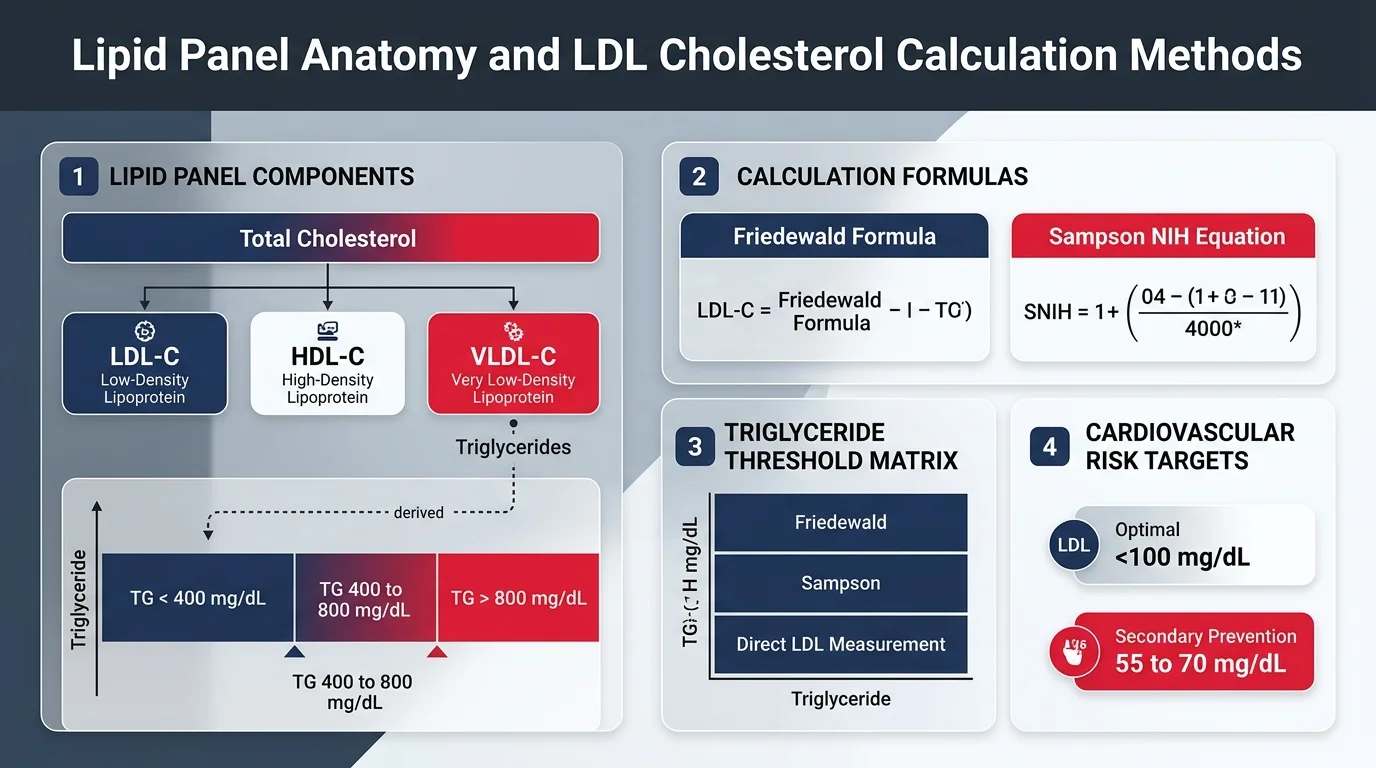
Why Does the Friedewald Formula Fail with High Triglycerides?
The central limitation of the 1972 Friedewald equation lies in its rigid physiological assumption. In reality, as circulating triglycerides accumulate, triglyceride-rich lipoproteins (chylomicrons, VLDL remnants, and intermediate-density lipoproteins) alter their lipid-to-protein ratio:
Friedewald and Sampson provide closely concordant results. Safe for routine primary prevention risk assessment.
Friedewald severely underestimates LDL (sometimes reporting falsely normal or even negative values). Sampson remains mathematically robust.
Mathematical calculations become unreliable. Direct chemical LDL assay or preparative ultracentrifugation is required by laboratory protocol.
Crucially, when patients achieve very low LDL levels on high-intensity statin therapy, ezetimibe, or PCSK9 inhibitors (e.g., $\text{LDL} < 70\text{ mg/dL}$), even moderate hypertriglyceridemia ($\text{TG } 200\text{--}399\text{ mg/dL}$) causes Friedewald to underestimate true LDL by 15 to 30 mg/dL. This artificial "under-calculation" can lead clinicians to falsely believe an ASCVD patient has met their therapeutic target when atherogenic particle burden remains unacceptably high.
Direct LDL vs. Calculated LDL: Key Differences
A frequent point of confusion on laboratory panels is whether to order a calculated LDL or a Direct LDL (dLDL). The clinical comparison table below outlines the diagnostic trade-offs:
| Clinical Characteristic | Calculated LDL-C (Sampson / Friedewald) | Direct Homogeneous LDL-C (dLDL) |
|---|---|---|
| Measurement Methodology | Mathematical deduction using Total Cholesterol, HDL, and Triglycerides | Chemical surfactants isolate LDL particles; automated spectrophotometric assay |
| Laboratory Cost | Zero additional cost (calculated automatically from basic lipid panel) | Higher cost; requires specialized commercial reagent kits |
| Accuracy in Severe Hypertriglyceridemia | Sampson valid up to 800 mg/dL; Friedewald fails at $\ge 400\text{ mg/dL}$ | Maintains accuracy with triglycerides up to 1000 mg/dL |
| Fasting Requirement | Traditionally preferred for Friedewald; Sampson robust in non-fasting samples | Can be reliably performed non-fasting |
| Interfering Substances | Severe hyperchylomicronemia, paraproteinemia, severe cholestasis | Atypical lipoprotein fractions, extreme hypertriglyceridemia ($>1000$) |
| Primary Clinical Indication | Routine screening, ASCVD prevention scoring, and statin monitoring | Fasting $\text{TG} > 400\text{ mg/dL}$, discordant clinical pictures, or clinical trial protocols |
2026 ACC/AHA & ESC Dyslipidemia Guidelines: LDL-C Target Goals
Contemporary clinical guidelines from the American College of Cardiology, American Heart Association (ACC/AHA), and European Society of Cardiology (ESC) establish personalized, risk-based LDL-C targets. Rather than viewing LDL through generic "normal" laboratory ranges, management is dictated by the patient's 10-year risk of Atherosclerotic Cardiovascular Disease (evaluated using our ASCVD Risk Calculator or Framingham Risk Score Calculator):
| Cardiovascular Risk Category | Defining Clinical Criteria | Target LDL-C Goal (mg/dL) | Target LDL-C Goal (mmol/L) |
|---|---|---|---|
| Extreme / Very-High Risk Secondary Prevention | Recent Acute Coronary Syndrome (< 1 yr), recurrent MI, polyvascular disease (CAD + PAD), or diabetes with target organ damage | < 55 mg/dL (and ≥ 50% reduction from baseline) | < 1.4 mmol/L |
| High Risk (Secondary Prevention) | Stable coronary artery disease, prior stroke/TIA, or peripheral artery disease | < 70 mg/dL | < 1.8 mmol/L |
| High Risk (Primary Prevention) | Severe primary hypercholesterolemia (baseline LDL ≥ 190 mg/dL) or diabetes mellitus in patients aged 40–75 | < 70–100 mg/dL (and ≥ 50% statin reduction) | < 1.8–2.6 mmol/L |
| Intermediate Risk | 10-year ASCVD risk 7.5% to 19.9% with risk-enhancing factors (e.g., family history, high CAC score) | < 100 mg/dL | < 2.6 mmol/L |
| Low Risk (Primary Prevention) | 10-year ASCVD risk < 5%; young adults without major vascular risk factors | < 116 mg/dL | < 3.0 mmol/L |
When assessing patients presenting with acute chest pain in hospital emergency departments, clinicians frequently evaluate acute ischemia risk using our HEART Score for Chest Pain Calculator and TIMI Risk Score Calculator prior to establishing long-term outpatient lipid lowering regimens.
Non-HDL Cholesterol & Cardiovascular Lipid Ratios
While LDL-C receives primary therapeutic focus, secondary lipid targets provide critical incremental prognostic value, especially in patients with metabolic syndrome, obesity, and insulin resistance:
1. Non-HDL Cholesterol ($\text{TC} - \text{HDL}$)
Non-HDL-C measures the cumulative cholesterol payload carried across all atherogenic particles (LDL, VLDL, IDL, and Lp(a)). Each of these particles contains exactly one molecule of Apolipoprotein B-100 (ApoB), making Non-HDL a cost-free biological surrogate for ApoB. According to ACC/AHA guidelines, the target Non-HDL goal is always precisely 30 mg/dL higher than the patient's LDL target (e.g., if LDL goal is < 70 mg/dL, Non-HDL goal is < 100 mg/dL).
2. Total Cholesterol to HDL Ratio
The TC/HDL Ratio quantifies the proportion of atherogenic to anti-atherogenic particles. A ratio below 3.5 denotes optimal cardiovascular health, 3.5 to 4.5 represents average adult risk, and ratios exceeding 5.0 signal substantially heightened coronary atherogenesis regardless of absolute LDL numbers.
3. Triglycerides to HDL Ratio (TG/HDL)
The TG/HDL ratio serves as a recognized clinical surrogate for insulin resistance and small, dense LDL particle phenotypes (Pattern B). An optimal ratio is < 2.0 in $\text{mg/dL}$. Ratios exceeding 3.5 correlate strongly with hyperinsulinemia, non-alcoholic fatty liver disease (NAFLD/MASLD), and atherogenic dyslipidemia.
Fasting vs. Non-Fasting Lipid Panels: Modern Standards
Historically, patients were mandated to undergo strict 12-hour water-only fasts before any lipid evaluation. In recent consensus statements from the AHA, ACC, and European Atherosclerosis Society (EAS), routine non-fasting lipid testing is now endorsed for the vast majority of clinical evaluations.
- Postprandial Stability: Total cholesterol, HDL-C, and LDL-C fluctuate minimally after routine meals (typically decreasing by less than 5 to 10 mg/dL due to mild hemodilution).
- Triglyceride Variation: Serum triglycerides increase transiently by 20 to 50 mg/dL (0.2–0.6 mmol/L) following a standard meal, which modern equations like Sampson account for seamlessly.
- When Fasting Remains Necessary: A repeat fasting lipid panel is indicated if:
- Baseline non-fasting triglycerides exceed 400 mg/dL (4.5 mmol/L).
- Initial screening uncovers unexplained severe dyslipidemia or familial hypercholesterolemia.
- Evaluating response to specific triglyceride-lowering therapies (e.g., icosapent ethyl or fibrates).
- Monitoring patients recovering from acute hypertriglyceridemic pancreatitis.
Real-World Clinical Worked Case Studies
Case 1: Metabolic Syndrome with Hypertriglyceridemia (Sampson vs. Friedewald Failure)
Clinical PharmacologyPatient Presentation: A 52-year-old male with type 2 diabetes and hypertension undergoes routine annual laboratory testing. He has no known prior coronary disease. His fasting lipid panel reveals:
- Total Cholesterol = 240 mg/dL
- HDL Cholesterol = 38 mg/dL
- Triglycerides = 460 mg/dL
Modern Sampson (NIH) Formula: 240/0.948 − 38/0.971 − [(460/8.56) + (460 × 202/2140) − (460²/16100)] − 9.44 = 138.4 mg/dL
Clinical Interpretation: Because triglycerides exceed 400 mg/dL, the Friedewald formula overestimates VLDL, generating a falsely reassuring LDL estimate of 110 mg/dL. The Sampson equation accurately calculates true LDL-C at 138.4 mg/dL (a 28.4 mg/dL discrepancy!).
Actionable Pathway: His Non-HDL cholesterol is markedly elevated at 202 mg/dL ($\text{TC} - \text{HDL}$), and his TG/HDL ratio is 12.1 (severe insulin resistance). In accordance with 2026 ACC/AHA guidelines, he is initiated on moderate-to-high intensity statin therapy targeting both LDL < 70 mg/dL and Non-HDL < 100 mg/dL.
Case 2: 64-Year-Old Female Post-MI (Statin Target Verification)
Secondary PreventionPatient Presentation: A 64-year-old female presents for a 3-month follow-up visit after acute myocardial infarction treated with drug-eluting stent placement. She has been taking Atorvastatin 80 mg daily. Her lipid panel in SI units shows:
- Total Cholesterol = 3.60 mmol/L (139.2 mg/dL)
- HDL Cholesterol = 1.35 mmol/L (52.2 mg/dL)
- Triglycerides = 1.20 mmol/L (106.3 mg/dL)
Friedewald LDL-C: 3.60 − 1.35 − (1.20 ÷ 2.2) = 1.70 mmol/L (65.8 mg/dL)
Non-HDL-C: 3.60 − 1.35 = 2.25 mmol/L (87.0 mg/dL)
Clinical Interpretation: Both formulas are in tight agreement (difference < 1 mg/dL). Her calculated LDL of 1.71 mmol/L (66 mg/dL) successfully meets the standard secondary prevention goal (< 1.8 mmol/L or < 70 mg/dL).
Management Consideration: However, because her acute coronary event occurred within the past 12 months, 2026 ACC/AHA and ESC "Very-High Risk" guidelines advocate an intensified goal of < 1.4 mmol/L (< 55 mg/dL). Her cardiologist adds Ezetimibe 10 mg daily to safely reach this optimal secondary prevention threshold.
Frequently Asked Questions (FAQs)
How is calculated LDL cholesterol determined from a lipid panel?
Calculated LDL-C is derived from three standard laboratory measurements: Total Cholesterol (TC), High-Density Lipoprotein Cholesterol (HDL-C), and Triglycerides (TG). In the classic Friedewald formula (mg/dL), LDL-C = Total Cholesterol − HDL-C − (Triglycerides / 5). In the modern Sampson/NIH equation, an advanced nonlinear regression accounts for broad triglyceride ranges up to 800 mg/dL.
What does "LDL cholesterol calculated" mean on a laboratory report?
"LDL calculated" indicates that the clinical laboratory did not use an automated chemical reagent to measure LDL directly. Instead, the laboratory instrument applied a mathematical algorithm (such as Friedewald, Martin-Hopkins, or Sampson/NIH) to the measured total cholesterol, HDL-C, and triglycerides.
Why is the Friedewald formula invalid when triglycerides are 400 mg/dL or higher?
The Friedewald formula assumes a constant 5:1 ratio of triglycerides to Very-Low-Density Lipoprotein cholesterol (VLDL-C). When serum triglycerides reach or exceed 400 mg/dL (4.52 mmol/L), this linear assumption collapses, causing substantial mathematical overestimation of VLDL-C and dangerous underestimation of atherogenic LDL-C. In such cases, the Sampson equation or a direct chemical LDL assay is clinically required.
What is the difference between direct LDL and calculated LDL?
Calculated LDL is an arithmetic estimate based on total cholesterol, HDL-C, and triglycerides. Direct LDL (dLDL) is a physical measurement performed using detergent-based homogeneous enzymatic assays or ultracentrifugation. While direct assays are unaffected by high triglycerides up to 1000 mg/dL, they carry higher laboratory costs and may occasionally misclassify atypical lipoprotein particles.
How do you convert cholesterol and triglycerides between mg/dL and mmol/L?
Because cholesterol and triglycerides have different molecular weights, they require distinct conversion factors. For total cholesterol, HDL-C, and LDL-C: divide mg/dL by 38.67 to get mmol/L (or multiply mmol/L by 38.67). For triglycerides: divide mg/dL by 88.57 to get mmol/L (or multiply mmol/L by 88.57).
What is non-HDL cholesterol and why is it important?
Non-HDL cholesterol equals Total Cholesterol minus HDL-C. It captures all circulating atherogenic, apolipoprotein B-containing lipoproteins—including LDL, VLDL, intermediate-density lipoproteins (IDL), and lipoprotein(a). Non-HDL-C does not require fasting and remains highly predictive of cardiovascular risk even when triglycerides are elevated.
What are the current ACC/AHA 2026 LDL-C target goals?
Under contemporary ACC/AHA and ESC dyslipidemia guidelines, target LDL-C levels depend on clinical cardiovascular risk category: < 55 mg/dL (< 1.4 mmol/L) with at least 50% reduction for very-high-risk secondary prevention; < 70 mg/dL (< 1.8 mmol/L) for high-risk patients; and < 100 mg/dL (< 2.6 mmol/L) for moderate-risk individuals.
Peer-Reviewed Scientific References & Clinical Guidelines
- Sampson M, Ling C, Sun Q, et al. A New Equation for Calculation of Low-Density Lipoprotein Cholesterol in Patients With Normolipidemia and/or Hypertriglyceridemia. JAMA Cardiology. 2020;5(5):540–548. doi:10.1001/jamacardio.2020.0011.
- Friedewald WT, Levy RI, Fredrickson DS. Estimation of the concentration of low-density lipoprotein cholesterol in plasma, without use of the preparative ultracentrifuge. Clinical Chemistry. 1972;18(6):499–502.
- Martin SS, Blaha MJ, Elshazly MB, et al. Comparison of a novel method vs the Friedewald equation for estimating low-density lipoprotein cholesterol levels from the standard lipid profile. JAMA. 2013;310(19):2061–2068. doi:10.1001/jama.2013.280532.
- Grundy SM, Stone NJ, Bailey AL, et al. 2018 AHA/ACC/AACVPR/AAPA/ABC/ACPM/ADA/AGS/APhA/ASPC/NLA/PCNA Guideline on the Management of Blood Cholesterol. Circulation. 2019;139(25):e1082–e1143.
- Mach F, Baigent C, Catapano AL, et al. 2019 ESC/EAS Guidelines for the management of dyslipidaemias: lipid modification to reduce cardiovascular risk. European Heart Journal. 2020;41(1):111–188. doi:10.1093/eurheartj/ehz455.
- Nordestgaard BG, Langsted A, Mora S, et al. Fasting is not routinely required for determination of a lipid profile: clinical and laboratory implications including flagging at desirable concentration thresholds. European Heart Journal. 2016;37(25):1944–1958.