How Is the Framingham Risk Score Calculated?
The Framingham Risk Score (FRS) is a validated clinical prediction tool designed to quantify an individual's absolute 10-year risk of experiencing a first cardiovascular event. Developed from longitudinal observational cohort data of the landmark Framingham Heart Study, the scoring algorithm integrates multiple independent risk factors into a multivariable Cox proportional hazards regression model. While acute emergency presentations with chest discomfort require immediate triage via the HEART Score for Chest Pain, long-term outpatient primary prevention relies on multi-variable risk engines such as the ASCVD Risk Estimator and the Framingham model.
While early versions focused strictly on "hard" coronary heart disease (coronary death and myocardial infarction), the modern gold-standard tool—published by D'Agostino et al. (2008) in Circulation—evaluates general cardiovascular disease (CVD). This comprehensive endpoint encompasses coronary heart disease (angina pectoris, coronary insufficiency, myocardial infarction), cerebrovascular disease (ischemic stroke, hemorrhagic stroke, transient ischemic attack), peripheral artery disease (claudication), and heart failure.
$P = 1 - S_0(10)^{\exp(\sum \beta_i X_i - \bar{\mu})}$
Where $S_0(10)$ represents the 10-year baseline survival rate (0.88936 in men, 0.95012 in women), $\beta_i$ are regression coefficients for each risk biomarker, and $\bar{\mu}$ represents the population mean log-hazard score (23.9802 in men, 26.1931 in women).
Framingham Calculation Formula & Variable Parameters
The standard laboratory-based Framingham equation incorporates seven clinical parameters measured during routine clinical evaluation:
| Risk Variable | Clinical Measurement | Standard Units | Impact on Calculated Risk |
|---|---|---|---|
| Age | Chronological age (30 to 79 years) | Years | Strongest non-modifiable predictor; exponential increase with age. |
| Total Cholesterol | Fasting or non-fasting serum total cholesterol | mg/dL or mmol/L | Proportional atherogenic lipid burden. |
| HDL Cholesterol | High-density lipoprotein cholesterol | mg/dL or mmol/L | Inverse association; protective factor (reduces risk). |
| Systolic Blood Pressure | Resting in-clinic seated blood pressure | mmHg | Endothelial sheer stress and vascular remodeling accelerator. |
| BP Treatment Status | Prescription of antihypertensive medication | Binary (Yes / No) | Treated individuals have higher baseline log-odds for the same SBP. |
| Cigarette Smoking | Current smoker within past month | Binary (Yes / No) | Accelerates endothelial dysfunction, platelet activation, and oxidation. |
| Diabetes Mellitus | Fasting glucose ≥ 126 mg/dL, HbA1c ≥ 6.5%, or on therapy | Binary (Yes / No) | Substantially escalates micro- and macrovascular atherosclerosis. |
Why Is HDL-C a Negative Risk Factor in Framingham Scoring?
In epidemiological cardiology and traditional point scoring matrices, high levels of High-Density Lipoprotein Cholesterol (HDL-C)—specifically values ≥ 60 mg/dL (1.6 mmol/L)—are classified as a negative risk factor. Unlike positive risk factors that add to the cardiovascular risk sum (such as elevated LDL, smoking, or hypertension), a negative risk factor actively subtracts risk points.
This negative association reflects the physiological role of HDL particles in reverse cholesterol transport. Apolipoprotein A-I (ApoA-I) on HDL facilitates the efflux of excess cholesterol from peripheral macrophage foam cells in the arterial wall back to the liver for biliary excretion. In clinical practice, evaluating total atherogenic lipid burden alongside the LDL Cholesterol Calculator helps clinicians assess whether low HDL coincides with elevated non-HDL particles requiring pharmacotherapy.
How to Calculate Framingham Risk Score by Hand (Point Scoring Worksheet)
Before automated electronic health records, clinicians calculated the Framingham 10-year risk by hand using standardized point scoring sheets developed under the National Cholesterol Education Program (NCEP) Adult Treatment Panel III (ATP III) and D'Agostino algorithms. In this method, each clinical variable is assigned an integer point value based on age categories:
| Variable Category | Clinical Tiers | Points in Men | Points in Women |
|---|---|---|---|
| Age | 30–34 / 35–39 / 40–44 / 45–49 / 50–54 / 55–59 / 60–64 / 65–69 / 70–74 | -1 to +14 pts | -9 to +16 pts |
| Total Cholesterol | < 160 / 160–199 / 200–239 / 240–279 / ≥ 280 mg/dL | 0 to +5 pts | 0 to +5 pts |
| Cigarette Smoker | Non-smoker vs. Active Smoker | 0 vs. +4 pts | 0 vs. +3 pts |
| HDL Cholesterol | < 35 / 35–44 / 45–49 / 50–59 / ≥ 60 mg/dL | +2, +1, 0, 0, -1 pt (Negative Factor) | +2, +1, 0, 0, -1 pt (Negative Factor) |
| Systolic BP (Untreated) | < 120 / 120–129 / 130–139 / 140–159 / ≥ 160 mmHg | 0, 0, +1, +1, +2 pts | -1, 0, +1, +1, +2 pts |
| Systolic BP (Treated) | < 120 / 120–129 / 130–139 / 140–159 / ≥ 160 mmHg | 0, +1, +2, +2, +3 pts | 0, +1, +2, +2, +3 pts |
| Diabetes Mellitus | Non-diabetic vs. Diabetic | 0 vs. +3 pts | 0 vs. +4 pts |
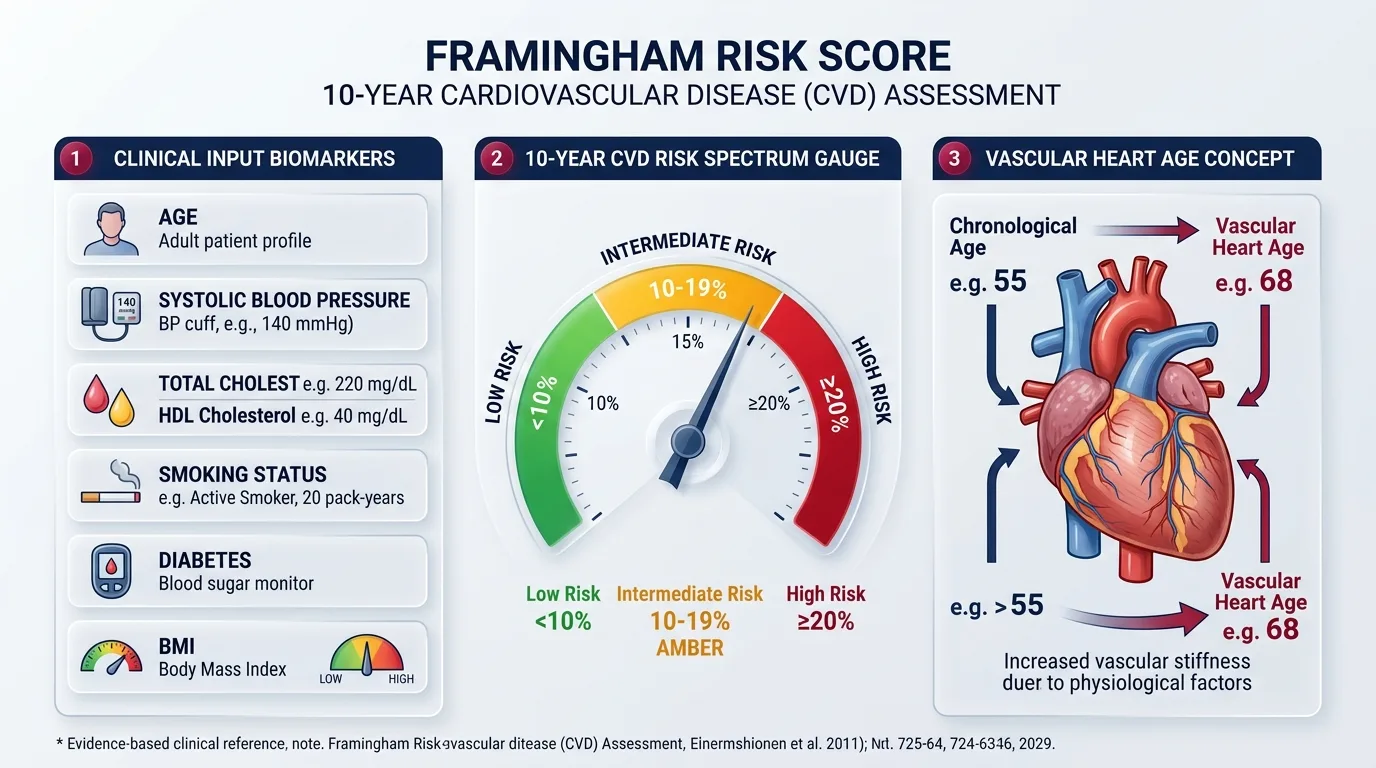
Points are summed to yield a total score, which is then mapped directly to a validated 10-year CVD risk percentage table. A point total corresponding to < 10% indicates low risk, 10% to 19% intermediate risk, and ≥ 20% high risk.
Clinical Interpretation & Risk Stratification (CCS Guidelines)
The Canadian Cardiovascular Society (CCS) Dyslipidemia Guidelines utilize the Framingham Risk Score as the cornerstone of primary prevention screening in asymptomatic adults. Based on the calculated 10-year general CVD risk, patients are stratified into three actionable risk categories:
| 10-Year Risk Tier | Calculated FRS Range | Primary Clinical Significance | Consensus Management Strategy |
|---|---|---|---|
| Low Risk | < 10% 10-Year Risk | Favorable cardiovascular trajectory; low immediate event likelihood. | Lifestyle optimization (Mediterranean diet, aerobic exercise, smoking abstinence). Reassess FRS every 3 to 5 years. |
| Intermediate Risk | 10% to 19.9% 10-Year Risk | Equivocal benefit zone requiring shared clinical decision-making. | Initiate statin therapy if LDL-C ≥ 3.5 mmol/L (135 mg/dL), non-HDL-C ≥ 4.2 mmol/L, ApoB ≥ 1.05 g/L, or if risk enhancers are present (family history of premature CAD, coronary artery calcium score CAC > 0). |
| High Risk | ≥ 20% 10-Year Risk | Substantial 10-year probability of myocardial infarction or stroke. | Strong recommendation for statin therapy. Target ≥ 50% LDL-C reduction and LDL-C < 2.0 mmol/L (< 70 mg/dL), combined with blood pressure normalization. |
Framingham Risk Score Using BMI (Non-Laboratory Office Model)
In many ambulatory clinical scenarios, recent lipid panels are unavailable, or patients are undergoing rapid community screening. To address this barrier, D'Agostino and colleagues validated an alternative non-laboratory Framingham model that substitutes Total Cholesterol and HDL Cholesterol with Body Mass Index (calculated via the BMI Calculator).
Extensive cross-validation cohorts have demonstrated that the BMI model achieves discrimination and calibration virtually identical to the lipid-based model (c-statistic ~0.76 to 0.79). It provides clinicians and patients with immediate, actionable risk stratification during initial consultations without waiting for phlebotomy laboratory turnarounds.
What Is Vascular Heart Age and How Is It Interpreted?
Cardiovascular risk percentages can be challenging for patients to conceptualize, particularly in younger individuals whose absolute 10-year risk remains mathematically low despite severe clustering of modifiable risk factors. To improve risk communication, the Framingham algorithm introduces Vascular Heart Age.
Heart age represents the chronological age of an individual of the same biological sex who possesses identical 10-year cardiovascular risk but maintains ideal risk factor levels (normal blood pressure, untreated, non-smoker, non-diabetic, optimal cholesterol). For example, if a 48-year-old male smoker with elevated blood pressure has a calculated heart age of 63, it illustrates that his vascular system is aging 15 years faster than his chronological calendar age.
Clinical Limitations, Confounders & Exclusions
While the Framingham Risk Score remains an invaluable benchmark in primary prevention, several critical clinical caveats must be observed:
- Exclusion of Established CVD: Patients with established coronary artery disease, prior stroke, peripheral vascular disease, or abdominal aortic aneurysm are already at highest risk; risk scores are inapplicable and secondary prevention protocols take precedence.
- Age Constraints: The original Framingham equations were derived and validated in adults aged 30 to 74 (extended to 79). They cannot reliably stratify teenagers, young adults (< 30), or the very elderly (> 79).
- Lifetime vs. 10-Year Horizon: A 35-year-old with severe dyslipidemia may exhibit a low 10-year risk (< 5%) simply due to young age, yet carry an immense lifetime cardiovascular liability. In such patients, lifetime risk tools and family history evaluations are essential.
- Ethnic & Regional Calibration: The Framingham cohort consisted predominantly of Caucasian individuals in Massachusetts. In specific South Asian, African, and Indigenous populations, the standard Framingham score may underestimate risk, prompting guidelines to recommend risk multipliers (e.g., 1.5× for South Asian ancestry).
- Confounders: Chronic inflammatory diseases (rheumatoid arthritis, lupus, psoriasis, HIV), chronic kidney disease, and metabolic syndrome are not accounted for in the baseline algorithm.
Clinical Worked Case Scenarios
Patient Presentation: A 54-year-old male executive presents for a routine wellness physical. He is an active cigarette smoker (1 pack/day) with no history of diabetes.
Vitals & Labs: Seated SBP 138 mmHg (untreated). Total Cholesterol 215 mg/dL (5.56 mmol/L), HDL-C 46 mg/dL (1.19 mmol/L).
Calculation & Outcome: Summing the logarithmic risk terms yields a 10-year CVD risk of 15.4% (Intermediate Risk) and a Vascular Heart Age of 64 years (+10 years older than chronological age).
Clinical Action Plan: Following Canadian Cardiovascular Society (CCS) guidelines, the physician discusses smoking cessation counseling and offers statin pharmacotherapy to reduce lifetime cardiovascular trajectory.
Patient Presentation: A 58-year-old female runner presents with elevated total cholesterol discovered on an executive screening panel. Non-smoker, non-diabetic, untreated SBP 124 mmHg.
Vitals & Labs: Total Cholesterol 232 mg/dL (6.0 mmol/L), HDL-C 78 mg/dL (2.02 mmol/L).
Calculation & Outcome: Because her HDL-C is substantially elevated (≥ 60 mg/dL), it functions as a strong negative risk factor. Her calculated 10-year CVD risk is 3.8% (Low Risk), and her Vascular Heart Age is 52 years (-6 years younger than chronological age).
Clinical Action Plan: Reassurance provided. Lifestyle maintenance encouraged without immediate need for statin pharmacotherapy.
Frequently Asked Questions (Clinical & Evidence-Based)
What does the Framingham Risk Score calculate?
The Framingham Risk Score calculates an individual's 10-year probability of developing general cardiovascular disease (CVD), which includes coronary heart disease (myocardial infarction, coronary insufficiency, and angina), cerebrovascular events (ischemic and hemorrhagic stroke, transient ischemic attack), peripheral artery disease, and heart failure.
What are the Framingham risk categories according to clinical guidelines?
Under major clinical consensus guidelines (such as the Canadian Cardiovascular Society CCS guidelines), 10-year CVD risk is stratified into three categories: Low Risk (< 10%), Intermediate Risk (10% to 19.9%), and High Risk (≥ 20%). A high-risk score generally indicates that statin therapy and aggressive lifestyle modification should be initiated.
Why is high HDL cholesterol considered a negative risk factor in Framingham scoring?
In cardiovascular risk assessment, HDL cholesterol is considered a negative risk factor because higher levels (specifically ≥ 60 mg/dL or 1.6 mmol/L) exert an independent atheroprotective effect through reverse cholesterol transport and endothelial preservation. In traditional point scoring sheets, high HDL subtracts 1 point from the total score, directly reducing calculated risk.
Can the Framingham Risk Score be calculated without cholesterol blood tests?
Yes. In the definitive 2008 D'Agostino et al. Framingham Heart Study model published in Circulation, a validated non-laboratory BMI-based model replaces Total Cholesterol and HDL Cholesterol with Body Mass Index (BMI). This allows accurate cardiovascular screening in community settings or initial office visits before bloodwork is completed.
What is Vascular Heart Age and how is it interpreted?
Vascular Heart Age (or heart age) represents the chronological age of a person with the same predicted 10-year cardiovascular risk but who possesses ideal risk factors (normal blood pressure, non-smoker, non-diabetic, optimal cholesterol). If a 50-year-old has a heart age of 65, it signifies that their vascular risk profile mirrors an otherwise healthy 65-year-old.
How does the Framingham Risk Score differ from the ACC/AHA ASCVD Risk Estimator?
The Framingham 2008 general CVD score evaluates total cardiovascular endpoints including angina, TIA, peripheral artery disease, and heart failure. In contrast, the ACC/AHA Pooled Cohort Equations accessible on our homepage specifically focus on hard atherosclerotic endpoints: nonfatal myocardial infarction, coronary heart disease death, and fatal or nonfatal stroke in individuals aged 40 to 79.
Who should not be assessed using the Framingham Risk Score?
The Framingham Risk Score is intended exclusively for primary cardiovascular prevention in adults without established cardiovascular disease. It should not be used for patients with known coronary artery disease, prior stroke, peripheral vascular disease, severe chronic kidney disease, or severe familial hypercholesterolemia (LDL-C ≥ 190 mg/dL or 4.9 mmol/L), as these individuals are automatically classified as high risk.
Peer-Reviewed References & Evidence Basis
- D'Agostino RB Sr, Vasan RS, Pencina MJ, Wolf PA, Cobain M, Massaro JM, Kannel WB. General cardiovascular risk profile for use in primary care: the Framingham Heart Study. Circulation. 2008 Feb 12;117(6):743-53. doi:10.1161/CIRCULATIONAHA.107.699579.
- Wilson PW, D'Agostino RB, Levy D, Belanger AM, Silbershatz H, Kannel WB. Prediction of coronary heart disease using risk factor categories. Circulation. 1998 May 12;97(18):1837-47. doi:10.1161/01.cir.97.18.1837.
- Pearson GJ, Thanassoulis G, Anderson TJ, et al. 2021 Canadian Cardiovascular Society Guidelines for the Management of Dyslipidemia for the Prevention of Cardiovascular Disease in Adults. Can J Cardiol. 2021 Aug;37(8):1129-1150. doi:10.1016/j.cjca.2021.03.016.
- Grundy SM, Stone NJ, Bailey AL, et al. 2018 AHA/ACC/AACVPR/AAPA/ABC/ACPM/ADA/AGS/APhA/ASPC/NLA/PCNA Guideline on the Management of Blood Cholesterol. Circulation. 2019 Jun 18;139(25):e1082-e1143. doi:10.1161/CIR.0000000000000625.
- National Cholesterol Education Program (NCEP) Expert Panel. Third Report of the National Cholesterol Education Program (NCEP) Expert Panel on Detection, Evaluation, and Treatment of High Blood Cholesterol in Adults (Adult Treatment Panel III) final report. Circulation. 2002 Dec 17;106(25):3143-421.