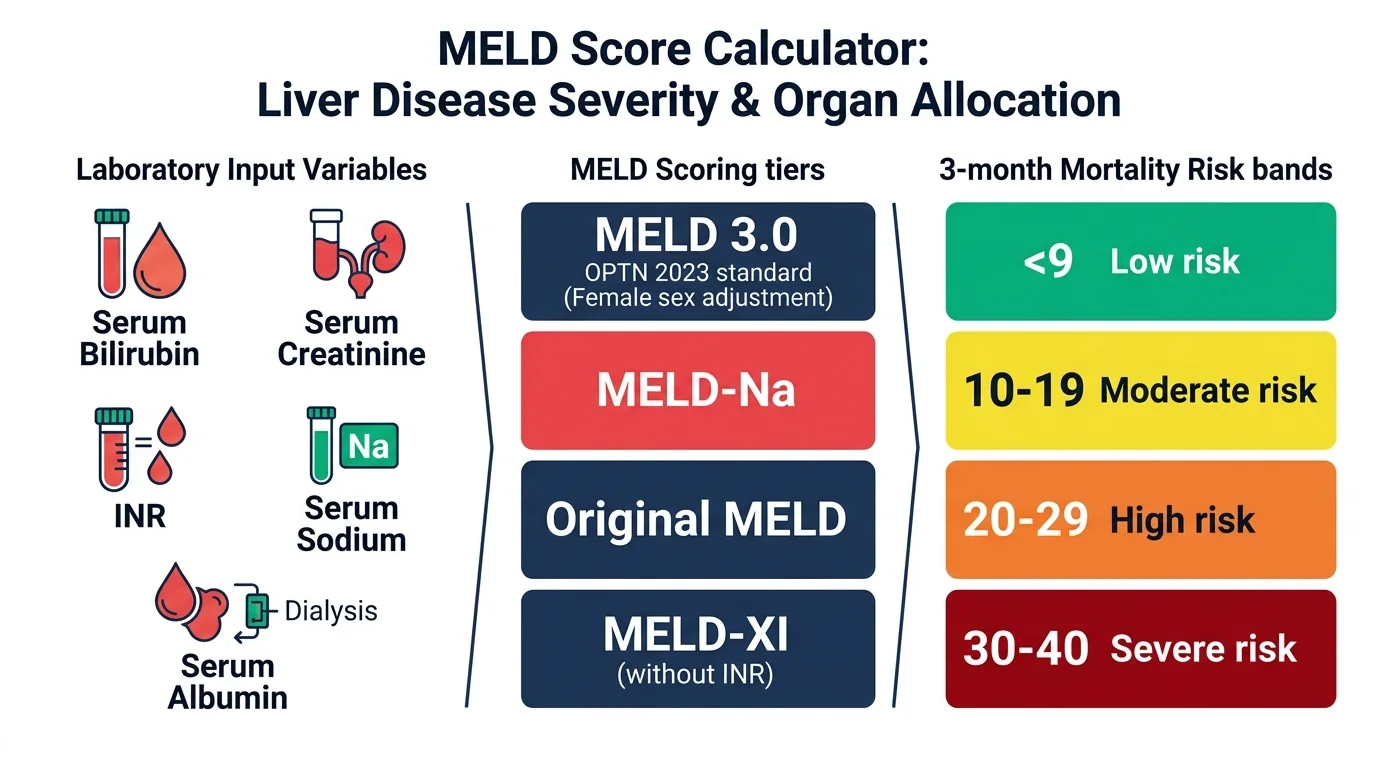
What Is the MELD Score? Evolution from Child-Pugh to MELD 3.0
The Model for End-Stage Liver Disease (MELD) is a validated numerical scoring system (ranging from 6 to 40) designed to quantify the severity of chronic end-stage liver disease and predict short-term (3-month) pre-transplant mortality. Originally developed by Dr. Patrick Kamath and colleagues at the Mayo Clinic in 2001 to predict survival following transjugular intrahepatic portosystemic shunt (TIPS) procedures, the score was rapidly adopted in February 2002 by the United Network for Organ Sharing (UNOS) and the Organ Procurement and Transplantation Network (OPTN) across the United States to govern deceased-donor liver allocation.
Prior to MELD, organ allocation relied on the historical Child-Turcotte-Pugh (CTP) classification. While clinically valuable, Child-Pugh suffered from critical limitations: it incorporated highly subjective clinical variables (such as grading the severity of hepatic encephalopathy and ascites), exhibited a narrow scoring range (5 to 15 points) with significant ceiling effects, and lacked the mathematical granularity required to equitably prioritize the sickest patients awaiting deceased-donor organs.
By replacing subjective clinical gestalt with three universally measured, objective laboratory tests—Serum Bilirubin, Serum Creatinine, and the International Normalized Ratio (INR)—MELD established a transparent, "sickest-first" allocation paradigm that dramatically reduced waitlist mortality worldwide.
Why MELD 3.0 Was Introduced: Eliminating Female Disparity & Adding Albumin
Over two decades of clinical use revealed important physiological disparities within the legacy MELD and MELD-Na models. Most notably, large multicenter cohort analyses demonstrated that women on the liver transplant waitlist faced significantly higher rates of waitlist mortality and lower rates of deceased-donor liver transplantation compared to men with identical disease severity. This sex disparity stemmed primarily from differences in baseline serum creatinine:
- Reduced Muscle Mass in Females: Women generally possess lower baseline skeletal muscle mass and lower daily endogenous creatinine generation than men. Consequently, a female patient experiencing substantial glomerular filtration decline (which can be independently monitored via the Creatinine Clearance Calculator or GFR Calculator) frequently exhibited a "normal" serum creatinine of 1.2 to 1.5 mg/dL, whereas a male patient with equivalent renal failure displayed a creatinine of 2.0 to 2.5 mg/dL, earning a much higher MELD score.
- Underestimation of Sarcopenic Cirrhosis: Cirrhotic sarcopenia suppresses serum creatinine levels, leading legacy MELD equations to underestimate true renal compromise.
The OPTN July 13, 2023 National Policy Update
To eliminate this systematic inequality, the OPTN officially implemented MELD 3.0 (derived by Kim et al., published in Gastroenterology 2021) as the mandatory national standard for liver allocation across the United States. MELD 3.0 adds a biological female sex adjustment (+1.33 points), incorporates Serum Albumin, lowers the serum creatinine ceiling to 3.0 mg/dL, and includes dynamic interaction terms between sodium, bilirubin, albumin, and creatinine.
MELD Scoring Equations: MELD 3.0, MELD-Na, Original MELD & MELD-XI
To ensure reproducible, clinically valid calculations, strict laboratory bounding constraints must be applied before executing any logarithmic transformations:
| Laboratory Variable | Lower Bound (Floor) | Upper Bound (Ceiling) | Clinical Rationale |
|---|---|---|---|
| Serum Bilirubin | 1.0 mg/dL (17.1 µmol/L) | None (actual value used) | Prevents negative natural logarithms ($\ln(x) < 0$ when $x < 1$). |
| Serum Creatinine | 1.0 mg/dL (88.4 µmol/L) | 3.0 mg/dL (MELD 3.0) 4.0 mg/dL (MELD-Na / Original) |
Values below 1.0 are set to 1.0. Lowering cap to 3.0 in MELD 3.0 avoids disproportionate skew from extreme renal failure. |
| INR | 1.0 ratio | None (actual value used) | Normal extrinsic coagulation is 0.9–1.1; values < 1.0 bounded to 1.0. |
| Serum Sodium | 125 mEq/L (mmol/L) | 137 mEq/L (mmol/L) | Hyponatremia reflects severe splanchnic vasodilation and effective arterial hypovolemia. Bounded between 125 and 137. |
| Serum Albumin | 1.5 g/dL (15 g/L) | 3.5 g/dL (35 g/L) | Synthesized exclusively by hepatocytes; values bounded between 1.5 and 3.5 g/dL in MELD 3.0. |
| Dialysis / CVVHD Status | — | Sets Creatinine to Cap | If dialyzed ≥ 2 times in past 7 days or 24h continuous CVVHD, Cr is fixed at 3.0 (MELD 3.0) or 4.0 (MELD-Na). |
1. The MELD 3.0 Formula (Current OPTN Standard)
Where: Female = 1, Male = 0. All variables bounded as defined above. Final score is rounded to the nearest integer and bounded between 6 and 40.
2. The MELD-Na Formula (OPTN 2016 – 2023)
Derived by Kim et al. in 2008, MELD-Na adjusts the original score for dilutional hyponatremia:
If MELD(i) > 11:
MELD-Na = MELD(i) + 1.32 × (137 − Sodium) − [ 0.033 × MELD(i) × (137 − Sodium) ]
If MELD(i) ≤ 11, MELD-Na equals MELD(i). Creatinine is capped at 4.0 mg/dL. Bounded between 6 and 40.
3. The Original MELD Formula (2002)
Creatinine capped at 4.0 mg/dL. Scores range from 6 to 40.
4. The MELD-XI Formula (MELD Excluding INR)
For patients receiving oral vitamin K antagonists (Warfarin) or direct oral anticoagulants (DOACs), INR is pharmacologically elevated and does not reflect intrinsic hepatic protein synthesis failure. In these patients, the validated MELD-XI equation (Heuman et al.) should be utilized:
Widely utilized in cirrhotic cardiomyopathy, post-Fontan failing physiology, and advanced heart failure cohorts.
3-Month Waiting List Mortality Stratification & UNOS Tiers
The primary clinical utility of MELD is stratifying 90-day mortality risk in patients with end-stage cirrhosis awaiting liver transplantation. Clinical trials and OPTN registry data define the following risk tiers:
| MELD Score Tier | Clinical Category | Observed 3-Month Mortality | Transplant Waitlist Management |
|---|---|---|---|
| ≤ 9 Points | Low Risk | ~1.9% (1.0% – 3.0%) | Well-compensated cirrhosis. Routine outpatient hepatology surveillance every 6–12 months. |
| 10 – 19 Points | Moderate Risk | ~6.0% (4.0% – 10.0%) | Early decompensation. Formal transplant evaluation recommended when score reaches ≥ 15. |
| 20 – 29 Points | High Risk | ~19.6% (15.0% – 28.0%) | Severe decompensation (refractory ascites, recurrent SBP, encephalopathy). Active transplant listing. |
| 30 – 39 Points | Severe Risk | ~52.6% (45.0% – 65.0%) | Acute-on-chronic liver failure (ACLF). Inpatient ICU monitoring; high regional organ allocation priority. |
| ≥ 40 Points | Critical / Extreme Risk | 71.3% – 100% | Highest deceased-donor allocation tier. Multi-organ failure; urgent emergent liver transplantation. |
The "MELD 15" Rule: Landmark studies by Merion et al. demonstrated that patients with MELD scores below 15 do not experience a survival benefit from deceased-donor liver transplantation (transplant mortality exceeds waitlist mortality). Consequently, a MELD score of 15 or higher serves as the universally accepted clinical threshold for initiating active liver transplant waitlisting.
Dialysis, Continuous Renal Replacement & Hepatorenal Syndrome
Renal dysfunction in cirrhosis carries severe prognostic implications. Hepatorenal Syndrome (HRS-AKI) occurs due to severe splanchnic arterial vasodilation, resulting in marked renal vasoconstriction and dramatic drops in glomerular perfusion pressure (often monitored alongside Mean Arterial Pressure (MAP) and BUN/Creatinine Ratio).
Under OPTN/UNOS allocation criteria, patients receiving dialysis are awarded the maximum allowable creatinine value:
- Qualifying Criteria: The patient must have received hemodialysis at least twice within the 7 days prior to the laboratory draw, or must have undergone at least 24 consecutive hours of Continuous Renal Replacement Therapy (CRRT / CVVHD) within the previous 7 days.
- Ceiling Enforcement: Under MELD 3.0, the creatinine value is fixed at 3.0 mg/dL. Under MELD-Na and Original MELD, it is fixed at 4.0 mg/dL.
- Simultaneous Liver-Kidney Transplantation (SLKT): Patients with end-stage cirrhosis and sustained acute kidney injury requiring dialysis for > 4–6 weeks, or documented chronic kidney disease with GFR ≤ 30 mL/min, frequently qualify for dual SLKT.
MELD Score vs Child-Pugh Score: Clinical Comparison
Both MELD and the Child-Turcotte-Pugh (CTP) score evaluate cirrhotic severity, but they are used for distinctly different clinical purposes:
| Feature | MELD Score (MELD 3.0 / MELD-Na) | Child-Turcotte-Pugh (CTP) Score |
|---|---|---|
| Primary Purpose | Deceased-donor liver allocation & 3-month waitlist mortality | General cirrhosis staging & drug dosing guidelines |
| Score Range | Continuous numerical scale: 6 to 40 points | Categorical classes: Class A (5–6), Class B (7–9), Class C (10–15) |
| Input Variables | 100% objective laboratory values (Bilirubin, Cr, INR, Na, Albumin, Sex) | 3 laboratory values (Bilirubin, Albumin, INR) + 2 subjective clinical signs (Ascites, Encephalopathy) |
| Kidney Function | Heavily weighted (Serum Creatinine & Dialysis status) | Completely absent (does not account for renal failure) |
| Ceiling Effect | Minimal (wide 34-point spectrum) | Severe ceiling effect at 15 points |
| Best Clinical Use | Liver transplant listing, ICU ACLF triage, TIPS procedural risk | Hepatocellular carcinoma (BCLC staging), FDA drug clearance adjustments |
Non-Transplant Surgical Risk Stratification
Patients with cirrhosis undergoing elective or emergent non-transplant abdominal, cardiovascular, or orthopedic surgery face substantial risks of hepatic decompensation, bleeding diathesis, and post-operative death. Clinical guidelines from the American Association for the Study of Liver Diseases (AASLD) strongly recommend calculating the MELD score prior to any surgical procedure:
Post-Operative 30-Day Mortality Tiers in Cirrhotic Patients
• MELD < 10: 5.0% – 10.0% 30-day post-op mortality. Surgery generally well tolerated.
• MELD 10 – 14: 15.0% – 20.0% post-op mortality. Moderate risk; requires optimization of coagulopathy and volume.
• MELD 15 – 19: 25.0% – 35.0% post-op mortality. High risk; elective procedures should be reconsidered or postponed.
• MELD ≥ 20: > 50.0% post-op mortality. Extreme prohibitive mortality; elective surgery is strictly contraindicated.
Worked Clinical Scenarios & Electronic Medical Record Documentation
Case 1: Female with Sarcopenic Cirrhosis & Dilutional Hyponatremia
MELD 3.0 BenefitClinical Presentation: A 54-year-old female with alcohol-associated cirrhosis presents for routine hepatology evaluation. Physical examination reveals mild muscle wasting and trace pedal edema. Labs: Bilirubin 2.2 mg/dL, Creatinine 1.3 mg/dL, INR 1.5, Sodium 129 mEq/L, Albumin 2.6 g/dL. No dialysis.
- Original MELD (2002): 17 points
- MELD-Na (2016): 21 points (benefited +4 points from hyponatremia)
- MELD 3.0 (2023): 24 points (gains +1.33 female bonus, albumin deficit, and interaction terms)
Case 2: Advanced Hepatorenal Syndrome on CVVHD
High Allocation TierClinical Presentation: A 61-year-old male with NASH/MASH cirrhosis admitted to the ICU with hepatorenal syndrome and septic shock. He has undergone continuous venovenous hemodialysis (CVVHD) for 36 hours. Labs: Bilirubin 8.4 mg/dL, raw Creatinine 4.8 mg/dL, INR 2.6, Sodium 132 mEq/L, Albumin 2.1 g/dL.
- Dialysis Rule Applied: Creatinine capped at 3.0 mg/dL for MELD 3.0, and 4.0 mg/dL for MELD-Na.
- Calculated MELD 3.0: 38 points
- Calculated MELD-Na: 40 points (capped at maximum 40)
- Estimated 3-Month Mortality: > 52.6% – 71.3%
Case 3: Cardiac Cirrhosis on Warfarin Anticoagulation (MELD-XI)
MELD-XI IndicationClinical Presentation: A 68-year-old male with severe ischemic cardiomyopathy (EF 20%), chronic congestive hepatopathy, and mechanical aortic valve on therapeutic Warfarin presents with abdominal distension. Labs: Bilirubin 3.1 mg/dL, Creatinine 1.8 mg/dL, INR 3.2 (pharmacologically anticoagulated), Sodium 135 mEq/L, Albumin 3.3 g/dL.
- Standard MELD-Na: 25 points (falsely inflated by therapeutic warfarin anticoagulation)
- MELD-XI (Excluding INR): 22 points (derived strictly from Bilirubin and Creatinine)
Frequently Asked Questions About the MELD Score
How often should a patient's MELD score be updated?
Under OPTN/UNOS policy, the required recertification frequency depends directly on the patient's current MELD score:
- MELD ≥ 25: Recertification required every 7 days with fresh laboratory draws.
- MELD 19 – 24: Recertification required every 30 days.
- MELD 11 – 18: Recertification required every 3 months.
- MELD ≤ 10: Recertification required every 12 months.
Can a patient's MELD score go down?
Yes. MELD scores fluctuate dynamically with patient condition. If acute alcohol hepatitis resolves, biliary obstruction is stented, bacterial peritonitis is cleared with antibiotics, or renal perfusion improves with volume expansion, Bilirubin, Creatinine, and INR can improve, resulting in a lower MELD score.
What are MELD "Exception Points"?
Certain liver conditions carry a high risk of death or disease progression that is not accurately reflected by bilirubin, creatinine, and INR alone. In these cases, the National Liver Review Board (NLRB) can grant MELD Exception Points. Common indications include:
- Hepatocellular Carcinoma (HCC) meeting Milan Criteria
- Hepatopulmonary Syndrome (HPS)
- Portopulmonary Hypertension (POPH)
- Familial Amyloid Polyneuropathy (FAP)
- Primary Hyperoxaluria type 1
Why does MELD 3.0 include serum albumin when original MELD excluded it?
In original 2001 MELD derivation, albumin was excluded because it correlated with other hepatic synthetic markers and its serum half-life is long (~20 days). However, sophisticated modern statistical modeling in Kim et al.'s 2021 study demonstrated that when combined with creatinine interaction terms, serum albumin independently improves 90-day waitlist mortality discrimination without reducing model parsimony.
How does MELD interact with cardiovascular and heart failure scores?
Severe right-sided heart failure causes backward venous congestion, resulting in hepatic passive congestion, sinusoidal dilatation, and eventual "cardiac cirrhosis." Clinicians evaluating decompensated heart failure track MELD and MELD-XI alongside cardiac risk tools including the HEART Score for Chest Pain, TIMI Risk Score, and Cardiac Output Calculator to gauge cardiogenic multiorgan failure.
What is the maximum MELD score possible?
The maximum official MELD score under UNOS and OPTN policy is 40 points. Even if raw logarithmic mathematical calculations yield a score above 40 (for example, in patients with profound jaundice, multi-organ shock, and severe coagulopathy), the final score is officially capped at 40.
Peer-Reviewed Medical References & Clinical Guidelines
- Kamath PS, Wiesner RH, Malinchoc M, et al. A model to predict survival in patients with end-stage liver disease. Hepatology. 2001;33(2):464-470. doi:10.1053/jhep.2001.22172
- Wiesner R, Edwards E, Freeman R, et al. Model for end-stage liver disease (MELD) and allocation of donor livers. Gastroenterology. 2003;124(1):91-96. doi:10.1053/gast.2003.50016
- Kim WR, Biggins SW, Kremers WK, et al. Hyponatremia and mortality among patients on the wait-list for liver transplantation. N Engl J Med. 2008;359(10):1018-1026. doi:10.1056/NEJMoa0801209
- Kim WR, Mannalithara A, Heimbach JK, et al. MELD 3.0: The Model for End-Stage Liver Disease Updated for the Current Era. Gastroenterology. 2021;161(6):1887-1895.e4. doi:10.1053/j.gastro.2021.08.041
- Heuman DM, Mihas AA, Habib A, et al. MELD-XI: A rational approach to "sickest first" liver allocation in patients on oral anticoagulation. Liver Transpl. 2007;13(1):30-37. doi:10.1002/lt.20906
- Organ Procurement and Transplantation Network (OPTN). Policy 9: Allocation of Livers and Liver-Intestines. Revised July 13, 2023. Available at: https://optn.transplant.hrsa.gov