What Is the GRACE Score in Acute Coronary Syndromes?
The GRACE Score (Global Registry of Acute Coronary Events) is a validated multivariable risk assessment model designed to predict in-hospital mortality and 6-month post-discharge all-cause mortality across the full spectrum of acute coronary syndromes (ACS). Developed from a rigorous prospective observational registry encompassing 94 hospitals in 14 countries across North America, Europe, South America, Australia, and New Zealand, the GRACE registry established quantitative bedside risk stratification for non-ST-elevation myocardial infarction (NSTEMI), unstable angina (UA), and ST-elevation myocardial infarction (STEMI).
Unlike simplistic binary screening systems, the GRACE score integrates continuous physiological parameters, baseline renal function, and acute hemodynamic compromise to generate an exact statistical prognosis. Under clinical practice guidelines from the American College of Cardiology (ACC), American Heart Association (AHA), and European Society of Cardiology (ESC), the GRACE score serves as a primary decision tool determining the timing and urgency of diagnostic coronary angiography and percutaneous coronary intervention (PCI).
How Is the GRACE Score Calculated?
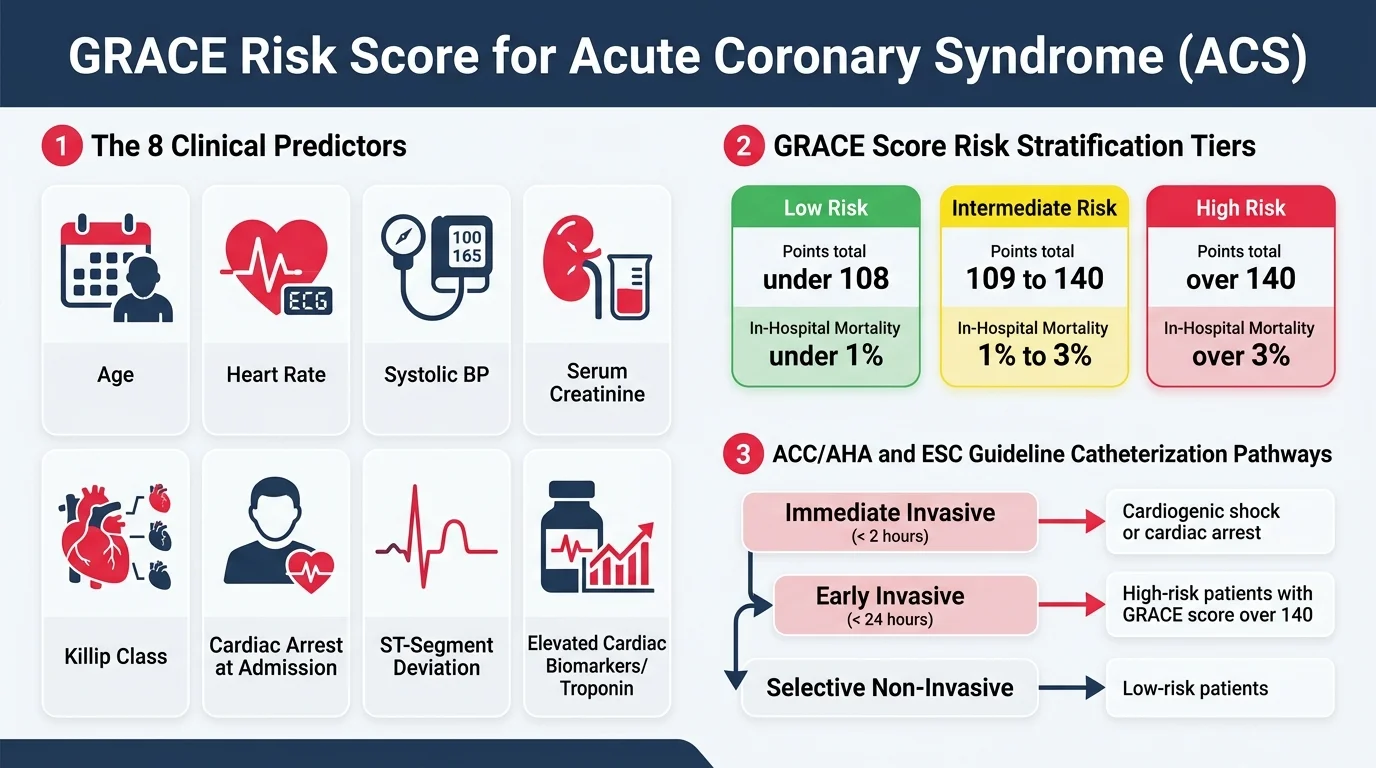
The GRACE risk algorithm evaluates 8 independent baseline clinical predictors identified via multivariable logistic regression modeling. Points are assigned across each variable and summed into a cumulative score ranging from 0 to over 250 points:
- Age (Years): Vascular vulnerability, vascular stiffening, and biological reserve diminish with advancing chronological age, contributing up to 100 points.
- Heart Rate (beats per minute): Tachycardia upon presentation reflects sympathetic adrenergic surge, acute neurohormonal activation, or early compensatory response to pump failure (0 to 46 points).
- Systolic Blood Pressure (mmHg): Inverse risk relationship where lower systolic pressure indicates cardiogenic compromise, forward output failure, or profound vascular collapse (0 to 58 points). Patients presenting with systolic pressures below 80 mmHg receive the maximum hemodynamic penalty.
- Initial Serum Creatinine: Renal clearance represents an essential prognostic marker in cardiorenal syndromes. Evaluated in mg/dL or µmol/L, renal dysfunction contributes up to 28 points. Clinicians often evaluate parallel renal metrics such as the Creatinine Clearance Calculator or Glomerular Filtration Rate (GFR) Calculator when dosing acute antiplatelet and anticoagulant agents.
- Killip Classification of Heart Failure: Stratifies the physical presence and severity of congestive heart failure on admission from Class I (absent) to Class IV (cardiogenic shock), adding up to 59 points.
- Cardiac Arrest at Initial Admission: Resuscitated out-of-hospital or in-hospital cardiac arrest carries an immediate 39-point addition, reflecting severe transmural ischemia or malignant ventricular arrhythmia.
- ST-Segment Deviation on Initial ECG: Transient or persistent ST-segment depression ≥ 0.5 mm (or transient elevation) adds 28 points, reflecting active plaque rupture and epicardial or subendocardial ischemia.
- Elevated Cardiac Biomarkers: Initial laboratory elevation of cardiac troponin (cTnI / cTnT) or CK-MB above the 99th percentile upper reference limit adds 14 points, confirming acute myocardial necrosis.
| Clinical Variable | Measurement Range / Category | Assigned Points |
|---|---|---|
| Age (Years) | ≤ 30 | 0 pts |
| 30 – 39 | 8 pts | |
| 40 – 49 | 25 pts | |
| 50 – 59 | 41 pts | |
| 60 – 69 | 58 pts | |
| 70 – 79 | 75 pts | |
| 80 – 89 | 91 pts | |
| ≥ 90 | 100 pts | |
| Heart Rate (bpm) | ≤ 49.9 | 0 pts |
| 50 – 69.9 | 3 pts | |
| 70 – 89.9 | 9 pts | |
| 90 – 109.9 | 15 pts | |
| 110 – 149.9 | 24 pts | |
| 150 – 199.9 | 38 pts | |
| ≥ 200 | 46 pts | |
| Systolic BP (mmHg) | ≥ 200 | 0 pts |
| 160 – 199.9 | 10 pts | |
| 140 – 159.9 | 24 pts | |
| 120 – 139.9 | 34 pts | |
| 100 – 119.9 | 43 pts | |
| 80 – 99.9 | 53 pts | |
| < 80 | 58 pts | |
| Serum Creatinine | 0 – 0.39 mg/dL (0 – 34 µmol/L) | 1 pt |
| 0.40 – 0.79 mg/dL (35 – 69 µmol/L) | 4 pts | |
| 0.80 – 1.19 mg/dL (70 – 105 µmol/L) | 7 pts | |
| 1.20 – 1.59 mg/dL (106 – 140 µmol/L) | 10 pts | |
| 1.60 – 1.99 mg/dL (141 – 176 µmol/L) | 13 pts | |
| 2.00 – 3.99 mg/dL (177 – 353 µmol/L) | 21 pts | |
| ≥ 4.00 mg/dL (≥ 354 µmol/L) | 28 pts | |
| Killip Class | Class I (No CHF signs) | 0 pts |
| Class II (Rales, S3, elevated JVP) | 20 pts | |
| Class III (Frank pulmonary edema) | 39 pts | |
| Class IV (Cardiogenic shock) | 59 pts | |
| Cardiac Arrest | No arrest at presentation | 0 pts |
| Resuscitated cardiac arrest | 39 pts | |
| ST Deviation | No significant ST changes | 0 pts |
| ST-segment depression or elevation | 28 pts | |
| Cardiac Biomarkers | Normal baseline troponin / enzymes | 0 pts |
| Elevated initial troponin or CK-MB | 14 pts |
Clinical Risk Stratification: In-Hospital & 6-Month Mortality
The clinical power of the GRACE risk scoring nomogram lies in its calibrated dual-endpoint prognostic capability. Patients are stratified into distinct mortality tiers depending on whether their clinical presentation is Non-ST-Elevation ACS (NSTEMI / Unstable Angina) or ST-Elevation Myocardial Infarction (STEMI):
| Clinical Presentation | GRACE Score Range | Risk Category | In-Hospital Mortality | Post-Discharge 6-Month Mortality |
|---|---|---|---|---|
| NSTEMI / Unstable Angina | ≤ 108 Points | Low Risk | < 1.0% | < 3.0% |
| 109 – 140 Points | Intermediate Risk | 1.0% – 3.0% | 3.0% – 8.0% | |
| > 140 Points | High Risk | > 3.0% (Up to > 25%) | > 8.0% (Up to > 40%) | |
| STEMI Presentation | ≤ 125 Points | Low Risk | < 2.0% | < 4.5% |
| 126 – 154 Points | Intermediate Risk | 2.0% – 5.0% | 4.5% – 11.0% | |
| > 154 Points | High Risk | > 5.0% (Up to > 35%) | > 11.0% (Up to > 45%) |
In observational validations, cumulative event rates rise exponentially rather than linearly above a score of 140. While a patient scoring 95 has an estimated in-hospital mortality of 0.6%, a patient scoring 175 carries an estimated in-hospital mortality exceeding 12%, escalating beyond 30% in scores above 210.
GRACE vs TIMI vs HEART Score: Clinical Tool Comparison
In contemporary emergency cardiology, clinicians utilize multiple validated decision support algorithms. Understanding their specific clinical indications prevents misapplication:
| Scoring Tool | Primary Clinical Setting | Scoring Input Type | Primary Clinical Endpoint | Guideline Utility |
|---|---|---|---|---|
| GRACE Score | Confirmed or highly suspected ACS (ED, CCU, Inpatient) | Continuous variables (Age, HR, SBP, Cr) + binary signs | In-hospital & 6-month all-cause mortality | Dictates catheterization timing (< 2h, < 24h, selective) |
| TIMI Risk Score | UA/NSTEMI or STEMI | 7 binary yes/no risk criteria (0–7 or 0–14 pts) | 14-day MACE or 30-day mortality | Rapid bedside triage for early invasive vs conservative care |
| HEART Score | Emergency Department undifferentiated chest pain | 5 categorical domains (History, ECG, Age, Risk, Troponin) | 6-week Major Adverse Cardiac Events (MACE) | Identifies low-risk chest pain eligible for safe ED discharge |
Why GRACE Achieves Superior Statistical Accuracy: In head-to-head validation studies (such as the multinational CRUSADE and FAST-MI registries), the GRACE score consistently demonstrates a receiver operating characteristic area under the curve (C-statistic) exceeding 0.82 to 0.86, substantially outperforming the simpler TIMI score (C-statistic ~0.65 to 0.70). This superiority stems directly from the inclusion of precise numerical blood pressure, heart rate, and creatinine values rather than arbitrary dichotomous cutoffs.
Killip Classification of Heart Failure in ACS
Originally described by Dr. Thomas Killip and Dr. John Kimball in 1967, the Killip classification stratifies the severity of left ventricular dysfunction and pulmonary congestion during acute myocardial infarction:
- Killip Class I (0 points): Absence of clinical heart failure. No pulmonary rales or crackles on auscultation; third heart sound (S3 gallop) is absent. Represents preserved forward hemodynamics and stable cardiac output.
- Killip Class II (+20 points): Mild-to-moderate heart failure. Demonstrates crackles/rales over less than 50% of the bilateral lung fields, audible S3 gallop, or elevated jugular venous distension (JVD). Reflects elevated left ventricular end-diastolic pressures.
- Killip Class III (+39 points): Severe heart failure with frank pulmonary edema. Extensive wet rales auscultated over more than 50% of the lung fields, often accompanied by marked dyspnea, tachypnea, and arterial desaturation.
- Killip Class IV (+59 points): Cardiogenic shock. Sustained systolic blood pressure < 90 mmHg (or mean arterial pressure < 65 mmHg) with objective signs of end-organ hypoperfusion (oliguria < 0.5 mL/kg/h, cold clammy extremities, altered mental status, or serum lactate > 2.0 mmol/L). Clinicians continuously track Mean Arterial Pressure (MAP) to assess coronary perfusion pressures during vasopressor or inotropic titration.
ACC/AHA and ESC Guidelines: Catheterization Timing Pathways
Coronary revascularization via percutaneous coronary intervention (PCI) or coronary artery bypass grafting (CABG) salvages jeopardized myocardium, limits infarct size, and reduces fatal ventricular arrhythmias. Current consensus clinical guidelines from the ACC/AHA (2021/2025) and ESC (2023) utilize the GRACE score to assign patients into clear temporal revascularization tiers:
1. Immediate Invasive Strategy (< 2 Hours)
Emergency invasive angiography is mandated irrespective of the raw numerical GRACE score if any very-high-risk criteria exist: hemodynamic instability or cardiogenic shock (Killip IV), recurrent or refractory chest discomfort despite maximal medical therapy, life-threatening ventricular tachyarrhythmias (VT/VF), mechanical complications of MI (papillary muscle rupture, acute VSD), or acute overt heart failure.
2. Early Invasive Strategy (< 24 Hours)
Class I guideline recommendation for patients presenting with an admission GRACE score > 140, dynamic ST-segment or T-wave changes, or established non-ST-elevation myocardial infarction with confirmed troponin elevation. Early catheterization significantly reduces recurrent ischemic admissions and improves post-discharge survival.
3. Delayed Inpatient Invasive Strategy (< 72 Hours)
Indicated for patients with an intermediate GRACE score (109 to 140), diabetes mellitus, renal insufficiency, prior coronary intervention (PCI or prior CABG), or left ventricular ejection fraction < 40%. Diagnostic angiography is planned during the index hospitalization.
4. Selective Ischemia-Guided Strategy
Appropriate for patients with a low GRACE score (≤ 108), normal serial cardiac biomarkers, and no recurrent symptoms. Non-invasive functional ischemia testing (stress echocardiography, nuclear myocardial perfusion imaging, or coronary CT angiography) is performed before considering invasive catheterization.
Impact of Renal Dysfunction in Acute Coronary Syndromes
A distinctive feature of the GRACE risk nomogram is the heavy weighting assigned to initial serum creatinine (up to 28 points). Impaired renal clearance represents both a direct physiological marker and an independent driver of cardiorenal vulnerability:
- Accelerated Atherosclerosis: Chronic kidney disease induces systemic chronic vascular calcification, hyperphosphatemia, chronic low-grade inflammation, and endothelial dysfunction.
- Contrast-Induced Acute Kidney Injury: Elevated baseline creatinine alerts interventional cardiologists to implement contrast-sparing techniques, aggressive isotonic hydration, and renal protective protocols during angiography.
- Therapeutic Dosing Considerations: Renal impairment necessitates precise dose adjustments for low-molecular-weight heparins (enoxaparin), direct oral anticoagulants, and glycoprotein IIb/IIIa inhibitors to prevent fatal hemorrhagic complications, commonly tracked alongside the HAS-BLED Score Calculator and CHA₂DS₂-VASc Score Calculator when managing concomitant atrial fibrillation.
Clinical Limitations, Confounders & Cautionary Rules
While the GRACE risk score is exceptionally validated, clinicians must recognize specific situational confounders:
- Baseline Chronic Kidney Disease: A patient with end-stage renal disease (ESRD) on maintenance hemodialysis or advanced CKD Stage 4 will automatically accumulate 21 to 28 points from serum creatinine alone, potentially shifting their calculated tier into High Risk despite a clinically stable presentation.
- Hyperacute Biomarker Window: Patients presenting within 1 to 2 hours of symptom onset may yield initial cardiac troponin levels below the assay's diagnostic threshold. The GRACE score should be recalculated upon receipt of serial high-sensitivity cardiac troponin results.
- Concomitant Infection or Sepsis: Tachycardia and mild renal impairment resulting from severe dehydration or acute infection can artificially elevate the GRACE calculation in patients without primary coronary plaque rupture (Type 2 Myocardial Infarction).
- Exclusion of Anatomical Complexity: The GRACE score evaluates baseline clinical presentation and does not incorporate angiographic anatomical complexity (such as SYNTAX score or unprotected left main disease).
Real-World Clinical Case Studies
Case 1: 71-Year-Old Male with Acute Chest Pain & Elevated Troponin
High Risk NSTEMIPresentation: A 71-year-old male with a history of hypertension and type 2 diabetes presents to the emergency department with 90 minutes of crescendo substernal chest pressure radiating to the left jaw. Admission vitals reveal a heart rate of 94 bpm and blood pressure of 114/72 mmHg. Initial ECG reveals 1.5 mm horizontal ST-segment depression in leads V4–V6. High-sensitivity troponin I is markedly elevated at 480 ng/L. Admission serum creatinine is 1.4 mg/dL. Physical examination reveals clear lungs without S3 gallop (Killip Class I), and no history of cardiac arrest.
Clinical Interpretation & Action: A GRACE score of 185 places this patient firmly into the High Risk Category (> 140 points), carrying an in-hospital mortality of approximately 14% and a 6-month mortality exceeding 26%. In accordance with ACC/AHA and ESC guidelines, the patient is initiated on dual antiplatelet therapy (aspirin plus ticagrelor), weight-adjusted unfractionated heparin, and transferred directly for early invasive cardiac catheterization within 24 hours.
Case 2: 44-Year-Old Female with Epigastric Burning & Normal ECG
Low Risk AtypicalPresentation: A 44-year-old female presents with intermittent burning epigastric discomfort after meals. Vital signs demonstrate a heart rate of 64 bpm and blood pressure of 132/80 mmHg. Initial and 3-hour serial ECGs demonstrate normal sinus rhythm without ST-segment deviation or T-wave inversion. High-sensitivity cardiac troponin levels are undetectable (< 3 ng/L). Serum creatinine is normal at 0.7 mg/dL. Lung fields are clear (Killip I).
Clinical Interpretation & Action: A GRACE score of 66 corresponds to a Low Risk Category (≤ 108 points), indicating an in-hospital mortality of < 0.5% and a 6-month mortality of < 1.5%. Under clinical pathways, invasive coronary angiography is avoided. The patient is placed on an ischemia-guided pathway with outpatient non-invasive functional testing and gastroenterology follow-up.
Frequently Asked Questions About the GRACE Score
What does the GRACE Score calculate?
The GRACE (Global Registry of Acute Coronary Events) Risk Score calculates short-term in-hospital mortality and 6-month post-discharge all-cause mortality for patients presenting with acute coronary syndromes, including non-ST-elevation myocardial infarction (NSTEMI), unstable angina (UA), and ST-elevation myocardial infarction (STEMI).
What is considered a high-risk GRACE score?
In non-ST-elevation acute coronary syndromes (NSTEMI/UA), a GRACE score greater than 140 is categorized as High Risk, carrying an in-hospital mortality greater than 3.0% and a 6-month mortality exceeding 8.0%. In STEMI presentations, a GRACE score greater than 154 designates High Risk, with in-hospital mortality exceeding 5.0%.
How does the GRACE Score guide cardiac catheterization timing?
Under ACC/AHA and European Society of Cardiology (ESC) guidelines, an admission GRACE score above 140 serves as a primary indication for an early invasive strategy (coronary angiography and revascularization within 24 hours). Intermediate-risk patients (GRACE 109 to 140) qualify for inpatient angiography within 72 hours, while low-risk patients (GRACE ≤ 108) may undergo selective ischemia testing.
What are the 8 clinical variables in the GRACE score?
The 8 independent baseline variables are: 1) Patient Age, 2) Heart Rate on presentation, 3) Systolic Blood Pressure, 4) Initial Serum Creatinine, 5) Killip Class (heart failure signs), 6) Cardiac Arrest at presentation, 7) ST-segment deviation on initial ECG, and 8) Elevated cardiac biomarkers (Troponin or CK-MB).
How does the GRACE Score differ from the TIMI Risk Score?
While both assess acute coronary syndromes, the TIMI score uses 7 binary yes/no criteria (0 to 7 points), whereas GRACE incorporates continuous biological variables (graded age, heart rate, systolic blood pressure, and renal function). Consequently, GRACE exhibits superior statistical discrimination (C-statistic > 0.82 vs ~0.65–0.70 for TIMI) and provides dual endpoints for both in-hospital and 6-month post-discharge survival.
What is the difference between GRACE 1.0 and GRACE 2.0?
GRACE 1.0 utilizes the traditional additive point nomogram based on 8 baseline variables (including initial serum creatinine and Killip class). GRACE 2.0 uses updated non-linear continuous regression equations and permits substituting loop diuretic use for Killip class and renal history for creatinine when initial laboratory results are delayed.
Why is serum creatinine weighted heavily in the GRACE calculation?
Renal insufficiency is an independent pathophysiological driver of cardiovascular mortality. Elevated creatinine reflects baseline microvascular disease, endothelial dysfunction, reduced clearance of cardiotoxic metabolites, and heightened vulnerability to contrast nephropathy, acute stent thrombosis, and refractory cardiogenic shock.
Peer-Reviewed Medical References & Clinical Guidelines
- Granger CB, Goldberg RJ, Dabbous O, et al. Predictors of hospital mortality in the global registry of acute coronary events. Arch Intern Med. 2003;163(19):2345-2353. doi:10.1001/archinte.163.19.2345
- Eagle KA, Lim MJ, Dabbous OH, et al. A validated prediction model for all forms of acute coronary syndrome: estimating the risk of 6-month postdischarge death in an international registry. Lancet. 2004;364(9436):745-753. doi:10.1016/S0140-6736(04)16937-0
- Fox KA, Dabbous OH, Goldberg RJ, et al. Prediction of risk of death and myocardial infarction in the six months after presentation with acute coronary syndrome: prospective multinational observational study (GRACE). BMJ. 2006;333(7578):1091. doi:10.1136/bmj.38985.646481.55
- Byrne RA, Rossello X, Coughlan JJ, et al. 2023 ESC Guidelines for the management of acute coronary syndromes. Eur Heart J. 2023;44(38):3720-3826. doi:10.1093/eurheartj/ehad191
- Lawton JS, Tamis-Holland JE, Bangalore S, et al. 2021 ACC/AHA/SCAI Guideline for Coronary Artery Revascularization: A Report of the American College of Cardiology/American Heart Association Joint Committee on Clinical Practice Guidelines. Circulation. 2022;145(3):e18-e114. doi:10.1161/CIR.0000000000001038