Peptide Reconstitution
Calculator:
BAC Water, Syringe Units
& Dose Planner
Whether you need to calculate exactly how much bacteriostatic water to add to your peptide vial, convert a mcg dose to U-100 syringe units, or plan a complete weekly injection schedule — the Heart Score Calculator peptide reconstitution tool does all three in one place. Supports BPC-157, TB-500, CJC-1295, Ipamorelin, GHK-Cu, and 12 more research peptides with pre-loaded typical vial sizes and doses. Free, no sign-up, instant results.
Most online peptide calculators only do one direction: enter vial and water, get units. We built 3 complete modes: standard reconstitution (concentration → units), reverse BAC water calculator (target units → water needed), and a multi-dose planner that maps your entire vial across weeks and flags stability expiry. Plus mcg/mg dual-input, a live syringe visual, and 17+ peptide presets. The most accurate peptide dosage calculator you will find — all free.
This calculator is provided for educational and informational purposes. Research peptides are intended for laboratory and in vitro study only. They are not approved for human consumption or therapeutic use in most jurisdictions unless prescribed by a licensed physician. Always comply with local regulations. This tool does not constitute medical advice.
Peptide Reconstitution Calculator
Peer-Reviewed FormulaEnter your vial size, how much BAC water you are adding, and your target dose. Get exact syringe units, mL draw, and concentration.
Total mg in your lyophilised vial
mL of bacteriostatic water
e.g. 250 mcg = 0.25 mg
Know your target syringe units? Enter vial size, your dose, and desired units — we calculate exactly how much BAC water to add.
How many units you want to draw per injection
Plan your full vial protocol. Enter vial size, BAC water, dose, and injection frequency — get a weekly schedule with stability expiry flags.
| Dose (mcg / mg) | Draw Volume (mL) | Syringe Units | Doses/Vial |
|---|
Always verify your vial's declared mass against the Certificate of Analysis (CoA) before calculating. Measure BAC water with a calibrated syringe. Small measurement errors propagate as dosing errors across every injection.
Peptide Reconstitution Formulas — The Complete Calculation Guide
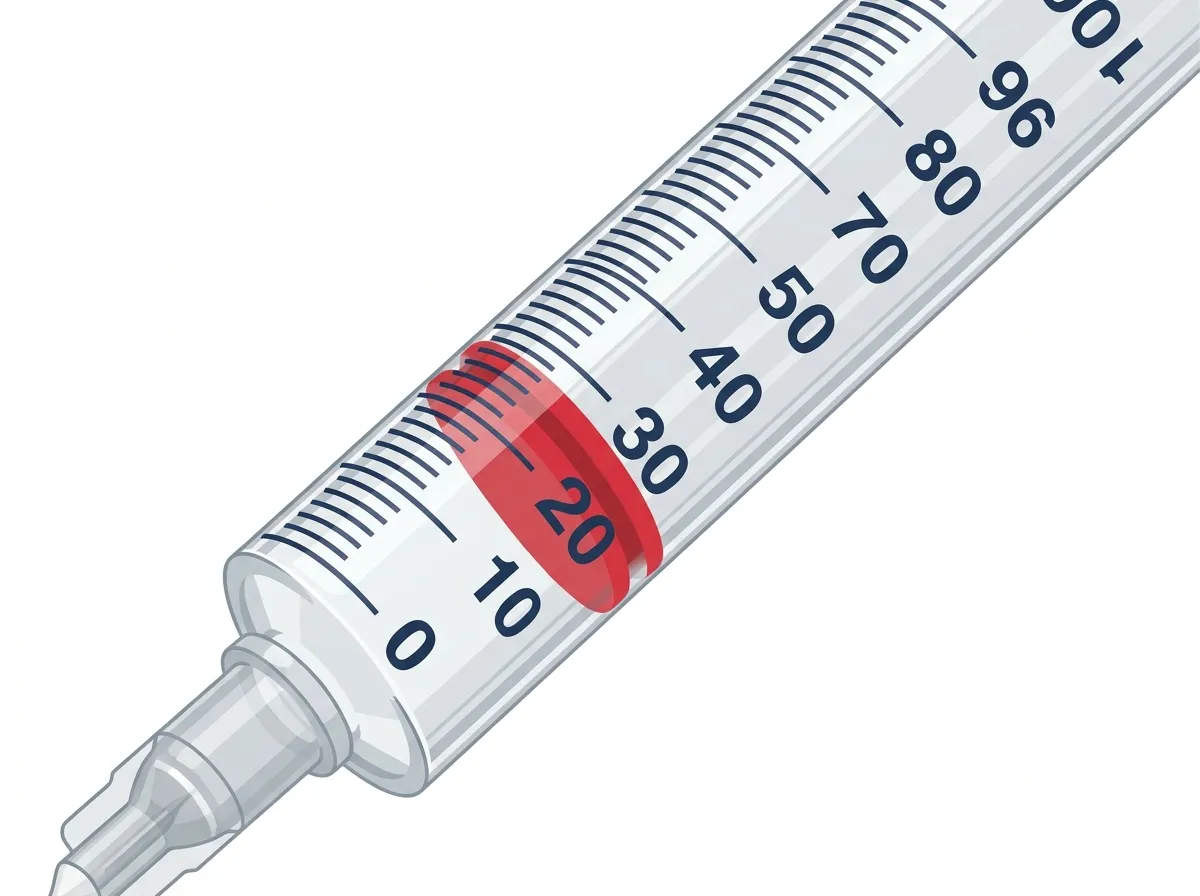
At its core, every peptide reconstitution calculation rests on three linked formulas. Understanding these formulas means you can verify any calculator's output by hand, catch errors before they affect your protocol, and adapt quickly when you need to change vial sizes or target doses mid-research. The Heart Score Calculator applies these exact formulas across all three calculation modes.
Formula 1 — Peptide Concentration (the Foundation)
When you add bacteriostatic water to a lyophilised peptide vial, you are creating a solution with a specific concentration — measured in milligrams per millilitre (mg/mL). This single value drives every downstream calculation. Get this right and everything else follows. This is also called the peptide dilution formula or the peptide mixing ratio.
Formula 2 — Draw Volume and mg to mL Peptide Conversion
Once you know the concentration, you can calculate how much solution to draw into your syringe for each dose. This is the peptide solution calculator formula that most tools implement. The result is in millilitres (mL), which then gets converted to U-100 syringe units by multiplying by 100. For a general-purpose mg to mL calculator covering any medication or liquid, our dedicated tool handles a wider range of substances beyond peptides.
Formula 3 — Reverse BAC Water Calculator
The reverse calculation is unique to our tool among free online peptide reconstitution calculators. It answers the question: "I want to draw exactly 20 units for my dose — how much BAC water should I add?" This is especially useful for researchers who prefer working with a specific, consistent syringe unit count across their entire protocol.
Peptide Reconstitution Quick Reference Table
This peptide dosage chart shows the most common reconstitution scenarios. Each row shows a vial size and BAC water combination with the resulting concentration and unit counts for standard research doses. Use it as a quick cross-check against our peptide reconstitution calculator above.
| Vial | BAC Water | Concentration | 100 mcg = | 250 mcg = | 500 mcg = | 1,000 mcg = |
|---|---|---|---|---|---|---|
| 1 mg | 1 mL | 1 mg/mL | 10 units | 25 units | 50 units | 100 units |
| 2 mg | 1 mL | 2 mg/mL | 5 units | 12.5 units | 25 units | 50 units |
| 5 mg | 1 mL | 5 mg/mL | 2 units | 5 units | 10 units | 20 units |
| 5 mg | 2 mL | 2.5 mg/mL | 4 units | 10 units | 20 units | 40 units |
| 5 mg | 5 mL | 1 mg/mL | 10 units | 25 units | 50 units | 100 units |
| 10 mg | 2 mL | 5 mg/mL | 2 units | 5 units | 10 units | 20 units |
| 10 mg | 4 mL | 2.5 mg/mL | 4 units | 10 units | 20 units | 40 units |
| 15 mg | 3 mL | 5 mg/mL | 2 units | 5 units | 10 units | 20 units |
| 30 mg | 3 mL | 10 mg/mL | 1 unit | 2.5 units | 5 units | 10 units |
All values for U-100 insulin syringes (1mL = 100 units). Dose in mcg. Verify with our calculator for exact values at non-standard vial sizes.
How to Reconstitute Peptides — Step-by-Step Protocol
Reconstituting lyophilised peptides correctly is not complicated, but it requires precision, aseptic technique, and patience. Errors during reconstitution — whether from contamination, incorrect solvent volumes, or aggressive mixing — cascade through every subsequent measurement and can render an entire vial useless. Follow this standard operating procedure every time.
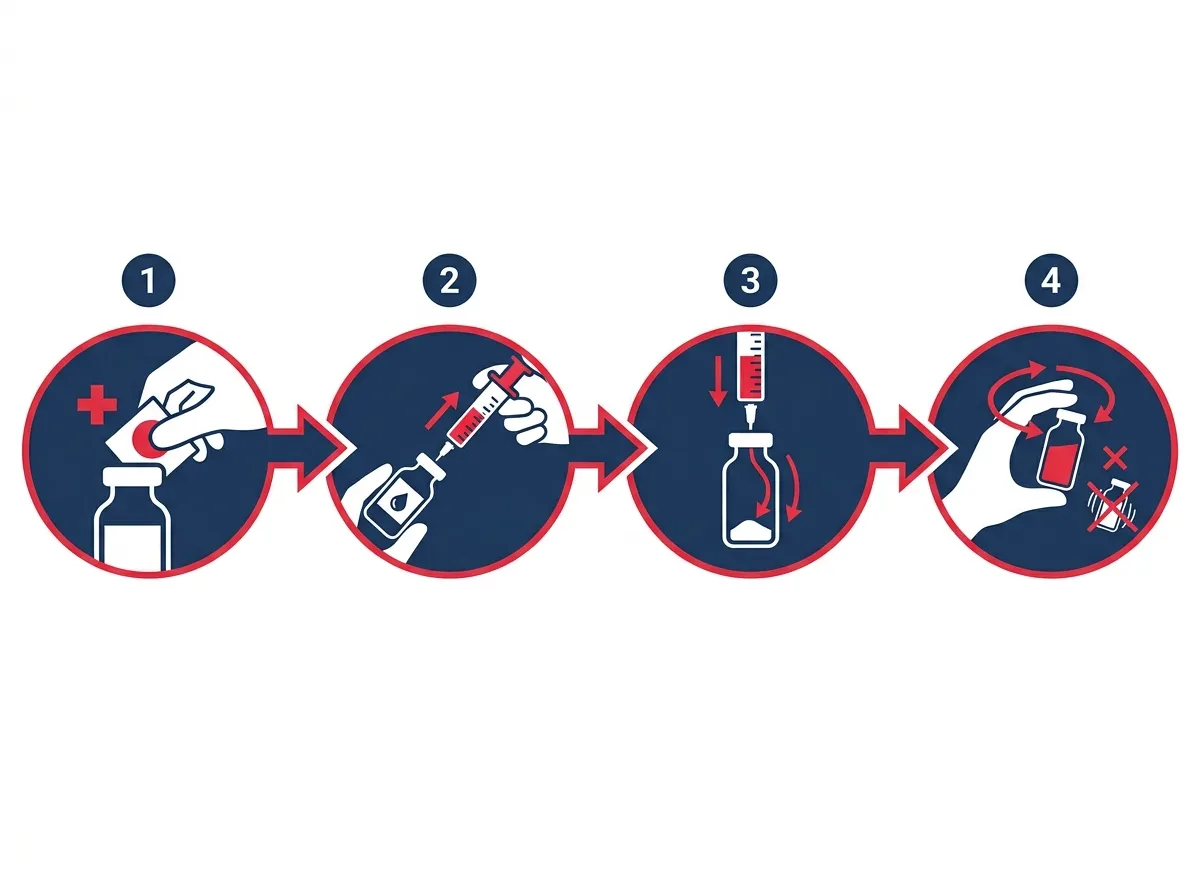
Before touching any equipment, use the peptide reconstitution calculator above to determine your exact BAC water volume. Write down the resulting concentration (mg/mL), draw volume (mL), and syringe units. Having these numbers confirmed before opening vials prevents rushed, error-prone recalculation under time pressure. Confirm the vial mass against the Certificate of Analysis from your supplier.
Wash hands thoroughly with soap and water for at least 20 seconds. If available, wear sterile gloves and work in a laminar flow hood or near a recently cleaned surface. Lay out all supplies: lyophilised peptide vial, bacteriostatic water vial, U-100 insulin syringes, alcohol swabs (70% isopropyl), and labelling supplies. Cleanliness at this stage is the most effective contamination prevention measure available.
Using a fresh alcohol swab, wipe the rubber stopper of both the peptide vial and the BAC water vial. Allow 15–30 seconds for the alcohol to fully evaporate before piercing — injecting through wet alcohol introduces it into the solution. Never reuse a swab between vials. If the peptide vial came vacuum-sealed, check that the stopper is intact before proceeding.
Using a calibrated insulin syringe, draw your calculated BAC water volume from the BAC water vial. To equalise pressure, first draw air equal to your target volume, insert the needle into the BAC water vial, inject the air, and then withdraw the liquid. Remove any air bubbles by tapping the syringe barrel gently and expelling them. Precision here is critical — a 10% error in BAC water volume means a 10% concentration error in every dose that follows.
Insert the needle through the peptide vial stopper at a slight angle so the tip touches the inside glass wall — not the powder cake. Inject the BAC water slowly so it trickles down the glass wall onto the powder. Never forcefully inject the liquid directly onto the lyophilised powder. The impact of a pressurised stream can mechanically damage the peptide structure and cause aggregation. This is the step most commonly skipped incorrectly by new researchers.
After adding BAC water, gently swirl the vial in slow circular motions for 1–5 minutes until the powder is fully dissolved and the solution is completely clear and colourless. Never shake vigorously, vortex, or use a stir bar — mechanical agitation denatures peptide bonds and causes aggregation. Research confirms that vigorous agitation significantly increases peptide degradation (Manning et al., 1989, PMID 2664067). If the solution remains cloudy after 10 minutes of gentle swirling, or develops visible particles or colour change, discard the vial.
Write the reconstitution date, peptide name, and concentration (e.g. "BPC-157 — 2.5mg/mL — Reconstituted 20 May 2026") directly on the vial. Refrigerate at 2–8°C (36–46°F) immediately. Most research peptides are stable for 28–30 days after reconstitution in BAC water when stored refrigerated and protected from light. Never freeze a reconstituted solution. Check the stability window in the peptide reference table below and plan your injection schedule accordingly.
BAC Water vs Sterile Water for Peptide Reconstitution — Which to Use?
The choice of solvent for peptide reconstitution directly affects how long your solution remains usable and how safely you can make multiple draws from the same vial. For any protocol involving more than a single injection from a reconstituted vial — which is the overwhelming majority of research protocols — bacteriostatic water (BAC water) is the correct choice.
The core difference: BAC water contains 0.9% benzyl alcohol as a preservative. This antimicrobial agent inhibits bacterial growth across multiple vial punctures over 28–30 days. Sterile water has no preservative. The moment you open a sterile water vial and draw from it, any subsequent draw risks contaminating the entire contents with environmental bacteria. For a vial you plan to inject from daily for 2–4 weeks, sterile water creates unacceptable contamination risk.
Use bacteriostatic water (BAC water) for any multi-dose research protocol where you will draw from the same vial more than once over days or weeks. BAC water is the standard for BPC-157, TB-500, CJC-1295, Ipamorelin, GHRP-2, GHK-Cu, PT-141, and virtually all other common research peptides. It maintains antimicrobial protection for 28–30 days and is compatible with U-100 insulin syringes of any gauge.
Sterile water is only appropriate for single-use preparations where the entire reconstituted volume will be used in one session. It is also used as a first-step solvent for highly hydrophobic or charged peptides that require dilute acetic acid or DMSO for initial dissolution before dilution with BAC water. Certain protein-based compounds may also be incompatible with benzyl alcohol — always check your specific compound's solubility notes.
Even with BAC water's benzyl alcohol preservative, proper refrigeration is non-negotiable. Room temperature storage dramatically accelerates peptide degradation — especially for temperature-sensitive compounds like IGF-1 LR3 and sermorelin. Store reconstituted vials in the main body of the refrigerator (not the door), where temperature fluctuations are minimal, and protected from light in a small box or bag.
Always request a Certificate of Analysis (CoA) from any peptide supplier — specifically one showing HPLC purity and mass spectrometry confirmation of molecular weight. A reputable CoA from an independent laboratory verifies that the vial contains the declared compound at the stated purity and mass. This is the starting assumption of every accurate peptide reconstitution calculation — if the vial mass is not what the label says, every unit count will be wrong.
Common Research Peptides — Vial Sizes, Typical Doses & Stability Reference
The following peptide reconstitution guide covers the most widely researched peptides, with typical lyophilised vial sizes, common research dose ranges, and post-reconstitution stability windows. Use these as starting reference points for our peptide administration calculator above — the presets are pre-loaded with these values. Body composition and fitness calculators like our BMI Calculator and VO2 Max Calculator can help researchers track the physiological context alongside peptide protocol timelines.
| Peptide | Typical Vial (mg) | Typical Dose (mcg) | Freq | Stability (BAC) | Notes |
|---|---|---|---|---|---|
| BPC-157 | 5 mg | 200–500 mcg | 1–2×/day | 28–30 days | Stable in BAC water; most popular healing peptide |
| TB-500 (Thymosin β4) | 5–10 mg | 2,000–5,000 mcg | 2×/week | 28–30 days | Higher dose compound; wide therapeutic window |
| CJC-1295 (no DAC) | 2–5 mg | 100–300 mcg | Before sleep | 21 days | Often combined with Ipamorelin (1:1 ratio) |
| Ipamorelin | 5 mg | 100–300 mcg | 1–3×/day | 28 days | Selective GH secretagogue; minimal side effects |
| GHK-Cu | 1–5 mg | 50–200 mcg | 1×/day | 28 days | Copper peptide; often used topically or subcutaneously |
| PT-141 (Bremelanotide) | 10 mg | 500–2,000 mcg | As needed | 28 days | MC4R agonist; administer 45 min before use |
| GHRP-2 | 5 mg | 100–300 mcg | 3×/day | 28 days | Strong GH secretagogue; increases ghrelin significantly |
| GHRP-6 | 5 mg | 100–300 mcg | 3×/day | 28 days | Significant hunger increase; potent GH release |
| Hexarelin | 5 mg | 100–200 mcg | 2–3×/day | 28 days | Most potent GHRP; receptor desensitisation common |
| Sermorelin | 15 mg | 200–500 mcg | Before sleep | 14–21 days | Short stability; use within 2–3 weeks of reconstitution |
| IGF-1 LR3 | 1 mg | 20–100 mcg | Daily | 14 days | Fragile; freeze pre-diluted aliquots. Requires care |
| Selank | 5 mg | 250–500 mcg | 1–2×/day | 28 days | Anxiolytic peptide; also used intranasally |
| Semax | 30 mg | 200–600 mcg | 1–2×/day | 30 days | Nootropic peptide; intranasal or subcutaneous |
| Epitalon | 10 mg | 500–1,000 mcg | Daily cycle | 28 days | Telomerase activator; typically 10-day cycles |
| Kisspeptin-10 | 2 mg | 50–100 mcg | Protocol-specific | 14–21 days | GnRH regulator; research context only |
| SS-31 (Elamipretide) | 5 mg | 50–200 mcg | Daily | 21 days | Mitochondria-targeting peptide |
Typical doses are reference ranges from published research literature — not clinical recommendations. Stability windows for BAC water reconstitution stored at 2–8°C. Always follow the specific protocol for your research model.
If your research involves GLP-1 receptor agonist peptides like semaglutide or tirzepatide, those require separate calculators due to their distinct dosing in milligrams and brand-specific formulations — our Semaglutide Dosage Calculator and Tirzepatide Calculator cover those compounds in full detail.
Peptide Storage After Reconstitution — Stability Guide
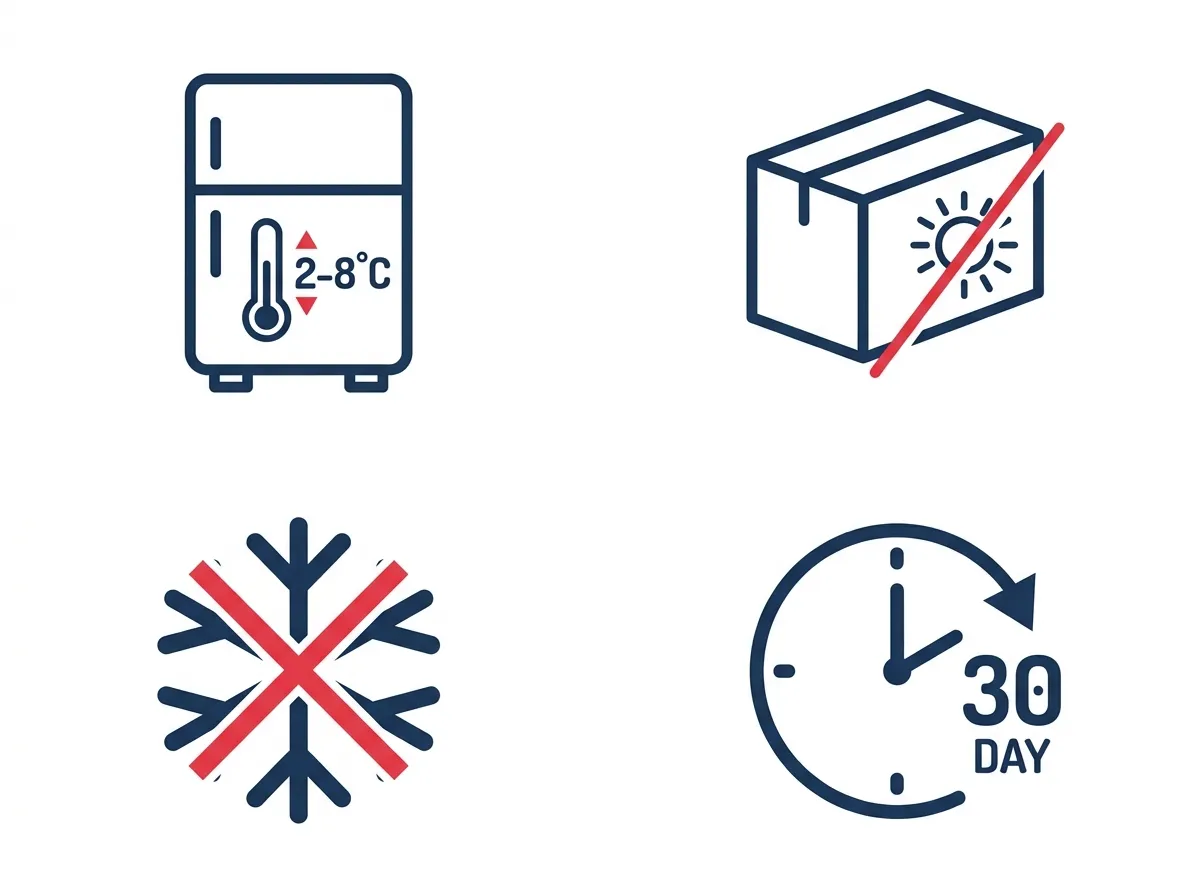
Knowing how long reconstituted peptides last is not optional — miscalculating your vial's stability window means injecting degraded, potentially ineffective compound. The table below provides guidance on peptide storage conditions and post-reconstitution shelf life. This information is essential when planning your multi-dose schedule using Mode 3 in our simple peptide reconstitution calculator.
| Storage Condition | Lyophilised (Unreconstituted) | Reconstituted in BAC Water | Notes |
|---|---|---|---|
| Room temperature (20–25°C) | Weeks–months (dry, dark) | 24–72 hours only | Not recommended for reconstituted solution |
| Refrigerated (2–8°C) | Months | 28–30 days | Standard storage for active use |
| Frozen (−20°C) | 1–2 years | Do NOT freeze | Freeze-thaw damages reconstituted solution |
| Frozen (−80°C) | 2–5 years | Do NOT freeze | For long-term lyophilised storage only |
| Refrigerated (IGF-1 LR3) | Months at −20°C | 14 days max | Fragile; pre-aliquot before reconstitution |
| Exposed to light | Degraded | Degraded faster | Always store in opaque container or foil-wrapped vial |
Never freeze a reconstituted peptide solution. Ice crystals that form during freezing physically shear peptide bonds and cause irreversible aggregation. If you cannot use an entire reconstituted vial within the stability window, the recommended approach is to reconstitute into smaller aliquots (separate vials) and freeze those while still in lyophilised form — then reconstitute individual aliquots as needed. This is particularly important for expensive compounds like IGF-1 LR3.
How the Peptide Reconstitution Calculator Works — Behind the Maths
The best peptide reconstitution calculator does not just give you a number — it shows its work. Every calculation the Heart Score Calculator peptide tool performs displays a full formula breakdown so you can verify the result manually at any time. This transparency is particularly important for research applications where reproducibility matters.
The calculator supports mcg (micrograms) and mg (milligrams) dose input interchangeably. Converting peptide mg to mcg is simply multiplying by 1,000 — and the tool handles this automatically so you can work in whatever unit your protocol specifies. For broader medication dose conversions covering a wider range of substances and clinical concentrations, the mg to mL Calculator provides a comprehensive general-purpose tool.
The multi-dose planner mode is where this calculator genuinely outperforms all competitors. After entering your vial size, BAC water volume, dose, and injection frequency, the planner generates a complete weekly schedule table and automatically flags weeks where your peptide solution approaches or exceeds its stability window. This prevents the common research error of planning a 6-week protocol from a single reconstituted vial that only remains stable for 4 weeks.
For those researching metabolic peptides and their effects on body composition, pairing the results from this calculator with our TDEE Calculator for total daily energy expenditure and our GFR Calculator for kidney function monitoring creates a comprehensive physiological tracking framework.