Calorie Calculator: Daily Needs + Macro Split
This calculator estimates basal metabolic rate (BMR) with the Mifflin-St Jeor equation, scales it to total daily energy expenditure (TDEE) by activity level, and converts a daily calorie target into protein, carbohydrate, and fat grams within heart-healthy ranges.
What Does a Calorie Calculator Estimate?
A calorie calculator estimates how much energy the body uses in a day and converts that estimate into a daily intake target. The chain has three links: basal metabolic rate (BMR), total daily energy expenditure (TDEE), and the target adjusted for a goal.
BMR is the energy used at complete rest to maintain basic functions — breathing, circulation, body temperature, and cellular repair. It accounts for roughly 60 to 70 percent of daily expenditure in sedentary adults. TDEE adds the energy cost of physical activity and the thermic effect of food, the energy used to digest and process meals, which is about 10 percent of intake.
The target is TDEE adjusted for intent: near TDEE for weight maintenance, below TDEE for weight loss, above TDEE for weight gain. This calculator then translates the target into grams of protein, carbohydrate, and fat — the macro split — using shares that fall within established dietary reference ranges.
Each step of the chain is an estimate. The equations were derived from population studies, and individual metabolism varies with body composition, age, hormones, medications, and health conditions. The BMR calculator and TDEE calculator on this site cover the first two steps in isolation.
How Are Daily Calorie Needs Calculated?
This calculator uses the Mifflin-St Jeor equation (1990) for BMR, the equation most often recommended in clinical guidance for adults without specialized body-composition data. It was developed from measurements in 498 healthy adults and validated against indirect calorimetry.1
BMR becomes TDEE through an activity multiplier that reflects habitual movement:
| Activity Level | Description | Multiplier |
|---|---|---|
| Sedentary | Little or no exercise, desk work | 1.2 |
| Light | Exercise 1–3 days per week | 1.375 |
| Moderate | Exercise 3–5 days per week | 1.55 |
| Active | Exercise 6–7 days per week | 1.725 |
| Very active | Hard daily exercise or a physical job | 1.9 |
These multipliers originate from the Harris-Benedict tradition of scaling basal estimates by lifestyle, a method reviewed and critiqued in the nutrition literature for nearly a century.2 They are practical but coarse: two people who both select "moderate" can differ substantially in daily steps, occupational movement, and exercise intensity. A systematic review by Frankenfield and colleagues (2005) found the Mifflin-St Jeor equation to be the most accurate widely available predictor of resting metabolic rate in non-obese and obese adults, while noting that all equations perform best at group level rather than for individuals.3
BMR vs TDEE vs Target Calories: What Is the Difference?
The three numbers describe different things, and mixing them up is the most common source of confusion in calorie planning.
| Measure | What It Describes | Typical Share of TDEE |
|---|---|---|
| BMR | Energy at complete rest | 60–70% |
| Activity energy | Movement, exercise, occupational activity | 20–30% |
| Thermic effect of food | Digestion and nutrient processing | ~10% |
| TDEE | Sum of all three; maintenance intake | 100% |
| Target | TDEE adjusted for maintain, cut, or bulk goal | Varies |
Eating at TDEE maintains weight over time, because energy in matches energy out. Eating below TDEE creates a deficit the body covers from stored energy; eating above creates a surplus stored mostly as fat, with some going to muscle when combined with resistance training and adequate protein.
The Cut mode in this calculator applies a 500 kcal deficit, the figure most often cited in clinical guidelines for a rate of roughly 0.5 kg per week. The Bulk mode adds 300 kcal, a moderate surplus intended to support muscle gain while limiting excess fat gain. Neither adjustment is a medical recommendation; they are conventional planning values that clinicians individualize.
What Is a Macro Split, and What Ranges Are Considered Healthy?
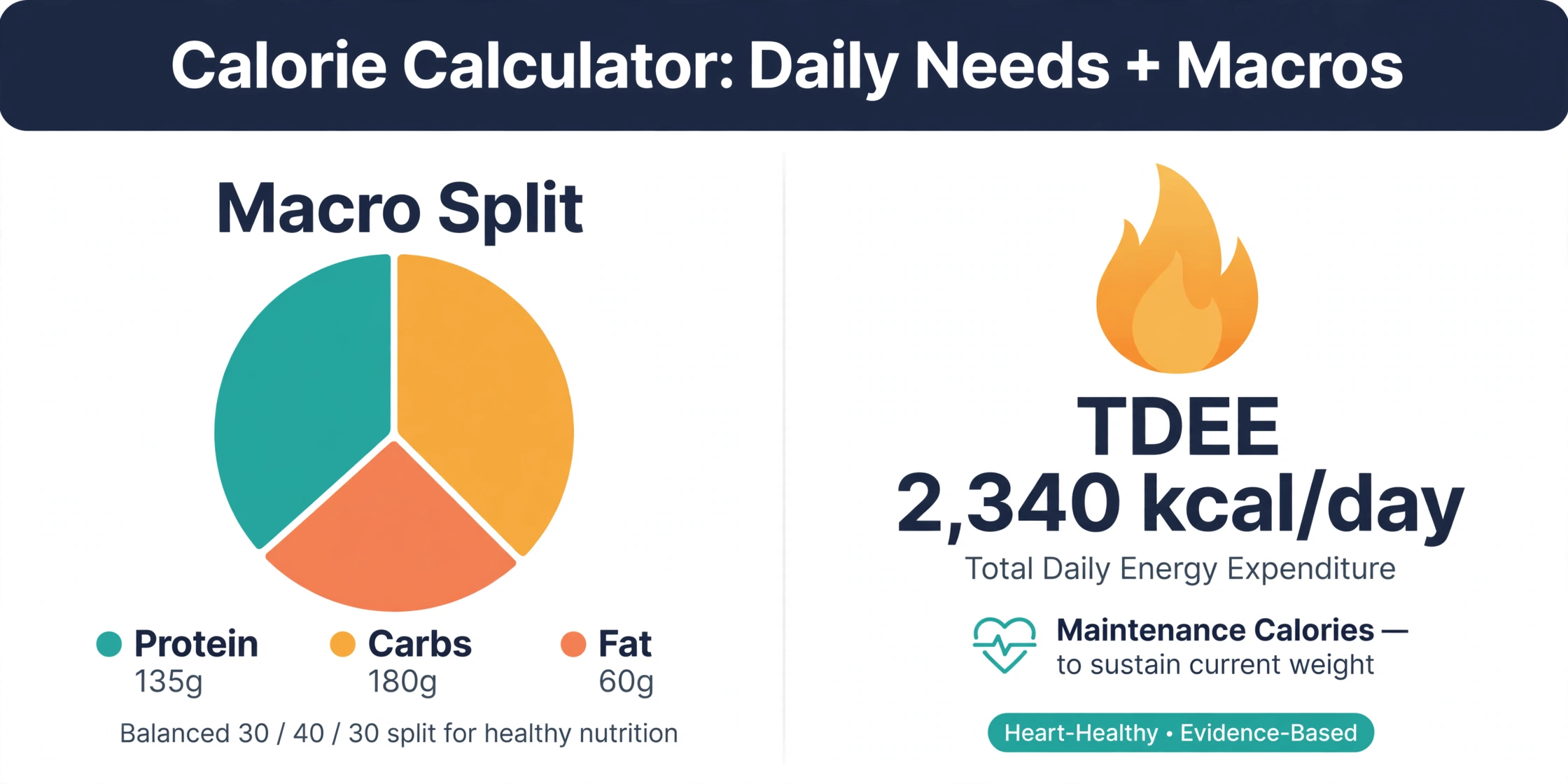
A macro split divides daily calories among the three macronutrients: protein and carbohydrate at 4 kcal per gram, fat at 9 kcal per gram. The split determines the gram targets shown in the results.
The Institute of Medicine's Acceptable Macronutrient Distribution Ranges (AMDR), published in the Dietary Reference Intakes (2005), define the ranges associated with adequate nutrition while minimizing chronic disease risk: protein 10–35%, fat 20–35%, and carbohydrate 45–65% of calories.4 The default splits in this calculator sit inside those ranges:
| Goal Mode | Protein | Carbohydrate | Fat | Rationale |
|---|---|---|---|---|
| Maintain | 25% | 45% | 30% | Balanced, within AMDR |
| Cut | 30% | 45% | 25% | Higher protein supports lean mass during a deficit |
| Bulk | 25% | 50% | 25% | Carbohydrate fuels training volume |
The heart-healthy framing comes from dietary patterns rather than any single ratio. The Mediterranean pattern — vegetables, fruits, whole grains, legumes, nuts, olive oil, moderate fish — reduced major cardiovascular events by about 30% versus a low-fat control diet in the PREDIMED trial.5 The DASH pattern lowered blood pressure in the DASH-Sodium trial, with larger reductions at lower sodium intakes.6 Both patterns fall comfortably within AMDR ranges, which is why the calculator's splits are compatible with them: the emphasis is on food quality — unsaturated fats, fibre, potassium — as well as quantity.
Protein deserves attention during weight loss because deficits can cost lean tissue alongside fat. Trials of higher-protein intakes during energy restriction show better preservation of lean mass than lower-protein intakes at the same deficit, which is the basis for the Cut mode's 30% protein share.
Limitations of Calorie Calculators
Athletes and very muscular individuals are a special case: the equation was validated in non-athletic adults, and high lean mass raises resting expenditure above the prediction. Researchers in sports settings sometimes use the Cunningham equation, which estimates resting metabolic rate from lean body mass (500 + 22 × lean mass in kg), as an alternative.
Finally, calories describe energy, not nutrition. A target can be met with very different diet quality. Cardiovascular guidelines consistently emphasize dietary patterns — Mediterranean, DASH — over calorie counting alone, because blood pressure, lipids, and glucose respond to food composition as well as energy balance.
Worked Example
Profile: a 35-year-old man, 178 cm, 80 kg, moderately active, goal: maintain.
BMR (Mifflin-St Jeor, men): 10 × 80 + 6.25 × 178 − 5 × 35 + 5 = 800 + 1112.5 − 175 + 5 = 1742.5 kcal/day.
TDEE: 1742.5 × 1.55 = 2701 kcal/day.
Target (maintain): 2701 kcal. Macros (25/45/30): protein = 2701 × 0.25 ÷ 4 = 169 g; carbohydrate = 2701 × 0.45 ÷ 4 = 304 g; fat = 2701 × 0.30 ÷ 9 = 90 g.
Cut variant: 2701 − 500 = 2201 kcal; protein at 30% = 165 g, carbohydrate at 45% = 248 g, fat at 25% = 61 g.
Quick Reference: TDEE by Activity (Sample Profile)
For a 35-year-old man, 178 cm, 80 kg (BMR ≈ 1743 kcal):
| Activity Level | Multiplier | TDEE (kcal/day) |
|---|---|---|
| Sedentary | 1.2 | 2091 |
| Light | 1.375 | 2396 |
| Moderate | 1.55 | 2701 |
| Active | 1.725 | 3006 |
| Very active | 1.9 | 3311 |
The table shows how much activity level changes the estimate — over 1200 kcal separates sedentary from very active for the same body. Choosing the activity level honestly is the highest-leverage input decision in the calculator.
Key Takeaways
- Daily needs follow a chain: BMR (Mifflin-St Jeor) × activity = TDEE, then adjusted for maintain, cut, or bulk.
- Mifflin-St Jeor predicts resting metabolic rate within about 10% for most people — an estimate, not an exact requirement.3
- A 500 kcal deficit corresponds to roughly 0.5 kg per week in guideline-based planning.
- Healthy macro splits fall inside the AMDR ranges: protein 10–35%, fat 20–35%, carbohydrate 45–65%.4
- Mediterranean and DASH patterns sit inside those ranges and carry the strongest cardiovascular trial evidence.56
Frequently Asked Questions
How accurate are online calorie calculators?
The Mifflin-St Jeor equation predicts resting metabolic rate within about 10 percent for most people in validation studies, but individual variation is substantial. Activity multipliers add further uncertainty because daily movement differs from the category labels. Treat calculator results as estimates rather than exact requirements.
What is the difference between BMR and TDEE?
Basal metabolic rate is the energy the body uses at complete rest to maintain basic functions such as breathing and circulation. Total daily energy expenditure adds the energy cost of physical activity and the thermic effect of food. TDEE is the figure that relates most directly to weight maintenance.
How many calories do I need to eat to lose weight?
Clinical guidelines commonly describe an energy deficit of 500 to 750 kilocalories per day, which corresponds to roughly 0.5 kilograms per week of weight change. The calculator's Cut mode applies a moderate deficit of 500 kilocalories. Very low intakes carry health risks and are typically managed with clinical supervision.
What is a healthy macro split?
The Institute of Medicine's Acceptable Macronutrient Distribution Ranges are 10 to 35 percent of calories from protein, 20 to 35 percent from fat, and 45 to 65 percent from carbohydrate. Mediterranean and DASH dietary patterns, which are associated with favorable cardiovascular outcomes in trials, fall within these ranges.
Does the Mifflin-St Jeor equation work for athletes?
The equation was developed and validated in non-athletic adults. People with very high muscle mass may burn more energy at rest than the equation predicts. Athletes and researchers sometimes use the Cunningham equation, which estimates resting metabolic rate from lean body mass, as an alternative.
Sources
- Mifflin MD, St Jeor ST, Hill LA, Scott BJ, Daugherty SA, Koh YO. A new predictive equation for resting energy expenditure in healthy individuals. Am J Clin Nutr. 1990;51(2):241-247. doi:10.1093/ajcn/51.2.241
- Frankenfield DC, Muth ER, Rowe WA. The Harris-Benedict studies of human basal metabolism: history and limitations. J Am Diet Assoc. 1998;98(4):439-445. doi:10.1016/S0002-8223(98)00100-X
- Frankenfield D, Roth-Yousey L, Compher C. Comparison of predictive equations for resting metabolic rate in healthy nonobese and obese adults: a systematic review. J Am Diet Assoc. 2005;105(5):775-789. doi:10.1016/j.jada.2005.02.010
- Institute of Medicine. Dietary Reference Intakes for Energy, Carbohydrate, Fiber, Fat, Fatty Acids, Cholesterol, Protein, and Amino Acids. Washington, DC: National Academies Press; 2005. (AMDR: protein 10–35%, fat 20–35%, carbohydrate 45–65%.) doi:10.17226/10490
- Estruch R, Ros E, Salas-Salvadó J, et al; PREDIMED Study Investigators. Primary prevention of cardiovascular disease with a Mediterranean diet supplemented with extra-virgin olive oil or nuts. N Engl J Med. 2018;378:e34. doi:10.1056/NEJMoa1800389
- Sacks FM, Svetkey LP, Vollmer WM, et al; DASH-Sodium Collaborative Research Group. Effects on blood pressure of reduced dietary sodium and the Dietary Approaches to Stop Hypertension (DASH) diet. N Engl J Med. 2001;344:3-10. doi:10.1056/NEJM200101043440101
Reviewed by the Medical Editorial Team — October 2026. Content is updated when new guidance or evidence emerges.
Documents the published equation, required inputs, intended population, and known limitations for each tool. This editorial work does not replace advice from a licensed healthcare professional.