What Is Body Surface Area?
Body surface area (BSA) is an estimate of the total surface area of the skin, expressed in square meters (m²). It is one of the oldest size-normalization metrics in medicine: instead of describing a person by weight alone, BSA combines height and weight into a single number that reflects overall body size.
Surface area matters physiologically because many body functions scale with area rather than mass. Heat is lost through the skin, so a larger surface area means faster heat exchange with the environment. Basal metabolic rate, oxygen consumption, cardiac output, and kidney filtration all track more closely with BSA than with weight alone. A tall, lean 70-kg adult and a short, stocky 70-kg adult share the same weight but have different surface areas — and BSA captures that difference where weight cannot.
The concept has a long history. The first widely adopted formula came from Delafield DuBois and Eugene F. DuBois in 1916, derived from direct measurements of just nine subjects — eight adults and one child. In 1935, Edith Boyd published a more complex formula grounded in detailed geometric measurements of the body at different stages of growth. In 1987, R. D. Mosteller published a dramatically simplified formula — a single square root — in the New England Journal of Medicine, designed for quick bedside calculation. All three formulas remain in use, and for typical adult body sizes they agree within about 1 to 2 percent.
The figure 1.73 m² deserves special mention: it represents the approximate BSA of an average young adult and serves as the standard reference size to which kidney function estimates are indexed. Estimated glomerular filtration rate (eGFR) is reported as mL/min/1.73 m², meaning the value is normalized to this reference body size so that results can be compared across patients of different builds.
| Profile | Typical height / weight | BSA (Mosteller) |
|---|---|---|
| Newborn | 50 cm / 3.5 kg | ~0.22 m² |
| 1-year-old child | 75 cm / 10 kg | ~0.46 m² |
| 10-year-old child | 140 cm / 32 kg | ~1.12 m² |
| Average adult woman | 165 cm / 65 kg | ~1.6 m² |
| Clinical reference standard | — | 1.73 m² |
| Average adult man | 180 cm / 80 kg | ~1.9 m² |
Before electronic calculators, clinicians read BSA from paper nomograms — the West nomogram, published in the mid-20th century, let a straightedge connect height and weight scales to read off BSA. The formulas on this page are the mathematical successors to that tool. Explore related size metrics in our medical calculators hub.
BSA Formulas Compared
Three formulas dominate clinical practice and online calculators. They were built in different eras, from different datasets, with different goals — yet they usually agree. The table below summarizes how they differ and where each is preferred.
| Formula | Year | Equation (H in cm, W in kg unless noted) | Derivation data | When it is preferred |
|---|---|---|---|---|
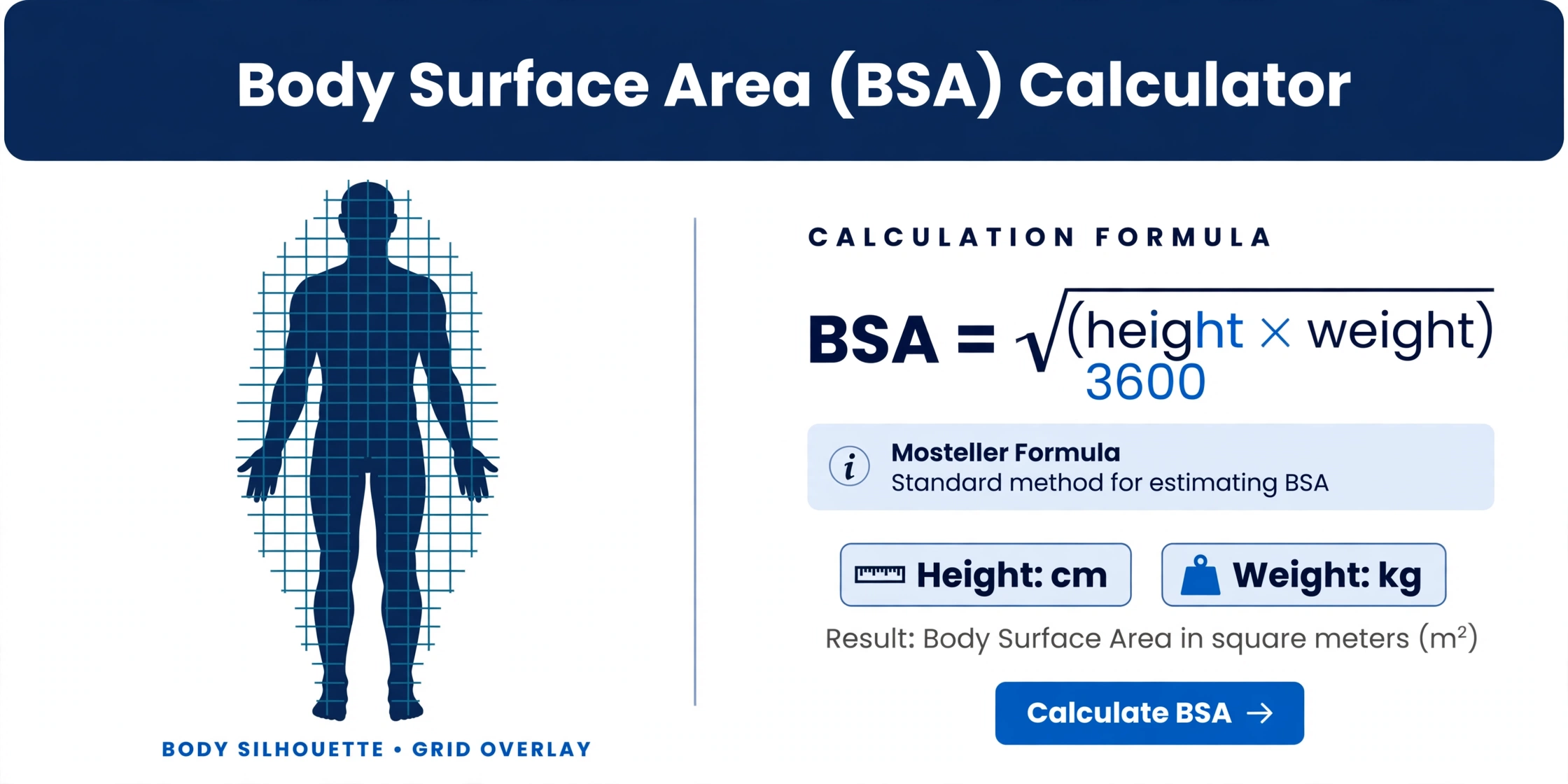
| Mosteller | 1987 | BSA = √((H × W) / 3600) | Simplified from existing data for bedside use | Quick mental or bedside calculation; pediatric dosing; most web calculators |
| DuBois & DuBois | 1916 | BSA = 0.007184 × W0.425 × H0.725 | Direct measurements of 9 subjects | The most referenced formula in medical literature; built into dosing software and cardiac index workflows |
| Boyd | 1935 | BSA = 0.0003207 × H0.3 × W(g)(0.7285 − 0.0188·log10W(g)) | Geometric measurements across stages of growth | Historical comparison; distinctive at unusual body sizes because its weight exponent changes with weight |
Boyd is the only formula whose weight exponent is not fixed: as weight in grams changes, the exponent (0.7285 − 0.0188 × log10(W)) shifts slightly, which its author intended to capture how body proportions change with size. The trade-off is complexity — Boyd is the hardest to compute by hand, which is why Mosteller’s single square root became popular.
Mosteller (1987)
BSA = √((H × W) / 3600)

DuBois & DuBois (1916)
BSA = 0.007184 × W^0.425 × H^0.725

Boyd (1935)  W in grams
BSA = 0.0003207 × H^0.3 × W^(0.7285 − 0.0188·log₁₀(W))
In practice, the choice of formula rarely changes a clinical decision at typical body sizes. For a 175 cm, 70 kg adult, all three land between 1.84 and 1.85 m². The differences grow at extremes: published comparisons show that at 175 cm and 200 kg, Mosteller gives about 3.12 m², DuBois about 2.89 m², and Boyd about 3.25 m² — a spread of roughly 7 percent. That spread is the reason formula choice is documented in research and dosing protocols.
Clinical Applications of BSA
BSA appears across medicine wherever body size — rather than weight alone — determines the right scale for a measurement or a dose. The main applications are below.
Chemotherapy dosing
Most cytotoxic chemotherapy is dosed per square meter of BSA: dose (mg) = ordered mg/m² × BSA (m²). BSA-based dosing adjusts for body size because drug clearance and distribution volumes scale with surface area, which reduces the risk of underdosing a large patient or overdosing a small one relative to a single flat dose. Some protocols cap BSA at 2.0 m² to limit excessive doses in very large patients; capping practices vary by regimen and institution, and clinical pathways specify the rule for each drug.
Cardiac index
Cardiac index (CI) is cardiac output divided by BSA: CI = CO (L/min) / BSA (m²). Because cardiac output naturally rises with body size, dividing by BSA produces a size-independent measure of heart pump performance, allowing comparison between patients of very different builds. The commonly cited resting reference range is 2.5 to 4.0 L/min/m², averaging near 3.0. Our cardiac output calculator covers how cardiac output itself is estimated, and the optional field above computes CI from any entered value.
Burn assessment
The Lund and Browder chart (1944) estimates burn size as a percentage of total BSA, with age-adjusted body-region percentages that account for how proportions change from infancy to adulthood. Burn size expressed as a percentage of BSA is a central input to fluid resuscitation planning — for example, the Parkland formula estimates 24-hour fluid needs from body weight and the percentage of BSA burned.
Renal function indexing
Estimated and measured glomerular filtration rates are indexed to 1.73 m² of BSA, so that kidney function can be compared fairly between a small and a large person. The same indexing concept underlies creatinine clearance estimates, which describe how efficiently the kidneys clear creatinine from the blood.
Pediatric and metabolic scaling
Many pediatric drug doses are scaled to BSA rather than weight because children’s body proportions differ markedly from adults’. Beyond drugs, physiologic measures such as basal metabolic rate, oxygen consumption, and minute ventilation are frequently indexed to BSA in research and critical care, since metabolic demand scales with surface area. For a different size metric used in dosing, see the companion ideal body weight calculator.
Many drugs clear in proportion to metabolic rate, which tracks surface area. That is why oncology and pediatrics favor m² over kg for dose scaling.
Dividing cardiac output by BSA lets clinicians compare a 50-kg and a 100-kg patient on the same scale — raw cardiac output alone cannot do that.
A burn covering one adult arm is roughly 9% of BSA. The Lund-Browder chart refines these percentages by age.
Kidney function is reported per 1.73 m² so that a result of 90 means the same thing regardless of the patient’s size.
BSA vs BMI: Different Tools
BSA and body mass index (BMI) both combine height and weight, but they answer different questions. BSA describes total size for scaling doses and physiologic measures; BMI describes weight relative to height for screening and classification. The table below contrasts them.
| Aspect | BSA | BMI |
|---|---|---|
| Units | m² (square meters) | kg/m² |
| Primary purpose | Scaling drug doses and physiologic measures to body size | Population screening and weight-category classification |
| Typical adult values | 1.4–2.2 m² | 18.5–24.9 kg/m² (typical range) |
| Distinguishes muscle from fat | No | No |
| Used for | Chemotherapy dosing, cardiac index, burn percentage, GFR indexing | Obesity screening, epidemiology, risk stratification |
| Reference standard | 1.73 m² (kidney indexing) | Fixed category cutoffs (18.5 / 25 / 30) |
Neither metric reflects body composition — a muscular athlete and a sedentary adult can share the same BMI or BSA with very different body fat percentages. Clinicians choose the metric that matches the decision at hand: BSA when a dose or physiologic value must scale with size, BMI when screening or classifying weight status. Our BMI calculator covers weight categories in detail.
Limitations of BSA
BSA is an estimate with known boundaries. Understanding them is part of using the number responsibly.
- It is an estimate, not a measurement. True surface area can only be measured directly by coating or geometric techniques, which are impractical in clinical care. Every formula approximates — the close agreement between formulas at typical sizes is reassuring, but it is agreement between estimates.
- Extreme body compositions reduce accuracy. The derivation datasets consisted mostly of average builds. Adipose tissue contributes less to drug clearance and metabolic rate than lean tissue, so BSA can misrepresent effective body size in severe obesity. Published comparisons show the three formulas spreading by roughly 7 percent at 175 cm and 200 kg — which is why some chemotherapy protocols cap BSA at 2.0 m² and why clinical pathways specify how to handle very large patients.
- Pediatric data are thin. The DuBois formula was derived from eight adults and a single child. Mosteller and Boyd extrapolate across sizes with limited direct validation in infants. Pediatric dosing therefore pairs BSA with clinical judgment and protocol-specific rules rather than relying on the number alone.
- Formulas diverge at extremes. Within the typical adult range the formulas agree within about 1–2 percent; at the edges of height and weight they diverge, and no formula has a decisive accuracy advantage across all populations.
- Body composition is invisible to BSA. Two people with identical height, weight, and BSA can have very different proportions of muscle, fat, and bone. BSA describes outer size, not what the body is made of.
- Proportions change with age. A child’s head is a larger fraction of total surface area than an adult’s — the Lund-Browder burn chart exists precisely because a single fixed formula cannot capture that shift.
Worked Example
Profile: an adult who is 175 cm tall and weighs 70 kg, calculated with the Mosteller formula.
Step 1 — multiply height by weight. 175 × 70 = 12,250.
Step 2 — divide by 3600. 12,250 ÷ 3600 = 3.4028.
Step 3 — take the square root. √3.4028 = 1.8447, which rounds to 1.84 m².
Cross-check with the other formulas. The same 175 cm / 70 kg profile through DuBois gives approximately 1.85 m², and through Boyd approximately 1.85 m² — all three agree within 1 percent, which is typical for average adult body sizes. Try these values in the calculator above to reproduce each result.
What the number means in context: at 1.84 m², this profile sits slightly above the 1.73 m² kidney-indexing reference. A chemotherapy regimen ordered at 100 mg/m² would calculate to about 184 mg before any protocol-specific adjustments such as dose capping — an illustration of how BSA converts a per-square-meter order into an individual dose, not a dosing recommendation. Actual dosing always follows the treatment protocol and clinician judgment.
Key Takeaways
- BSA estimates total skin surface area in m² from height and weight; typical adults fall roughly between 1.4 and 2.2 m².
- Mosteller (1987), DuBois (1916), and Boyd (1935) usually agree within ~1–2% at typical body sizes and diverge at extremes.
- Chemotherapy dosing, cardiac index (CI = CO ÷ BSA), burn assessment, and kidney function indexing all build on BSA.
- 1.73 m² is the standard reference size used to index eGFR and compare kidney function across body sizes.
- BSA is an estimate that does not reflect body composition; formulas are least certain at extremes of size.
Frequently Asked Questions
What is a normal BSA for an adult?
There is no single ‘normal’ BSA, because the value depends on height and weight. Published reference ranges place typical adults between about 1.4 and 2.2 m², with average men near 1.9 m² and average women near 1.6 m². The figure 1.73 m² is the standard reference size used to index kidney function (eGFR is reported per 1.73 m²). Values are interpreted relative to the individual’s build, not against a universal cutoff.
Which BSA formula is most accurate?
No single formula is universally most accurate; each was validated against different datasets. For typical adult body sizes, Mosteller, DuBois, and Boyd agree within about 1–2%, so the choice rarely changes a result. Mosteller is preferred for simplicity, DuBois remains the most referenced in medical literature, and Boyd’s weight-dependent exponent makes it distinctive at unusual body sizes. Published comparisons show the formulas diverge by roughly 7% at extremes, such as 175 cm with 200 kg.
Why is chemotherapy dosed by BSA?
Chemotherapy drugs have narrow margins between effective and toxic doses, and drug clearance scales with body size. BSA-based dosing (dose = mg/m² × BSA) adjusts the dose to the individual’s size more precisely than a flat dose for everyone. Some protocols cap BSA at 2.0 m² to avoid excessive doses in very large patients. Dosing decisions always follow the specific treatment protocol and clinician judgment.
How is BSA used to calculate cardiac index?
Cardiac index (CI) equals cardiac output divided by BSA: CI = CO (L/min) / BSA (m²). Because a larger person naturally has a higher cardiac output, dividing by BSA produces a size-independent measure of heart pump performance. The commonly cited resting reference range is 2.5 to 4.0 L/min/m², with an average near 3.0. This calculator estimates CI when a cardiac output value is entered.
Clinical Sources & Citations
- DuBois D, DuBois EF. A formula to estimate the approximate surface area if height and weight be known. Arch Intern Med. 1916;17(6):863-871. PMID: 2520314
- Mosteller RD. Simplified calculation of body-surface area. N Engl J Med. 1987;317:1098. PMID: 3657876
- Boyd E. The Growth of the Surface Area of the Human Body. Minneapolis: University of Minnesota Press; 1935. (Institute of Child Welfare, Monograph Series No. X)
- Lund CC, Browder NC. The estimation of areas of burns. Surg Gynecol Obstet. 1944;79:352-358.
- Cardiac index reference range: hemodynamic reference tables list a resting cardiac index of 2.5–4.0 L/min/m² (average ~3.0), calculated as CI = CO/BSA. See Cardiac Output Measurement: Hemodynamic Variables, Example Reference Ranges, and Formulas.
- Kidney Disease: Improving Global Outcomes (KDIGO). KDIGO 2024 Clinical Practice Guideline for the Evaluation and Management of Chronic Kidney Disease — eGFR expressed per 1.73 m² of BSA. kdigo.org
Editorial review statement: This page was reviewed by the Heart Score Calculator editorial team in October 2026 for formula accuracy, citation integrity, and readability. Content is updated when guidelines change.
Documents the published equation, required inputs, intended population, and known limitations for each tool. This editorial work does not replace advice from a licensed healthcare professional.
Primary sources for this calculator: DuBois & DuBois Arch Intern Med 1916 (derivation of the 0.007184 formula); Mosteller N Engl J Med 1987 (simplified square-root formula); Boyd, The Growth of the Surface Area of the Human Body, 1935 (weight-dependent exponent formula); Lund & Browder 1944 (burn assessment). Formula constants cross-checked against multiple published BSA references.